
The Political and Economic Risks of Trump's Offshore Wind Freeze on Clean Energy Markets
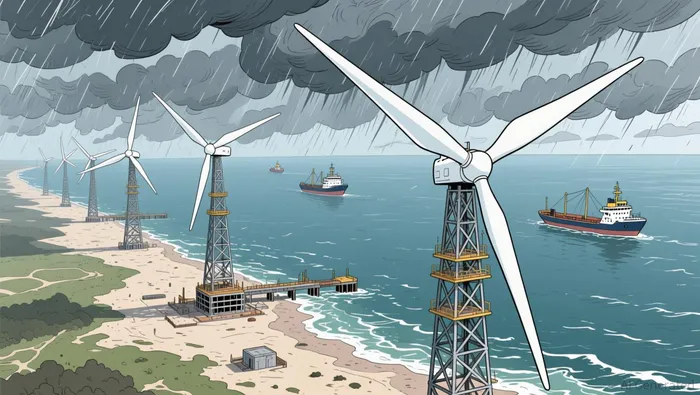
The Trump administration's abrupt freeze on offshore wind leasing and construction in late 2025 has sent shockwaves through the U.S. clean energy sector, exposing the fragility of renewable energy markets under politically driven policy shifts. By halting five major projects along the East Coast-Vineyard Wind, Revolution Wind, Coastal Virginia Offshore Wind, and others-the administration has not only disrupted immediate development but also cast a long shadow over the sector's long-term viability. This analysis examines the short-term market chaos, the erosion of investor confidence, and the cascading labor and economic consequences, while highlighting the broader risks of politicizing energy infrastructure.
Short-Term Market Disruption: A $114 Billion Black Swan
The administration's January 2025 Presidential Memorandum temporarily withdrew all areas on the Outer Continental Shelf from offshore wind leasing, citing national security and environmental concerns. This was followed by a December 2025 executive action pausing construction on five projects, including Dominion Energy's Coastal Virginia Offshore Wind (CVOW), which was 60% complete and projected to supply 2 gigawatts of electricity to 660,000 homes by 2026. The immediate fallout was severe: stock prices for major developers like Orsted and Vestas plummeted, with Orsted's shares dropping 12% in a single day.
The economic stakes are staggering. These projects represented $25 billion in private investment and 10,000 jobs, with CVOW alone expected to generate $420 million in direct investment for Connecticut. The pause has forced developers to reassess funding strategies, with Orsted raising $9.4 billion earlier in 2025 to mitigate regulatory uncertainty. Meanwhile, the Department of the Interior's Secretarial Order No. 3437 has further tightened federal support, terminating 3.5 million acres of designated offshore wind land and increasing permitting scrutiny.
Long-Term Investment Implications: A 56% Decline in Offshore Wind Development
The administration's actions have rewritten long-term market projections. According to a report by the Clean Energy Finance Council, offshore wind development is now expected to decline by 56% by 2035 compared to pre-2025 forecasts, translating to $114 billion in lost investments. This reversal threatens the sector's ability to meet the Biden-era target of 30 gigawatts of offshore wind capacity by 2030-a goal now jeopardized by the loss of 6 gigawatts in active projects according to analysis.
Compounding the issue is the administration's 50% tariff on wind turbine components imported from Europe and China, which has raised project costs and further weakened financial viability according to E360 analysis. The One Big Beautiful Bill Act (OBBBA), passed in July 2025, has also stripped critical tax credits for wind energy, exacerbating the sector's financial strain. These measures signal a systemic de-prioritization of offshore wind, pushing developers to pivot to alternative renewables like solar and battery storage, where policy support remains relatively stable according to clean energy analysts.
Labor Market Repercussions: Job Losses and a Stalled Green Transition
The human cost of the freeze is equally alarming. The paused projects were projected to create 10,000 jobs, including 800 full-time positions for Revolution Wind in Connecticut. The uncertainty has already triggered workforce retraining programs, as developers scramble to redeploy labor to solar and storage projects according to industry reports. However, the transition is far from seamless. Port development and manufacturing hubs in the Northeast-key to offshore wind's supply chain-now face cancellation, threatening thousands of indirect jobs.
The labor market's adaptability is further strained by a pre-existing skills gap. By 2026, the solar industry alone faces a projected shortage of 53,000 workers, driven by rapid growth and aging demographics. The offshore wind freeze risks exacerbating this gap by diverting attention and resources from workforce development programs tailored to wind-specific roles.
A Broader Risk: Undermining U.S. Leadership in Clean Energy
The administration's actions risk ceding U.S. leadership in offshore wind to Europe and China, where the industry has already matured according to analysis. This shift is not merely economic but geopolitical. Offshore wind is a cornerstone of energy security, reducing reliance on fossil fuels and insulating the grid from volatile markets. By prioritizing short-term political gains over long-term resilience, the administration has created a regulatory environment that deters innovation and investment according to Clean Energy Finance Council.
Conclusion: A Call for Policy Stability
The Trump offshore wind freeze underscores the existential risks of politicizing energy policy. Short-term disruptions-stock volatility, job losses, and project cancellations-are compounded by long-term consequences: a weakened domestic supply chain, a brain drain in renewable expertise, and a loss of global competitiveness. For investors, the lesson is clear: stable, predictable policy frameworks are essential to attract capital to high-risk, long-lead sectors like offshore wind. Without them, the U.S. risks falling behind in the clean energy race, with irreversible economic and environmental costs.





Comentarios
Aún no hay comentarios