
The Political and Economic Risks of Trump's Childcare Funding Freeze on Blue State Economies
The Trump administration's 2026 freeze of $10 billion in federal childcare and social services funding for five Democratic-led states-California, Colorado, Illinois, Minnesota, and New York-has ignited a storm of political and economic controversy. By halting critical programs such as the Child Care and Development Fund (CCDF), Temporary Assistance for Needy Families (TANF), and the Social Services Block Grant (SSBG), the policy has introduced significant market instability and raised urgent questions about the long-term sustainability of social welfare-linked sectors. This analysis examines the interplay between politically driven fiscal policies and their cascading effects on employment, sector-specific investments, and state-level economic resilience.
A Politically Charged Policy with Economic Consequences
The administration's rationale for the freeze centers on allegations of fraud, particularly in Minnesota, where federal prosecutors uncovered misuse of funds for luxury assets like cars and real estate. However, critics argue that the lack of substantiated evidence in the other four targeted states-California, Colorado, Illinois, and New York-casts doubt on the legitimacy of the action. Democratic governors have condemned the move as a politically motivated attack on vulnerable families, with New York's Kathy Hochul calling it "vindictive and cruel." This politicization of federal aid risks eroding trust in public institutions and exacerbating regional economic disparities.
The freeze also imposes stringent new requirements on states, mandating exhaustive documentation for fund usage before disbursement. Such bureaucratic hurdles threaten to delay critical support for low-income households, potentially destabilizing childcare providers and social service networks. For instance, the CCDF freeze alone could disrupt subsidies for working parents, increasing costs for families and incentivizing childcare center closures.
Labor Market Strains and Sector-Specific Vulnerabilities
The childcare sector, already grappling with a 9% workforce deficit compared to pre-pandemic levels, faces heightened risks. The freeze exacerbates existing labor shortages by reducing demand for childcare services, particularly in states reliant on federal subsidies. This dynamic is compounded by the sector's reliance on immigrant labor, which has declined by 39,000 workers since 2025 due to stricter immigration policies. The resulting workforce instability not only strains providers but also reduces access to care for low-income families, creating a feedback loop of economic fragility. 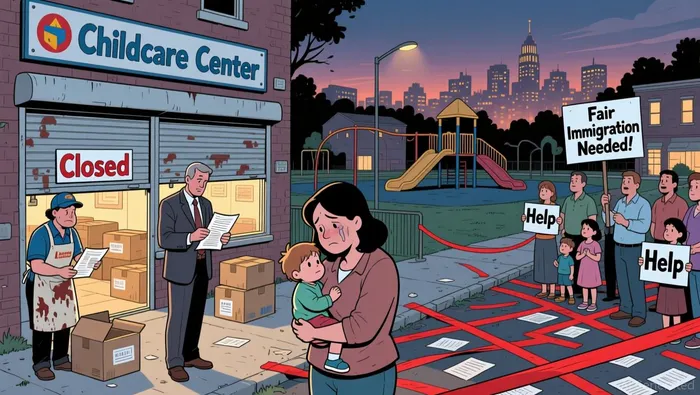
Market instability metrics further underscore these risks. The freeze has triggered volatility in childcare and social services sector ETFs, as investors react to policy uncertainty. Additionally, proposed cuts to Medicaid and SNAP-part of broader fiscal policies like Project 2025-could lead to 1.2 million job losses nationwide by 2029, disproportionately affecting high-poverty states. These trends highlight the interconnectedness of federal policy decisions and sector-specific economic outcomes.
Investment Risks and the Erosion of Social Safety Nets
Investors in social welfare-linked sectors must now navigate a landscape marked by policy-driven uncertainty. The administration's emphasis on fiscal austerity and work requirements for programs like SNAP risks further eroding state-level capacity to deliver services. For example, stricter eligibility rules could disqualify 688,000 SNAP recipients and 3.1 million TANF beneficiaries, reducing demand for related services and pressuring state budgets.
Moreover, the politicization of federal statistical agencies-evidenced by budget cuts to data collection on food insecurity and household well-being-complicates efforts to assess policy impacts. This lack of reliable data heightens investment risks, as market participants struggle to gauge the true economic toll of funding freezes and regulatory shifts.
Conclusion: A Call for Policy Resilience
The Trump administration's childcare funding freeze exemplifies how politically driven policies can generate systemic economic risks. For blue states, the immediate challenges include labor market instability, reduced access to social services, and heightened sector-specific investment volatility. Long-term, the erosion of federal support for social safety nets could undermine economic growth and exacerbate regional inequalities. Investors and policymakers alike must prioritize strategies that insulate vulnerable populations from policy-driven shocks, ensuring that fiscal decisions are grounded in evidence rather than partisanship.







Comentarios
Aún no hay comentarios