
The Political and Economic Ripple Effects of Trump's Federal Law Enforcement Expansion on US Cities
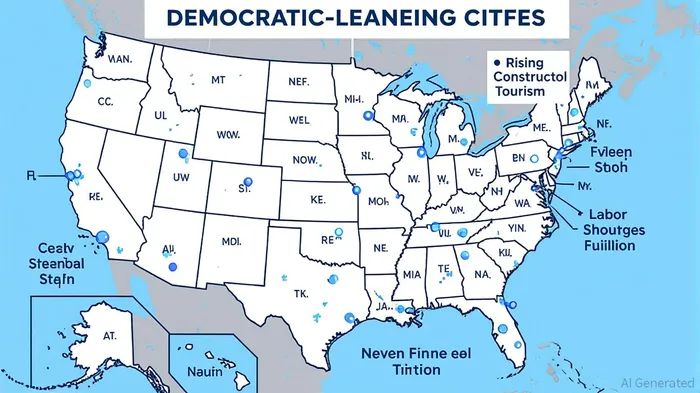
The Trump administration's aggressive expansion of federal law enforcement—particularly within the Department of Homeland Security (DHS)—and its trade policies have created significant ripple effects across Democratic-leaning cities. From 2020 to 2025, these policies have reshaped retail, tourism, and real estate markets in urban centers like San Francisco, New York, and Chicago, where economies are deeply intertwined with immigration, international trade, and immigrant labor. This analysis examines the interplay between policy shifts and economic outcomes, offering insights for investors navigating the evolving landscape.
Retail Sector: Labor Shortages and Tariff-Driven Inflation
Trump's immigration enforcement policies, including mass deportations and restrictions on legal immigration, have disrupted labor markets in sectors reliant on immigrant workers. For instance, 1 in 3 hospitality workers in the U.S. is foreign-born, and stricter enforcement has led to labor shortages, particularly in cities like New York and Chicago, where service industries dominate retail activity . Concurrently, Trump's tariffs on imports—such as 25% levies on goods from Canada and Mexico—have increased the cost of consumer goods, squeezing household budgets. A 2025 CNN analysis estimates that the average American family now spends $2,150 annually more on essentials like food and housing due to these policies . In San Francisco, retail employment remains 14.9% below 2019 levels, reflecting broader struggles to recover from pandemic-related declines compounded by policy-driven inflation .
Tourism Industry: Declining International Arrivals and Geopolitical Tensions
Trump's visa policies, including $15,000 bonds for tourists from countries with high overstaying rates, have deterred international visitors. A Yahoo report highlights an 8.2% projected drop in international arrivals to the U.S. in 2025, with Canadian and Mexican travelers—key demographics for cities like San Francisco and New York—avoiding the country due to trade tensions and hostile rhetoric . The Washington Post notes that this decline has slowed hotel occupancy rates in tourist hubs like Las Vegas and Niagara Falls, with ripple effects on local retail and service providers . Meanwhile, Trump's rhetoric against “sanctuary cities” has created a climate of fear among immigrant communities, indirectly reducing foot traffic in urban commercial districts .
Real Estate Markets: Construction Costs, Labor Gaps, and Affordability Crises
The real estate sector in Democratic cities has faced dual pressures from Trump's policies. First, tariffs on steel, aluminum, and Chinese-made construction materials have increased the average cost of a new home by $9,200, exacerbating affordability challenges in high-cost markets like San Francisco and New York . Second, mass deportations have reduced the supply of immigrant labor in construction, which accounts for 14% of the industry workforce. A PennPENN-- Wharton Budget Model analysis warns that a four-year policy of deporting 10% of unauthorized immigrants annually could shrink GDP by 1% and delay housing projects, further straining supply . While Trump's deregulation agenda aims to lower housing costs, the inflationary effects of tariffs and labor shortages have offset these benefits, leaving urban real estate markets in a state of flux .
Investor Implications and Future Outlook
For investors, the interplay of Trump's policies and urban economic dynamics presents both risks and opportunities. In retail, businesses reliant on immigrant labor may need to diversify their workforce or adopt automation to mitigate labor shortages. Tourism-dependent cities could benefit from targeted marketing to domestic travelers, though long-term recovery hinges on policy stability. In real estate, developers might prioritize projects in suburban areas with lower construction costs and less regulatory complexity, while urban centers grapple with affordability crises.
However, the political tensions between federal enforcement priorities and Democratic cities' economic interests suggest ongoing volatility. As Trump's second term progresses, investors must monitor how trade policies, immigration enforcement, and local regulatory responses shape the trajectory of these markets.
Source
[1] Trump's deportation agenda will destroy millions of jobs [https://www.epi.org/publication/trumps-deportation-agenda-will-destroy-millions-of-jobs-both-immigrants-and-u-s-born-workers-would-suffer-job-losses-particularly-in-construction-and-child-care/]
[2] Here's how Trump's tariffs could affect Americans [https://www.cnn.com/2025/07/09/economy/why-tariffs-backfire-trump-intl]
[3] New York's Recovery, Five Years After Covid [https://www.city-journal.org/article/new-york-city-covid-pandemic-recovery-five-years]
[4] Trump Finds a Brilliant New Way to Wreck the Tourism Industry [https://www.yahoo.com/news/articles/trump-finds-brilliant-way-wreck-194122145.html]
[5] 5 ways that Trump's policies are impacting summer vacation [https://www.washingtonpost.com/business/2025/08/02/trump-policies-impact-summer-travel/]
[6] Mass Deportation: Analyzing the Trump Administration's Immigration Policy [https://www.americanimmigrationcouncil.org/report/mass-deportation-trump-democracy/]
[7] How Trump's Latest Tariffs Could Affect Your Wallet [https://helenair.com/life-entertainment/nation-world/food-drink/article_d0283d8e-44ac-597a-8303-248c753a5fd8.html]
[8] How Trump's mass deportations could backfire on the economy [https://www.cnn.com/2025/07/25/business/trump-jobs-immigration-economy]
[9] Trump says he's considering eliminating tax on home sales [https://subscriber.politicopro.com/article/2025/07/trump-says-hes-considering-eliminating-tax-on-home-sales-00467915]







Comentarios
Aún no hay comentarios