
The Political and Economic Implications of Trump's Firing of Lisa Cook for Financial Markets
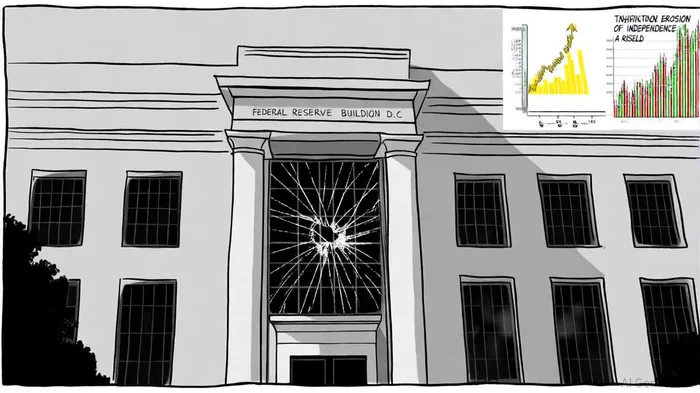
The firing of Federal Reserve Governor Lisa Cook by President Donald Trump has ignited a firestorm of debate over the independence of the U.S. central bank and its implications for financial markets. This unprecedented move—based on unproven allegations of mortgage fraud—has raised urgent questions about the politicization of monetary policy and the long-term stability of the U.S. economy. For investors, the episode underscores a critical risk: the potential for political instability to distort the Fed's ability to act as an impartial arbiter of economic conditions.
The Legal and Political Quagmire
Trump's rationale for removing Cook hinges on allegations of “deceitful and potentially criminal conduct” in her mortgage applications, a claim Cook has vehemently denied. Her legal team argues that the president lacks the authority to fire her under the Federal Reserve Act, which stipulates that governors can only be removed “for cause” through formal proceedings[1]. This legal ambiguity has created a constitutional standoff, with Cook vowing to challenge the decision in court. Legal experts warn that a successful challenge could set a dangerous precedent, normalizing executive overreach into the Fed's operations[2].
Politically, the move aligns with Trump's broader strategy to reshape the Fed's Board of Governors. By replacing Cook—a Democrat-appointed governor with a 14-year term ending in 2038—with a loyalist, Trump aims to tilt the Board toward his economic agenda, including aggressive rate cuts. This shift could amplify inflationary pressures, as critics argue that politically motivated monetary easing risks repeating the stagflationary mistakes of the 1970s[3].
Market Reactions and Investor Sentiment
Financial markets initially absorbed the news with relative calm. The S&P 500 rose 0.9% in the days following the announcement, buoyed by hopes of lower interest rates[4]. However, subtler indicators suggest growing unease. The 30-year Treasury yield climbed to 4.92%, while gold prices surged—a traditional hedge against inflation and geopolitical uncertainty[5]. Global markets, particularly in Asia and Europe, reacted more sharply, with indices like Germany's DAX and France's CAC 40 declining[6].
These mixed signals highlight a key tension: investors are torn between short-term optimism over potential rate cuts and long-term concerns about the Fed's credibility. As one Bloomberg analyst noted, “The Fed's independence is the bedrock of global trust in U.S. markets. If that erodes, capital will flee to safer jurisdictions”[7].
Economic Risks and Policy Uncertainty
Economists warn that Trump's actions could destabilize the U.S. economy in several ways. First, a politicized Fed may struggle to respond effectively to economic shocks, such as a recession or inflation spike. Second, the erosion of the Fed's independence could weaken the dollar's global standing, as foreign investors demand higher yields to compensate for perceived risks[8]. Third, politically driven rate cuts could exacerbate inflation, forcing the Fed into a reactive, rather than proactive, policy stance[9].
The legal battle over Cook's firing adds another layer of uncertainty. If the Supreme Court rules in favor of Trump, it could embolden future administrations to treat the Fed as a political tool. Conversely, a ruling in Cook's favor would reinforce the Fed's independence but might deepen political polarization, further complicating policy coordination[10].
Investment Strategy in a Politicized Environment
For investors, the key takeaway is to hedge against both inflation and policy instability. Here are three actionable strategies:
1. Diversify into Inflation-Protected Assets: Treasury Inflation-Protected Securities (TIPS) and commodities like gold offer protection against potential inflationary pressures.
2. Rebalance Portfolios Toward Defensive Sectors: Utilities, healthcare, and consumer staples tend to outperform during periods of economic uncertainty.
3. Monitor Legal and Policy Developments: The outcome of Cook's lawsuit and subsequent Fed appointments will shape the trajectory of monetary policy. Investors should adjust positions accordingly.
Conclusion
The firing of Lisa Cook is more than a political spectacle—it is a test of the Fed's institutional resilience. While the immediate market reaction has been muted, the long-term risks of politicizing monetary policy are profound. For investors, the lesson is clear: in an era of heightened political instability, adaptability and vigilance are paramount. The Fed's independence is not just a legal or political issue; it is a cornerstone of global financial stability.







Comentarios
Aún no hay comentarios