
The Political and Economic Implications of the U.S. CBDC Debate for Digital Assets
The U.S. government's decisive rejection of central bankBANK-- digital currencies (CBDCs) in 2025 has reshaped the digital asset landscape, creating both risks and opportunities for privacy-focused cryptocurrencies. President Donald Trump's executive order Strengthening American Leadership in Digital Financial Technology, coupled with the CBDC Anti-Surveillance State Act, has positioned the U.S. as a global outlier in CBDC development while fostering a regulatory environment that prioritizes private digital currencies and blockchain innovation. This shift has profound implications for investors, particularly those targeting privacy-centric assets like MoneroXMR-- (XMR) and ZcashZEC-- (ZEC).
Regulatory Clarity and the Rise of Privacy Coins
The U.S. CBDC ban, codified in both executive and legislative actions, explicitly prohibits federal agencies from issuing or endorsing a digital dollar according to the executive order. This policy aligns with a broader regulatory agenda that promotes dollar-backed stablecoins and decentralized systems while emphasizing individual privacy and financial sovereignty. The GENIUS Act and CLARITY Act have further clarified the legal framework for digital assets, reducing ambiguity around stablecoin reserves and jurisdictional oversight. For privacy-focused cryptocurrencies, this regulatory clarity has mitigated some of the existential risks posed by CBDCs, which could have otherwise crowded out decentralized alternatives through state-backed surveillance and control according to a political analysis.
However, the regulatory environment remains complex. While the GENIUS Act excludes payment stablecoins from securities classification, the CLARITY Act's transfer of crypto jurisdiction to the CFTC introduces new compliance challenges for privacy-preserving technologies. These dynamics highlight the dual-edged nature of U.S. policy: fostering innovation while imposing constraints that could limit the scalability of privacy coins.
Market Performance and Institutional Adoption
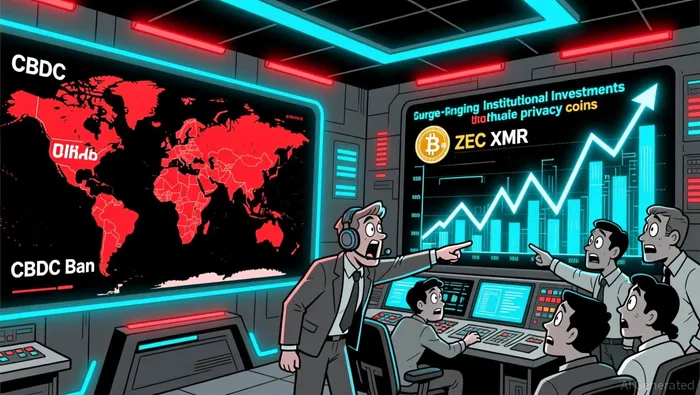
Privacy-focused cryptocurrencies have outperformed major digital assets in 2025, driven by heightened demand for financial privacy and regulatory tailwinds. Zcash (ZEC), for instance, surged 652% year-to-date, with a market capitalization exceeding $59.8 billion. Monero (XMR) also gained 93%, contrasting sharply with Bitcoin's 3% decline and Ethereum's 6% drop over the same period according to market analysis. This divergence underscores the growing appeal of privacy coins as a hedge against surveillance-based monetary systems and global financial instability.
Institutional adoption has accelerated alongside these trends. Over 55% of traditional hedge funds now hold digital assets, with 47% citing U.S. regulatory changes as a catalyst for increased allocations according to industry reports. Zcash's optional privacy features and higher liquidity-its daily trading volume surpassed $1 billion-have made it a preferred entry point for institutional investors according to market data. Grayscale's Zcash Trust further legitimizes the asset class, offering accredited investors a regulated vehicle for exposure according to market analysis.
Global Implications and Systemic Risks
The U.S. CBDC ban has significant geopolitical ramifications. By rejecting a government-backed digital currency, the U.S. risks ceding leadership in cross-border payment systems to nations like China, whose e-CNY and mBridge initiatives are advancing rapidly according to market research. This divergence could erode the dollar's dominance in global trade, particularly as other jurisdictions adopt CBDCs to reduce reliance on U.S. financial infrastructure. For privacy-focused cryptocurrencies, this creates a paradox: while the U.S. ban protects their relevance domestically, it also exposes them to international fragmentation and regulatory arbitrage.
Systemic risks remain a concern. The 2022 TerraLUNA-- Luna collapse and the 2025 Bybit hack-where $1.5 billion in EthereumETH-- was stolen according to a security report-highlight vulnerabilities in private digital currencies. While the U.S. promotes stablecoins as CBDC alternatives, their reliance on private reserves and lack of central bank guarantees could destabilize markets if mismanaged according to industry analysis. Privacy coins, though less prone to such risks, face scrutiny for their potential use in illicit activities, a challenge regulators are unlikely to ignore.
Conclusion: Navigating the New Normal
For investors, the U.S. CBDC debate presents a unique inflection point. Privacy-focused cryptocurrencies are well-positioned to benefit from regulatory clarity and institutional adoption, particularly as Zcash's market performance and infrastructure (e.g., Grayscale Trust) demonstrate. However, systemic risks, geopolitical shifts, and evolving regulations necessitate a cautious approach. The key lies in balancing exposure to privacy-centric assets with diversification across stablecoins and traditional digital currencies, while monitoring global CBDC developments that could reshape the landscape.
As the U.S. charts a path distinct from global CBDC trends, the digital asset market will likely continue to evolve in response to both policy and technology. For now, privacy-focused cryptocurrencies remain a compelling, albeit volatile, corner of this ecosystem.







Comentarios
Aún no hay comentarios