
The Political Delays in U.S. Crypto Regulation: A Strategic Opportunity for Long-Term Investors?
The U.S. crypto regulatory landscape in late 2025 remains a patchwork of competing priorities, bureaucratic inertia, and partisan gridlock. While the SEC and CFTC have made strides in clarifying their respective roles-Project Crypto's modernization efforts and the CFTC's expanded commodity oversight draft-political divisions have stalled critical legislation, with some bills potentially delayed until 2027 and implementation pushed to 2029. This uncertainty has created a paradox: a market starved for clarity but ripe with opportunity for investors who can navigate the volatility.
Regulatory Uncertainty: A Double-Edged Sword
The U.S. delay in passing comprehensive crypto legislation has allowed regions like the EU to leap ahead. The EU's MiCA framework, for instance, has already established a structured environment for institutional participation, attracting capital and innovation. Meanwhile, the U.S. remains mired in jurisdictional battles between the SEC and CFTC. The Senate Agriculture Committee's bipartisan draft, which seeks to grant the CFTC exclusive oversight of spot digital commodity markets, lacks key definitions for terms like "blockchain" and "decentralized finance," leaving critical gaps. This ambiguity has forced investors to adopt a wait-and-see approach, but it also creates a unique window for strategic entry.
According to a report by BlackRock, long-term investors-often referred to as "whales"-are rebalancing portfolios as BitcoinBTC-- approaches key price thresholds, such as $100K, while macroeconomic uncertainty from the Federal Reserve's policy outlook amplifies volatility. For sophisticated investors, this volatility is not a deterrent but a catalyst. Corrections in late 2025, driven by unwinding leverage and speculative excesses, have been viewed as long-term entry points.
Market Entry Strategies: Institutional Adoption and Regulated Vehicles
The maturation of crypto infrastructure has transformed how investors approach market entry. Institutional adoption is accelerating, with spot Bitcoin and EthereumETH-- ETFs managing over $115 billion in assets under management by mid-2026. These products, enabled by clearer frameworks like the EU's MiCA and the U.S. GENIUS Act for stablecoins, have reduced friction for institutional participation.
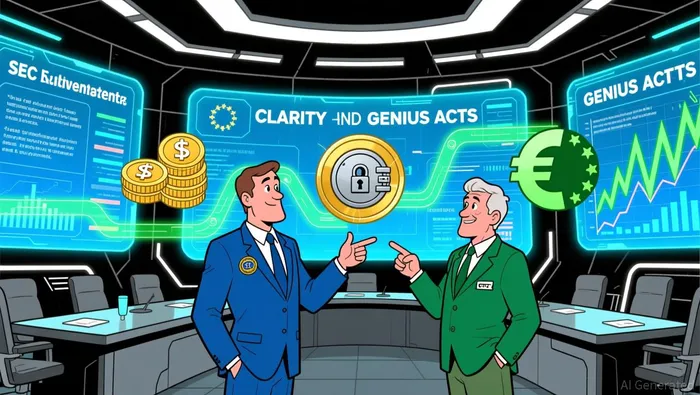
For U.S. investors, the anticipated passage of the CLARITY Act in 2026 could redefine the regulatory playing field. This legislation aims to clarify the SEC-CFTC divide by defining Bitcoin and Ethereum as commodities under CFTC jurisdiction, while securities-like assets remain under SEC oversight. Such clarity would reduce compliance burdens and unlock further institutional capital. Meanwhile, the full implementation of the GENIUS Act-requiring stablecoins to maintain 1:1 reserves in high-quality assets-will enhance consumer trust and drive adoption.
Risk Rebalancing: Hedging, Diversification, and Discipline
As the crypto market evolves, risk management has become a cornerstone of investor strategy. The rise of qualified custody solutions, on-chain settlement systems, and API connectivity has turned crypto into a regulated asset class, enabling institutions to hedge effectively. Futures and options are now essential tools for locking in profits or mitigating losses, while stop-loss orders enforce disciplined exits during sharp corrections.
Data from 21Analytics suggests that real-world asset (RWA) tokenization will expand beyond $36 billion in on-chain supply by 2026, offering new avenues for diversification. Tokenized real estate, treasuries, and other assets will allow investors to balance exposure to crypto's volatility with traditional asset stability.
The 2026–2029 Outlook: A Strategic Opportunity
Despite the U.S. regulatory delays, the long-term outlook for crypto remains bullish. The projected passage of the CLARITY Act and GENIUS Act in 2026 will create a more structured environment, while tax reforms like the PARITY Act aim to reduce compliance burdens for retail investors. These developments will likely accelerate institutional adoption, with major banks like JPMorgan and Citi expanding crypto custody and trading services.
For long-term investors, the key is patience. The U.S. may lag in regulatory clarity, but its market depth and innovation potential remain unmatched. As the Transatlantic Taskforce for Markets of the Future prepares to issue recommendations in early 2026, global coordination could further stabilize cross-border transactions. By 2029, the U.S. could reclaim its leadership in crypto, provided it resolves its political divisions.
In the meantime, investors who embrace volatility as a feature-not a bug-will find fertile ground for growth. The next decade of crypto will belong to those who can balance caution with conviction, leveraging regulatory uncertainty as a strategic advantage.





Comentarios
Aún no hay comentarios