
Poland's Industrial Sector at a Tipping Point: Strategic Nearshoring and EU-Driven Recovery Fuel 2026 Investment Boom
Poland's industrial sector is poised for a transformative phase, driven by a confluence of strategic nearshoring momentum and EU-funded structural rebalancing. While short-term volatility-stemming from political uncertainty and slow EU fund absorption-has clouded the narrative, the long-term fundamentals are compelling. German nearshoring investments, EU Recovery and Resilience Fund (RRF) allocations, and sectoral reallocation toward green and digital infrastructure are creating a perfect storm for growth. Investors who act now stand to benefit from undervalued Polish industrial equities and infrastructure-linked assets ahead of a 2026 boom.
German Nearshoring: A Catalyst for Industrial Resilience
German companies are increasingly prioritizing Poland as a nearshoring hub, with 51% of firms planning to relocate production in Central and Eastern Europe selecting Poland as their preferred destination. This trend is not confined to the IT sector, which has long been a magnet for foreign investment. Industrial sectors such as automotive, machinery, and steel are now seeing significant inflows. In the first half of 2025 alone, Polish-German trade hit a record €90 billion, with Germany exporting €49.4 billion worth of goods to Poland.
The appeal lies in Poland's strategic location, skilled labor force, and EU membership, which ensures predictable regulatory conditions. For example, the automotive sector has seen major German automakers expand production in Poland, leveraging its proximity to German markets and access to EU-wide supply chains. Similarly, machinery and steel producers are capitalizing on Poland's industrial infrastructure and cost advantages. These investments are not speculative-they are part of a broader shift in global supply chains, with Poland emerging as a critical node in Europe's industrial network.
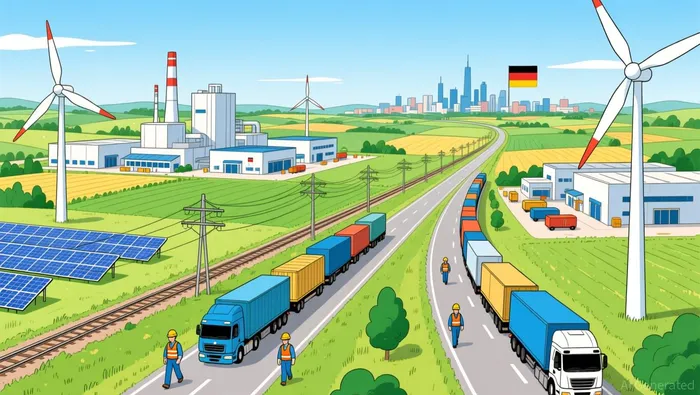
EU Funding: A Structural Tailwind for 2026
Poland's RRF plan, allocated €59.8 billion (€25.3 billion in grants and €34.5 billion in loans), is a cornerstone of its economic strategy. While absorption rates remain low-35% as of 2024-the government has signaled a push to accelerate disbursements ahead of the 2026 deadline. This creates a clear timeline for investors: the next 12–18 months will see a surge in capital deployment, particularly in energy, transport, and digital infrastructure.
Energy is a focal point. The RRF includes €1.4 billion for high-speed internet expansion and €1.2 billion in state aid for renewable manufacturing (e.g., solar panels, batteries). These investments align with Poland's REPowerEU goals, aiming to reduce fossil fuel dependence and boost energy security. By 2026, the plan targets 30 GW of installed capacity from photovoltaic and onshore wind projects. For investors, this means opportunities in renewable energy infrastructure, grid modernization, and related supply chains.
Transport and manufacturing are equally promising. The RRF allocates funds for sustainable mobility (e.g., electrified rail networks, urban bus systems) and industrial competitiveness, including R&D support for SMEs according to the RRF plan. The Polish government's Security and Defence Fund, which has reallocated some RRF resources, further underscores the strategic importance of industrial resilience.
Sectoral Rebalancing: From Volatility to Growth
Despite near-term challenges-such as administrative bottlenecks and political risks-the structural case for Poland remains robust. The RRF's emphasis on green and digital transitions is reshaping the industrial landscape. For instance, the Polish Investment Zone (PSI) offers tax incentives to attract FDI, while EU funding is driving infrastructure upgrades that enhance logistics connectivity.
The construction sector, already growing at 2.4% in 2025, is expected to accelerate to 4% annually from 2026–2029, driven by energy and transport projects. This creates opportunities in construction materials, engineering services, and equipment suppliers. Meanwhile, the IT sector's 6.15% CAGR and its role in supporting nearshoring efforts highlight Poland's dual strength in both traditional and high-tech industries.
The Investment Case: Timing Is Everything
The key to unlocking Poland's potential lies in timing. With RRF absorption lagging the EU average, there is a window to invest in undervalued assets before 2026's funding surge drives up valuations. Industrial equities-particularly in machinery, steel, and renewable energy-offer exposure to nearshoring demand and EU-driven growth. Infrastructure-linked assets, such as logistics hubs and renewable energy projects, are also prime targets.
However, risks remain. Political uncertainty and corruption concerns could delay implementation. Yet, the sheer scale of planned investments-€43.7 billion in additional funding through the Security Action for Europe (SAFE) instrument-suggests that Poland's industrial trajectory is irreversible.
Conclusion: A Tipping Point for Poland
Poland's industrial sector is at a tipping point. German nearshoring is reshaping supply chains, EU funding is accelerating structural rebalancing, and sectoral reallocation is creating a foundation for sustained growth. While short-term volatility persists, the long-term outlook is clear: 2026 will mark a turning point in Poland's industrial evolution. For investors, the time to act is now-before the boom.







Comentarios
Aún no hay comentarios