
Poland's Crypto Regulatory Deadlock: Geopolitical Risks and Innovation Potential in Central Europe
The European Union's digital asset landscape is at a crossroads, with Poland's crypto regulatory impasse emerging as a pivotal flashpoint. As the only EU member state without a domestic implementation of the Markets in Crypto-Assets (MiCA) regulation, Poland's political and institutional gridlock has created a unique tension between geopolitical risk and innovation potential. This analysis explores how the country's regulatory vacuum-rooted in a vetoed bill and deepening political divisions-threatens its economic sovereignty while also highlighting the latent opportunities for a reimagined crypto ecosystem.
The Geopolitical Risks of Regulatory Fragmentation
Poland's refusal to adopt MiCA has left its crypto sector in a legal gray zone, exposing the country to significant geopolitical vulnerabilities. President Karol Nawrocki's veto of the crypto bill, upheld by parliament in December 2025, was framed as a defense of civil liberties and small business competitiveness. However, critics argue this decision undermines Poland's alignment with EU standards and creates a regulatory arbitrage that could attract illicit financial flows. According to a report by , the absence of a domestic authority to issue MiCA-compliant licenses has left Polish crypto firms unable to access the EU's passporting system, which allows cross-border operations. This not only weakens Poland's ability to compete with MiCA-compliant jurisdictions like Lithuania and Malta but also risks positioning the country as a haven for unregulated activity, including money laundering and fraud.
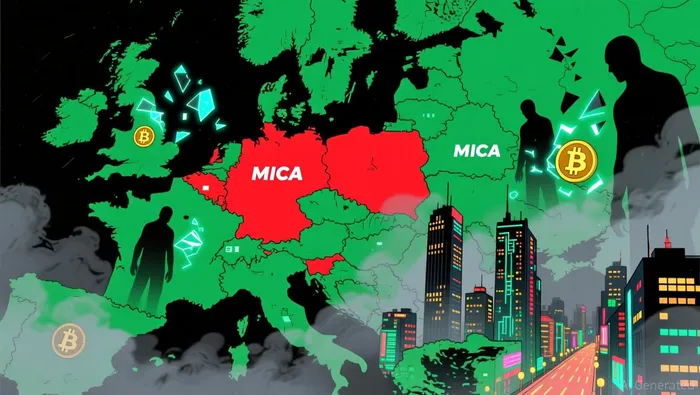 The geopolitical stakes are further heightened by Prime Minister Donald Tusk's warnings that the regulatory vacuum could facilitate Russian-linked financial operations. Tusk's pro-EU coalition has framed the bill as a national security imperative, emphasizing the need to counter organized crime and destabilizing external influences. Yet, President Nawrocki's opposition-rooted in concerns over excessive regulatory complexity and domain-blocking powers-has deepened institutional distrust. This divide mirrors broader EU tensions between regulatory harmonization and national sovereignty, with Poland's stance potentially setting a precedent for other member states hesitant to adopt MiCA.
Innovation Potential in a Regulatory Vacuum
Despite the risks, Poland's crypto market remains one of the most dynamic in Europe. Chainalysis data indicates that Poland ranked eighth in Europe for total cryptocurrency value received between July 2024 and June 2025, with over 7.9 million users. This adoption rate suggests a resilient demand for digital assets, even in the absence of formal regulation. The Polish crypto industry, however, faces a paradox: while user growth continues, firms are increasingly considering relocation to MiCA-compliant jurisdictions like Malta or the Czech Republic. This migration risk underscores the need for a regulatory framework that balances oversight with innovation.
The recent reintroduction of a revised crypto bill offers a potential path forward. As stated by Bitcoin World, the new legislation aims to address presidential concerns by streamlining regulatory complexity, reducing supervisory fees, and incorporating consumer protection measures. If passed, the bill could position Poland as a blockchain innovation hub, leveraging its existing user base and infrastructure. However, success hinges on avoiding overreach-such as the controversial domain-blocking provisions-that could drive businesses abroad. The challenge lies in crafting a framework that fosters innovation while mitigating risks like anti-money laundering (AML) vulnerabilities.
Central Europe's Contrasting Trajectories
Poland's regulatory deadlock contrasts sharply with the proactive approaches of its Central European neighbors. Slovakia, the Czech Republic, and Hungary have all implemented rigorous MiCA-aligned frameworks, with the Czech Republic introducing higher capital requirements for high-risk services and Hungary adopting a unique Validator system to ensure transaction legitimacy. These countries are capitalizing on Poland's inaction, attracting crypto firms seeking regulatory clarity and EU-wide operational flexibility. The result is a regional innovation race, where Poland's political hesitancy risks ceding market leadership to neighbors with more concrete strategies.
Conclusion: A Delicate Balancing Act
Poland's crypto regulatory impasse encapsulates a broader EU dilemma: how to reconcile geopolitical security with technological innovation. While the current deadlock exposes the country to AML risks and economic competitiveness losses, the revised bill's potential to create a balanced framework offers hope for a renaissance in its digital asset sector. Investors must weigh the short-term uncertainties against the long-term possibility of a reformed regulatory environment-one that could either solidify Poland's position as a Central European crypto leader or accelerate its marginalization in the EU's digital economy.






Comentarios
Aún no hay comentarios