
Five Point's Cash Tender Offer and Strategic Capital Reallocation: A Blueprint for Shareholder Value and Capital Efficiency
In the dynamic world of real estate investment trusts (REITs), capital structure optimization is a critical lever for enhancing shareholder value. Five Point HoldingsFPH--, LLC (NYSE: FPH) has recently executed a strategic refinancing maneuver that exemplifies this principle. By launching a cash tender offer for its 10.500% Senior Notes due 2028 and issuing new debt to extend maturities, the company has demonstrated a disciplined approach to reducing borrowing costs and improving financial flexibility. This analysis explores how these actions align with best practices in REIT restructuring and their implications for capital efficiency and long-term value creation.
The Mechanics of the Tender Offer: A Cost-Effective Debt Reduction Strategy
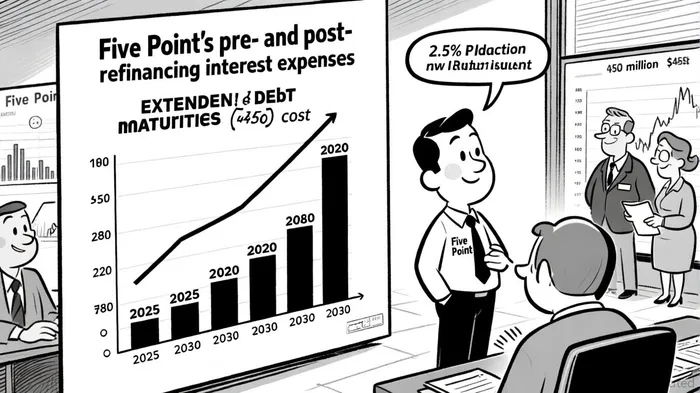
On September 15, 2025, Five PointFPH-- announced a cash tender offer for its 10.500% Initial Rate Senior Notes due 2028, priced at $1,008.57 per $1,000 principal amount. The pricing mechanism was tied to the yield of a U.S. Treasury Reference Security due November 15, 2025, ensuring alignment with market conditions[1]. This tender was part of a broader refinancing strategy, including a concurrent $450 million issuance of 8.000% Senior Notes due 2030. By leveraging this new debt, Five Point aimed to redeem its higher-cost 2028 notes and extend the maturity of its 7.875% Senior Notes due 2025 to 2030[2].
The tender offer's structure highlights Five Point's focus on capital efficiency. The company reduced the interest expense on the 2028 notes by 2.5% while extending their maturity by two years. For the 2025 notes, the refinancing extended their maturity by five years, albeit with a marginal 0.125% increase in interest cost. This trade-off reflects a strategic prioritization of liquidity preservation over minor cost savings, a common tactic in REIT capital management[3].
Strategic Rationale: Mitigating Refinancing Risks and Enhancing Flexibility
The refinancing addresses a key vulnerability in Five Point's capital structure: near-term debt maturities. By extending the 2025 notes to 2030, the company reduces the pressure to refinance $450 million in debt within a five-year window, a period marked by historically volatile interest rates. According to a report by Panabee, this extension “significantly improves cash flow predictability and reduces the risk of liquidity constraints”[3].
Moreover, Five Point's strong liquidity position—$581.6 million in cash and borrowing availability as of June 30, 2025[2]—underscores its ability to execute such a strategy without compromising operational flexibility. The company's balance sheet strength allows it to pursue aggressive refinancing while maintaining a robust credit profile, a critical factor for REITs reliant on access to debt markets.
Shareholder Value Creation: Quantifying the Impact
The tender offer and refinancing are expected to generate measurable value for shareholders. By reducing the interest expense on the 2028 notes by 2.5%, Five Point will free up approximately $26.25 million annually in interest savings (calculated as 2.5% of $1,050 million in outstanding debt[1]). These savings can be redirected toward dividends, property acquisitions, or further debt reduction, all of which enhance shareholder returns.
Additionally, the extension of debt maturities reduces the risk of forced asset sales or dividend cuts during periods of market stress. For REITs, which are sensitive to interest rate fluctuations, this stability is invaluable. As stated by Five Point's investor relations team, the refinancing “positions the company to navigate a prolonged high-rate environment while maintaining its dividend growth trajectory”[2].
Capital Efficiency in Action: A Model for REIT Restructuring
Five Point's approach exemplifies capital-efficient restructuring. By using a combination of new debt and existing liquidity, the company avoids dilutive equity raises while optimizing its debt maturity profile. The tender offer's conditional structure—requiring a binding commitment from initial purchasers—ensures that the refinancing only proceeds if it meets predefined cost thresholds, minimizing downside risk[3].
This strategy also aligns with broader industry trends. REITs are increasingly adopting multi-year debt instruments and leveraging arbitrage opportunities between short- and long-term rates. Five Point's ability to secure an 8.000% rate for 2030 notes, despite the 10.500% cost of its 2028 debt, reflects its strong credit standing and the market's confidence in its operational performance[1].
Conclusion: A Win-Win for Shareholders and Creditors
Five Point's cash tender offer and refinancing strategy represent a masterclass in capital structure optimization. By reducing interest expenses, extending maturities, and preserving liquidity, the company has enhanced its financial flexibility while mitigating refinancing risks. For shareholders, these actions translate into a more resilient business model and a stronger foundation for long-term value creation. As the REIT sector navigates an uncertain macroeconomic landscape, Five Point's disciplined approach serves as a benchmark for capital-efficient restructuring.





Comentarios
Aún no hay comentarios