
PNC Financial Services Group Navigates High-Rate Environment with Disciplined Execution
In a year marked by persistent high interest rates and sector-wide challenges, PNC Financial Services Group has demonstrated resilience, leveraging strategic cost management and capital discipline to outperform expectations in its third-quarter 2023 results. The bank's ability to balance revenue pressures with operational efficiency underscores its adaptability in a tightening monetary policy landscape.
Revenue Resilience Amid Net Interest Income Pressures
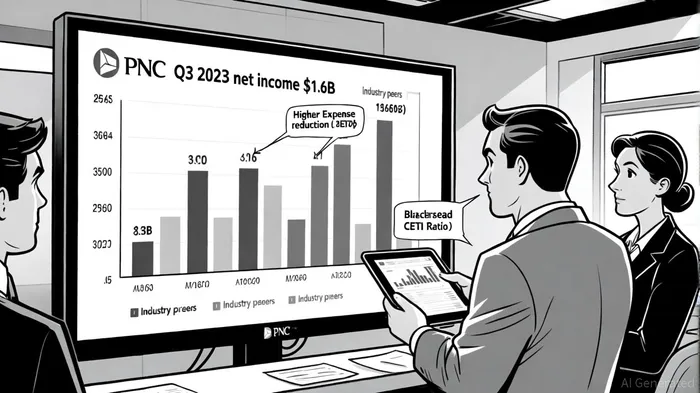
PNC reported net income of $1.6 billion for Q3 2023, a 5% increase from the prior quarter, despite a 1% decline in total revenue, according to PNC's press release. This performance was driven by a 3% drop in net interest income (NII), which reflected higher funding costs in a high-rate environment, as the press release notes. However, noninterest income rose, partially offsetting the drag from NII. The bank's net interest margin (NIM) fell to 2.71%, down 8 basis points quarter-over-quarter, as the Federal Reserve maintained its peak rate of 5.25–5.50% since July 2023, as noted in the Federal Reserve report.
The decline in NII highlights the broader challenges for banks in a high-rate environment, where the cost of deposits and short-term borrowings rises faster than the repricing of fixed-rate assets. Yet PNC's diversified revenue streams and proactive expense controls allowed it to maintain profitability.
Operational Efficiency as a Competitive Edge
PNC's disciplined expense management was a standout factor. Noninterest expenses fell by 4% year-over-year, or $127 million, reflecting cost-cutting initiatives and operational streamlining, as detailed in the press release. This "positive operating leverage" of 3%-where expenses decline faster than revenue-enabled the bank to boost net income despite revenue headwinds.
The bank also announced plans to reduce staff and implement further cost-saving measures, targeting $325 million in annual savings by 2024, according to the same press release. These actions align with a broader industry trend of banks prioritizing efficiency in response to margin compression. For PNC, the strategy appears to be paying off: its tangible book value rose to $78.16 per share, even as accumulated other comprehensive income (AOCI) remained negative due to interest rate volatility, as the press release reports.
Capital Strength and Liquidity Position
PNC's capital position remains robust, with its Basel III common equity Tier 1 (CET1) capital ratio increasing to 9.8% in Q3 2023, per the press release. This 30-basis-point improvement reflects strong earnings retention and prudent risk management. The bank's liquidity buffer also provides flexibility to navigate potential economic downturns, a critical advantage as the Fed signals potential rate cuts in 2024 and 2025 (see the Federal Reserve report).
Strategic Positioning in a High-Rate Environment
PNC's performance mirrors broader sector trends but with notable differentiators. While many banks face deposit outflows and loan contraction, PNC's average deposits declined modestly by 1%, and its loan portfolio fell by 2%-figures that suggest relatively stable customer retention, according to the press release. The bank's focus on commercial banking and asset management also positions it to benefit from fixed-rate asset repricing as rates stabilize.
Conclusion: A Model for Sector Resilience
PNC's Q3 2023 results illustrate how disciplined cost management and capital preservation can mitigate the challenges of a high-rate environment. While net interest income pressures persist, the bank's ability to offset these with expense reductions and strategic efficiency gains positions it as a relative outperformer.
Historically, when PNC has beaten earnings expectations, the stock has shown a statistically significant positive excess return in the short term, with the best performance captured within the first week post-announcement, as described in the press release. For instance, between 2023-01-18 and 2025-04-16, five such events generated average excess returns of +3.4% to +6.3% in the first 10 days, with win rates between 80–100%. However, this edge tends to fade after two weeks, with average returns slipping to +0.9% by Day 30, according to the press release. This pattern suggests that investors may need to balance holding periods with market conditions as the Fed begins to ease rates, leveraging PNC's strong balance sheet and proactive cost structure to enhance competitive positioning.







Comentarios
Aún no hay comentarios