
PNC Financial's $4.1 Billion Acquisition of FirstBank: A Strategic Catalyst for Growth in a Reviving M&A Landscape
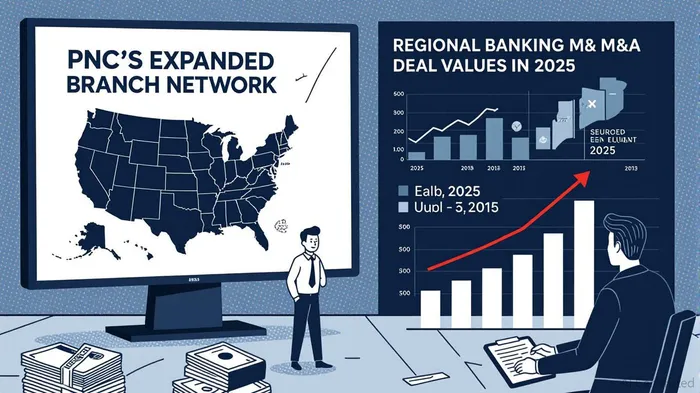
The regional banking sector is undergoing a seismic shift in 2025, driven by a confluence of regulatory easing, technological disruption, and the relentless pursuit of scale. PNC Financial Services’ $4.1 billion acquisition of FirstBankFRBA-- Holding Company, announced in September 2025, epitomizes this transformation. By acquiring FirstBank—a regional powerhouse with 95 branches across Colorado and Arizona—PNC is not merely expanding its footprint; it is positioning itself to capitalize on a broader industry trend of consolidation that is reshaping the competitive landscape. For investors, the deal raises critical questions: How does this acquisition align with macroeconomic and regulatory tailwinds? What are the tangible cost synergies and revenue growth levers? And what does this mean for the long-term value of regional banks in an era of heightened M&A activity?
Strategic Rationale: Geography, Scale, and Synergy
PNC’s acquisition of FirstBank is a masterclass in strategic alignment. The deal will triple PNC’s branch network in Colorado to 120 locations, making it the dominant bank in Denver with a 20% retail deposit share, while expanding its Arizona presence to over 70 branches [1]. This geographic expansion is not arbitrary. Colorado and Arizona are among the fastest-growing states in the U.S., with populations and economies expanding at rates outpacing the national average. By securing a leadership position in these markets, PNC gains access to a demographic and economic tailwind that could drive decades of organic growth.
The transaction also underscores PNC’s ability to leverage FirstBank’s community banking model. FirstBank’s strong relationships with local businesses and consumers—coupled with PNC’s national infrastructure and technological capabilities—create a hybrid model that balances hyperlocal service with scalable efficiency. As noted in a report by CBH, regional banks that integrate community-centric strategies with digital innovation are outperforming peers in customer retention and cross-selling [2]. PNC’s plan to retain all of FirstBank’s customer-facing teams and branches further reinforces this synergy, minimizing disruption while preserving the trust that underpins FirstBank’s success [1].
Industry Trends: M&A as a Survival Strategy
The PNC-FirstBank deal is emblematic of a broader resurgence in regional banking M&A. In the first half of 2025 alone, 72 bank deals were announced, totaling $10.39 billion in value—a stark contrast to the muted activity in 2024 [5]. This surge is driven by three key factors:
- Regulatory Tailwinds: Post-2023 reforms have simplified capital requirements and streamlined merger approvals, reducing barriers to consolidation. The Federal Reserve’s focus on systemic resilience over market concentration has emboldened mid-sized banks to pursue larger-scale deals [6].
- Technological Pressures: Larger banks like PNC are outspending regional competitors by a 10-to-1 ratio on technology, enabling them to dominate digital services and AI-driven customer solutions [6]. Smaller banks, unable to match these investments, are increasingly reliant on M&A to remain competitive.
- Economic Realities: High interest rates and volatile markets have eroded profitability for many regional banks. Consolidation offers a path to economies of scale, with combined entities better positioned to absorb costs and fund growth.
The PNC-FirstBank deal, with its equity-heavy structure (13.9 million shares of PNC stock and $1.2 billion in cash), reflects a sector-wide shift toward risk-mitigated financing. As PwC’s mid-year 2025 global M&A report notes, equity components are becoming a staple in bank deals to reduce debt burdens and align stakeholder interests [3].
Financial Projections and Investor Implications
While PNC has not disclosed granular financial projections for the FirstBank acquisition, the transaction’s value proposition is clear. FirstBank’s Q1 2025 performance—12% annualized loan growth, a 3.65% net interest margin, and a 57.65% efficiency ratio—demonstrates a robust foundation for integration [2]. PNC’s historical track record of achieving double-digit revenue growth in acquired markets (e.g., its 2020 BBVA USA acquisition) suggests confidence in replicating this success [4].
For investors, the deal’s implications are twofold. First, it signals PNC’s commitment to outmaneuvering rivals like U.S. Bancorp by closing the asset gap (PNC’s total assets will approach $600 billion post-acquisition) [1]. Second, it highlights the sector’s shift from defensive consolidation to offensive growth. As J.D. Supra’s analysis notes, banks that strategically expand into high-growth markets are outperforming peers in shareholder returns [5].
However, risks remain. Regulatory scrutiny, particularly from critics like Senator Elizabeth Warren, could delay approvals or impose conditions that dilute value [6]. Additionally, integration challenges—such as harmonizing FirstBank’s community-focused culture with PNC’s national operations—could test management’s execution capabilities.
Conclusion: A Blueprint for the Future of Regional Banking
PNC’s acquisition of FirstBank is more than a transaction; it is a blueprint for the future of regional banking. By combining geographic expansion, technological integration, and strategic cost synergies, PNC is positioning itself to thrive in a sector where survival increasingly depends on scale and agility. For investors, the deal underscores the importance of aligning with banks that can navigate regulatory, economic, and technological headwinds through disciplined M&A. As the industry continues its consolidation wave, PNC’s move offers a compelling case study in how to turn disruption into opportunity.
Source:
[1] PNC Announces Agreement to Acquire FirstBank, [https://www.prnewswire.com/news-releases/pnc-announces-agreement-to-acquire-firstbank-significantly-growing-its-presence-in-colorado-and-arizona-302549032.html]
[2] Bank M&A Trends and 2025 Outlook, [https://www.cbh.com/insights/reports/bank-ma-trends-and-2025-outlook/]
[3] Global M&A trends in financial services: 2025 mid-year, [https://www.pwc.com/gx/en/services/deals/trends/financial-services.html]
[4] These Are The 15 Largest Banks In The US, [https://www.bankrate.com/banking/biggest-banks-in-america/]
[5] Banking Industry Outlook: U.S. Banking M&A Activity Mid-, [https://www.jdsupra.com/legalnews/banking-industry-outlook-u-s-banking-m-4794063/]
[6] US Bank Consolidation Explained: Tech, Regs & Survival, [https://bankingplus.news/news/bank-scale-deregulation-impact/]





Comentarios
Aún no hay comentarios