
PlusAI's SPAC Deal: A $1.2B Bet on 2027 Truck Launch
The immediate catalyst is a definitive deal. Plus Automation has agreed to merge with special purpose acquisition company Churchill Capital Corp IX, creating a pure-play autonomous truck software firm. The transaction is a near-certainty, with no closing conditions and a board-approved structure. It is expected to close in the first quarter of 2026.
The financial terms are straightforward. The deal values the combined company at a $1.2 billion pre-money equity valuation. This provides up to $300 million in gross proceeds to fund the company through its critical next phase. The capital is earmarked to reach the commercial launch of factory-built autonomous trucks in 2027.
Post-merger, the company will operate as PlusAI, a software-focused entity with no debt. It will trade on Nasdaq under the ticker PLS. This SPAC route offers a clear path to public markets, providing the capital and validation needed to execute its OEM-led strategy and scale its virtual driver platform.
The Path to Commercialization: 2027 as the Make-or-Break Date
The company's entire investment thesis now hinges on a single, aggressive timeline. PlusAI expects its $300 million in gross proceeds to fully fund operations through the commercial launch of factory-built autonomous trucks in 2027. That date is the make-or-break milestone. The capital is not for incremental growth, but for a final, decisive push to market.
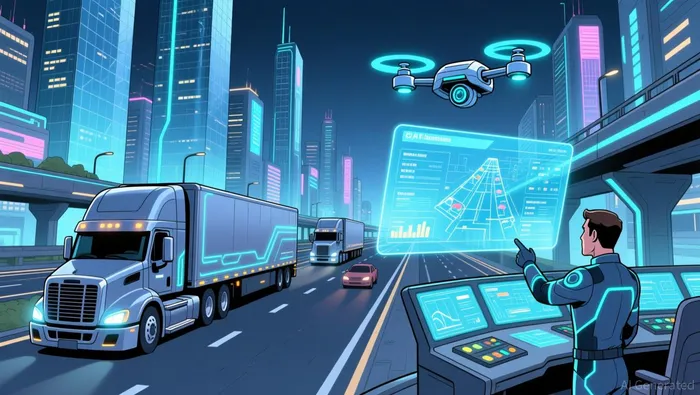
Current activities are focused on proving the technology and building customer momentum. The company is conducting public road testing in Texas and Sweden, with additional customer fleet trials scheduled for autumn 2025. These trials are critical for gathering real-world data and securing early commercial commitments. The business model itself is designed for the long game: a "driver-as-a-service" model that creates recurring, per-mile revenue once the trucks are on the road. The value accrues later, but the path to that revenue is now clearly mapped to 2027.
The risk is execution over the next two years. The company must successfully transition from testing to full-scale production, validate its OEM partnerships, and navigate regulatory approvals-all while burning cash. The timeline is compressed, and any delay in the 2027 launch would directly threaten the capital runway and the entire valuation story. For now, the clock is set.
Board Strengthening and Competitive Edge
The board appointments are a tactical move to shore up governance ahead of the public listing. Effective at the closing, two seasoned executives are joining: David Peterschmidt, a veteran with a track record at Inktomi and Sybase, and Harry Harczak, a former CFO at CDW and audit partner at PwC. Their combined experience in technology and finance is meant to provide immediate credibility and operational discipline as the company transitions to a public entity.
This governance upgrade is paired with a clear competitive advantage in real-world data. PlusAI claims to have accumulated more than five million miles of driving with its SuperDrive software. That distance is a key asset, providing a proprietary dataset to train its AI models. For context, that figure already exceeds the 2.6 million miles driven by its closest public rival, Kodiak Robotics. This data moat is a tangible edge in developing a robust virtual driver.
The strategic setup is now focused on the $2 trillion freight market in the U.S. and Europe. The company's OEM-led model, backed by partnerships with major truckmakers like TRATON and Hyundai, aims to scale through factory-built vehicles. The board's new members are there to guide this final push, ensuring the company is well-governed and financially sound as it races toward the 2027 launch. The moves aim to strengthen both internal control and external positioning in a crowded field.
Catalysts and Risks: What to Watch
The investment thesis is now a binary bet on a single timeline. The near-term catalyst is clear: the successful completion of the customer fleet trials scheduled for autumn 2025. These trials are the final proof point before the 2027 launch. Demonstrating software readiness and securing early commercial commitments during this period will validate the company's path and provide crucial momentum heading into the public listing.
The primary risk is also a single point of failure. Any delay to the commercial launch of factory-built autonomous trucks in 2027 would severely pressure the valuation. The company's entire capital runway is structured around this date. A slip would force a reassessment of the $1.2 billion pre-money valuation and could trigger dilution or a need for additional fundraising at a lower price.
The S-4 filing highlights two specific, non-negotiable risks that will be watched closely. First is regulatory approval for the commercial deployment of L4 autonomous trucks. The timeline for securing these permits is critical and outside the company's direct control. Second is technology development-specifically, the ability to scale the SuperDrive platform safely and reliably across the planned launch regions. Any stumbles here would directly impact the launch date.
For investors, a key watchpoint will be management's participation in upcoming investor conferences. The company has scheduled its senior team to participate in the Needham Growth Conference on January 15, 2026. These one-on-one meetings will be a primary channel for the company to provide updates on progress, address concerns, and reinforce the 2027 timeline. The quality and confidence of these communications will be a leading indicator of the setup's health.







Comentarios
Aún no hay comentarios