
Plug Power's Strategic Challenges and Market Outlook: Evaluating the Implications of Clear Street's Downgrade on Hydrogen Infrastructure Investment
The recent downgrade of Plug PowerPLUG-- (NASDAQ:PLUG) by Clear Street from "Buy" to "Hold" underscores a critical juncture for the hydrogen infrastructure sector. This move, driven by valuation concerns and broader macroeconomic headwinds, raises questions about the sustainability of investor enthusiasm for hydrogen technology and its role in the energy transition. While Plug Power remains a key player in decarbonizing industrial and energy systems, the downgrade signals a recalibration of expectations, particularly as the company navigates leadership transitions and regulatory uncertainties.
Valuation Concerns and Market Realignment
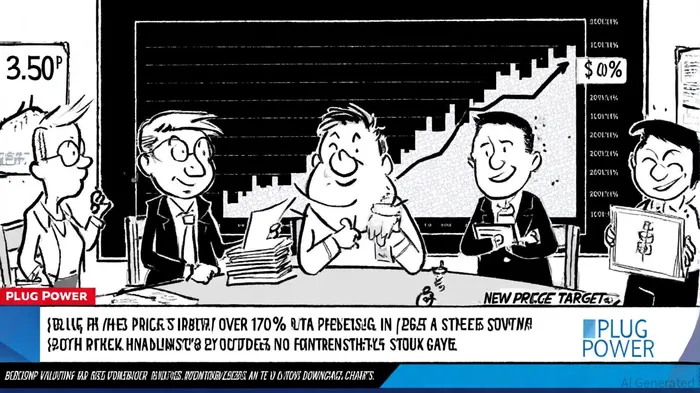
Clear Street's decision to lower its rating to "Hold" reflects skepticism about Plug Power's current valuation. The firm notes that the stock's 170% surge in the prior month-a performance far outpacing broader market indices-has already priced in short-term optimism, leaving limited upside potential. At $4 per share, the valuation is deemed "not ideal," especially given the company's cash burn of $819 million over the past twelve months. This divergence between market euphoria and operational realities highlights a broader challenge: investors are increasingly demanding tangible progress on profitability and infrastructure deployment before committing capital.
The downgrade coincided with Plug Power's announcement of a leadership transition, with CEO Andy Marsh set to step down in March 2026. While new leadership could bring strategic clarity, it also introduces uncertainty during a critical phase for hydrogen adoption. Clear Street's price target of $3.50 implies a 12.5% correction from the current price, a move that would align the stock with more conservative growth assumptions.
Broader Industry Headwinds
Seaport Research Partners, another critical voice, downgraded the stock to "Sell," citing delays in U.S. and European hydrogen policy frameworks. For instance, the H2Hubs program-a $8 billion initiative under the Bipartisan Infrastructure Law-has allocated only a fraction of its funds, creating bottlenecks for infrastructure projects. Similarly, Germany's collapsed Power Plant Security Act and the EU's lagging progress toward 2030 renewable hydrogen targets have eroded confidence in the sector's scalability.
These policy delays are compounded by technical and economic hurdles. Hydrogen production remains capital-intensive, and Plug Power's focus on stationary power and material handling applications-while strategically sound-faces competition from cheaper alternatives like battery storage. The firm's recent decision to exit the HYVIA joint venture and narrow its operational scope reflects a pragmatic shift but also underscores the sector's need for consolidation.
Strategic Adjustments and Liquidity Measures
Plug Power has taken steps to stabilize its financial position. A warrant inducement agreement is expected to raise $370 million in immediate proceeds, though concerns about share dilution persist. Additionally, the company secured $30 million in liquidity through the transfer of the Federal Investment Tax Credit (ITC), a move that eases short-term cash flow pressures. However, Seaport Research Partners anticipates negative gross margins until Q2 2026, with a projected compound annual growth rate of just 7% from 2023 to 2026. These metrics suggest that profitability remains elusive, even as the company invests in Texas-based infrastructure to expand its hydrogen generation capacity.
Implications for Hydrogen Infrastructure Investment
The downgrade and broader industry dynamics have significant implications for hydrogen infrastructure investment. First, they highlight the sector's vulnerability to policy delays and regulatory shifts. Investors must now weigh the risks of overvalued assets against the long-term potential of hydrogen in decarbonizing energy grids and heavy industries. Second, the focus on cost discipline and operational efficiency-exemplified by Plug Power's strategic refocusing-signals a maturation of the sector. However, this shift may come at the expense of innovation and scale, which are critical for achieving cost parity with conventional energy sources.
For hydrogen infrastructure to attract sustained capital, stakeholders must address three key areas:
1. Policy Certainty: Accelerating the allocation of public funds and aligning regulatory frameworks across jurisdictions.
2. Cost Reduction: Innovating in electrolyzer technology and supply chain logistics to lower production costs.
3. Diversification: Expanding hydrogen's applications beyond niche markets to include sectors like data centers and transportation, where demand is more predictable.
Conclusion
Clear Street's downgrade of Plug Power is a cautionary signal for the hydrogen sector, emphasizing the need for disciplined capital allocation and realistic growth expectations. While the company's long-term vision for hydrogen remains compelling, the path to profitability is fraught with valuation, operational, and policy challenges. Investors should approach hydrogen infrastructure with a balanced lens, recognizing both its transformative potential and the structural risks that demand careful mitigation. As the energy transition unfolds, the ability to navigate these complexities will determine not only Plug Power's fate but the broader viability of hydrogen as a cornerstone of sustainable infrastructure.





Comentarios
Aún no hay comentarios