
Plug Power's Hydrogen Gambit: Can It Power the AI Data Center Revolution?
The rise of artificial intelligence has ignited an energy crisis in data centers, with electricity consumption projected to account for 6.7% to 12% of U.S. energy demand by 2028, according to an IRENA report. Plug PowerPLUG--, a hydrogen fuel cell pioneer, has positioned itself as a key player in this transition, touting partnerships with hyperscalers like Microsoft, Amazon, and Google. Yet, as the company races to scale its green hydrogen infrastructure, critical misalignments between its offerings and the specific energy demands of AI data centers emerge.
The Hydrogen Promise and Plug Power's Ambitions
Plug Power's strategy hinges on hydrogen's dual role as a clean energy source and a storage medium. CEO Andrew Marsh has emphasized hydrogen fuel cells as a solution for backup power and peak load shaving in data centers, with pilot projects like the 3MW system for Microsoft demonstrating technical feasibility, as noted in an IO Fund analysis. The company's recent $1.66 billion loan guarantee from the U.S. Department of Energy underscores its ambition to build six green hydrogen facilities across the U.S., per a NEN Power blog.
However, hydrogen's scalability remains unproven in the context of AI's exponential energy needs. While Plug Power highlights its 5 GW electrolyzer commitment with Allied Green Ammonia in Australia and Uzbekistan, these projects target heavy industry decarbonization rather than the high-density, on-demand power required by data centers. The latter demands not just clean energy but also infrastructure capable of delivering 600kW per server rack-a challenge that the IO Fund analysis suggests hydrogen's current logistics and storage limitations may hinder.
Cost and Infrastructure: Hydrogen's Achilles' Heel
Green hydrogen's production cost-$2.28–7.39 per kilogram, according to a ScienceDirect review-far exceeds that of renewables or battery storage. For context, Deloitte estimates that 44 GW of additional clean energy demand will stem from data centers alone by 2030 (reported in the IO Fund analysis). At current prices, hydrogen's economic viability for AI applications is questionable, especially when compared to solar and wind, which now supply 91% of new utility-scale generation at lower costs than fossil fuels (as highlighted in the IRENA report).
Plug Power's reliance on electrolysis and hydrogen storage infrastructure further complicates matters. Unlike batteries, which can be deployed modularly and require minimal new infrastructure, hydrogen demands specialized storage (e.g., high-pressure tanks or cryogenic facilities) and distribution networks. These challenges are compounded by the fact that 96% of today's hydrogen is still produced from fossil fuels, undermining its green credentials (per the ScienceDirect review).
Competing Technologies: Batteries and Renewables Take Center Stage
Battery storage systems (BESS) and direct renewables are rapidly outpacing hydrogen in addressing data center needs. Lithium-ion batteries, with round-trip efficiencies of 95%, excel in short-term grid stabilization and peak shaving-critical for AI workloads with fluctuating demand (outlined in the NEN Power blog). Meanwhile, hybrid solar-wind systems with AI-driven optimization are reducing costs by 5%–20%, offering a more immediate solution for 24/7 clean energy (as described in the IO Fund analysis).
Goldman Sachs predicts 40% of new data center capacity will be powered by renewables by 2025, a trend accelerated by falling solar and wind costs (reported in the IO Fund analysis). Even hydrogen proponents like Edgecloud Link acknowledge the need to transition from blue hydrogen (derived from natural gas) to green hydrogen-a shift that remains economically and technically fraught, according to a Silicon Valley article.
Investment Implications: A High-Risk, High-Reward Play
Plug Power's stock has surged 90% in six months, buoyed by its DOE loan and partnerships with tech giants. Yet, its success hinges on resolving three key issues:
1. Cost Reduction: Green hydrogen must drop below $2/kg to compete with renewables and batteries.
2. Infrastructure Development: Partnerships with energy providers to build hydrogen distribution networks are critical.
3. Regulatory Support: Federal funding for clean energy remains politically uncertain, as noted in analyses such as the NEN Power blog.
For investors, Plug Power represents a speculative bet on a future where hydrogen's scalability and zero-emission profile outweigh its current limitations. However, the dominance of battery storage and renewables in 2025 suggests that hydrogen may play a complementary rather than primary role in the AI data center ecosystem.
Conclusion
Plug Power's hydrogen vision aligns with the decarbonization imperative but faces stiff competition from cheaper, more scalable alternatives. While its partnerships with hyperscalers and DOE backing are promising, the company must navigate high costs, infrastructure gaps, and technological hurdles to remain relevant in the AI-driven data center era. For now, investors should weigh its long-term potential against the accelerating adoption of renewables and batteries.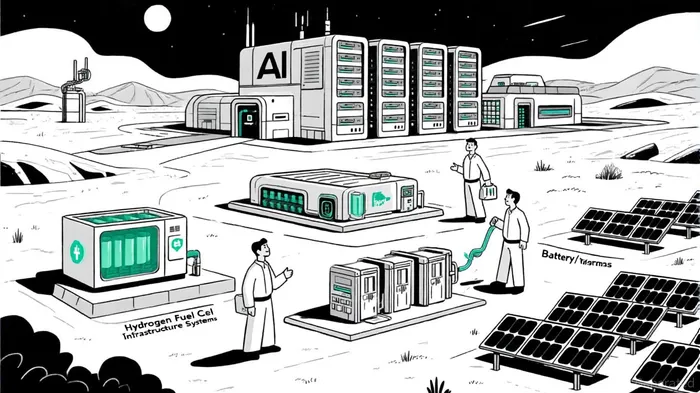





Comentarios
Aún no hay comentarios