
PLUG Power's Green Hydrogen Gambit: Strategic Financing and Policy Tailwinds Fuel 57.7% Stock Surge
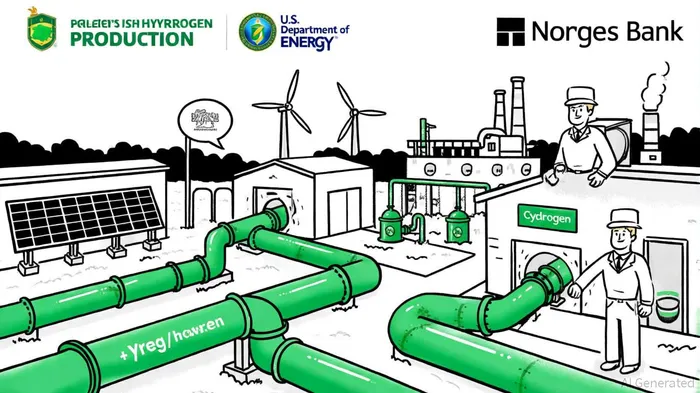
Plug Power (PLUG) has surged 57.7% in 2025, driven by a confluence of strategic financing milestones and policy tailwinds that position it as a linchpin in the U.S. green hydrogen economy. This surge reflects not just speculative fervor but a calculated pivot toward vertical integration, federal validation, and institutional confidence—a trifecta that could redefine the company's trajectory.
Strategic Financing: A Federal Backstop for Vertical Integration
At the core of Plug's resurgence is the $1.66 billion loan guarantee from the U.S. Department of Energy (DOE), a landmark deal that underscores federal commitment to decarbonizing energy infrastructure [2]. This funding accelerates Plug's transition from a niche fuel cell provider to a full-stack energy company, controlling hydrogen production, liquefaction, and delivery. The Georgia hydrogen plant, which produced a record 300 metric tons of liquid hydrogen in April 2025, now serves as a blueprint for scaling. Complementing this is the Louisiana plant, a 15-ton-per-day green hydrogen facility set to launch in 2025, further diversifying Plug's production footprint [1].
The DOE loan is more than capital—it's a signal. By backing Plug's infrastructure, the government implicitly endorses its technology and business model, reducing perceived risk for investors and partners. This federal validation is critical in an industry where upfront costs and regulatory hurdles often deter private investment.
Policy-Driven Momentum: Partnerships and Institutional Confidence
Plug's growth is also fueled by strategic alliances and institutional bets. The extension of its partnership with Uline through 2030 ensures recurring demand in material handling, a sector ripe for hydrogen adoption [2]. Meanwhile, a new contract with a North American wire and cable manufacturer to deploy a clean hydrogen ecosystem highlights Plug's ability to expand beyond traditional markets [2].
Institutional confidence has surged, notably with Norges Bank increasing its stake to 7.95%, a move that signals long-term conviction in Plug's green hydrogen strategy [1]. Such institutional backing often amplifies market sentiment, as large investors prioritize companies with scalable, policy-aligned narratives.
Cost Optimization and Profitability Hopes
Plug isn't just scaling—it's streamlining. Project Quantum Leap, a $150–200 million annual cost-cutting initiative, targets operational inefficiencies while expanding margins [2]. Combined with revenue from electrolyzer sales and hydrogen production, these efforts could bridge the gap between current losses and future profitability. Analysts at J.P. Morgan note that Plug's vertical integration reduces exposure to volatile input costs, a critical advantage in a nascent industry [2].
The Bigger Picture: A Hydrogen Economy in Motion
Plug's success hinges on the broader hydrogen economy's acceleration. With the U.S. government allocating $9.5 billion for hydrogen hubs under the Infrastructure Investment and Jobs Act, Plug's infrastructure-first approach is uniquely positioned to capture market share. The company's ability to secure federal funding, institutional capital, and corporate partnerships creates a flywheel effect: scale begets efficiency, which begets demand.





Comentarios
Aún no hay comentarios