
Play-to-Earn NFT Games in 2025: Sustainable Tokenomics and the Future of Player Retention
The NFT gaming sector in 2025 has evolved beyond speculative hype to become a serious arena for investment-grade platforms. At the core of this transformation are sustainable economic models and long-term player retention strategies-factors that distinguish top-performing projects like Axie Infinity, Illuvium, and The Sandbox. These games leverage deflationary mechanics, community governance, and high-quality gameplay to create ecosystems that balance user engagement with financial resilience. For investors, understanding these dynamics is critical to identifying projects with durable value.
The Tokenomics of Sustainability: Deflationary Mechanisms in Action
A sustainable NFT game economy hinges on managing token supply to avoid inflationary collapse. Leading projects employ dual-token systems and burning mechanisms to achieve this.
- Axie Infinity: Origins remains a benchmark, with its $AXS (governance) and $SLP (utility) tokens. The $AXS token has a fixed supply of 270 million, creating scarcity, while $SLP is burned during Axie breeding and upgrades. This deflationary pressure counteracts inflation from in-game rewards, ensuring long-term value retention, according to a data-driven analysis.
- Illuvium's $ILV and SILV tokens further innovate by integrating staking rewards and governance. SILV, a staked derivative of $ILV, incentivizes long-term holding while reducing circulating supply, as noted in a Top NFT games roundup.
- The Sandbox uses SAND tokens for transactions and governance, with a portion of fees burned after land sales. This creates a self-regulating economy where supply contraction offsets demand from user-generated content, as explained in a tokenomics primer.
These models demonstrate how tokenomics can align player incentives with ecosystem health. By design, they prevent the "token floods" that plagued early NFT games, ensuring that value accrues to both players and investors.
Community Governance: The Engine of Long-Term Retention
Decentralized governance is no longer a novelty-it's a necessity. Games with active DAOs (Decentralized Autonomous Organizations) empower players to shape updates, tokenomics, and even marketing strategies.
- The Sandbox and Decentraland exemplify this trend. Their DAOs allow SAND and MANA holders to vote on land sales, event funding, and platform upgrades, as detailed in an Ethereum gaming analysis.
- Axie Infinity's AXSAXS-- holders similarly influence scholarship programs and game mechanics. The 2025 roadmap emphasizes "gradual decentralization," ensuring community input without destabilizing the economy, according to an AXS deep dive.
- Gods Unchained and Alien Worlds further innovate by tying governance to in-game achievements. For example, Alien Worlds' staking-based voting rewards strategic players, blending gameplay with governance, as shown in a Top 11 NFT games list.
Such structures reduce reliance on centralized teams, mitigating risks of mismanagement and fostering trust. As one analyst notes, "Governance tokens are the new equity-players aren't just users; they're stakeholders," in an economics explainer.
Retention Through Quality: Beyond the "Play-to-Earn" Hype
Sustainable NFT games recognize that tokenomics alone cannot retain users. Engaging gameplay and real-world utility are equally vital.
- Illuvium's AAA-quality open-world RPG and auto-battler mechanics attract both crypto enthusiasts and traditional gamers. Its cross-chain interoperability ensures accessibility, while NFT land ownership drives long-term investment, as discussed in tokenomics tips.
- Star Atlas combines sci-fi strategy with fleet-building mechanics, appealing to a niche but passionate audience. Its dual-token system (ATLAS and POLIS) supports both governance and in-game utility, creating a flywheel effect, according to a Top NFT games list.
- Big Time's time-traveling narrative and guild-based scholarship programs lower entry barriers, while Shrapnel's high-fidelity FPS gameplay bridges blockchain and mainstream gaming, as highlighted in a crypto gaming roundup.
These projects prove that NFT games can compete with traditional titles by prioritizing polish and innovation. As user retention improves, so does the economic value of in-game assets.
The Investment Thesis: Scalability and Resilience
For investors, the key is identifying projects with scalable deflationary mechanics and active communities.
- Axie Infinity's 2025 roadmap includes expanding its RoninRON-- sidechain to support cross-game assets, enhancing liquidity and reducing reliance on a single title, as noted in a Best NFT games.
- The Sandbox and Decentraland are integrating branded experiences (e.g., virtual concerts, fashion shows), diversifying revenue streams and attracting non-gamer audiences, coverage that appears in 10 best NFT games.
- Mojo Melee and CryptoMines demonstrate how DeFi principles (e.g., staking, yield farming) can be embedded into gameplay, creating hybrid models that appeal to both crypto natives and casual players, as explored by FinanceFeeds.
However, challenges remain. The sector faced a 57% market correction in Q1 2025 due to macroeconomic pressures, according to NFT Evening. Yet, top-tier projects with robust tokenomics and active communities have weathered the storm, proving their resilience.
Conclusion: The Future of NFT Gaming is Sustainable
The Play-to-Earn NFT space in 2025 is no longer about quick profits-it's about building ecosystems that reward patience. Projects like Axie InfinityAXS--, IlluviumILV--, and The SandboxSAND-- have shown that deflationary tokenomics, community governance, and quality gameplay can coexist to create investment-grade platforms. For those willing to look beyond the hype, these games represent a new frontier of decentralized value creation.
As the sector matures, the winners will be those that treat their economies as living systems-constantly adapting to player needs while preserving scarcity and utility. The future of NFT gaming isn't just about playing; it's about owning, governing, and growing. 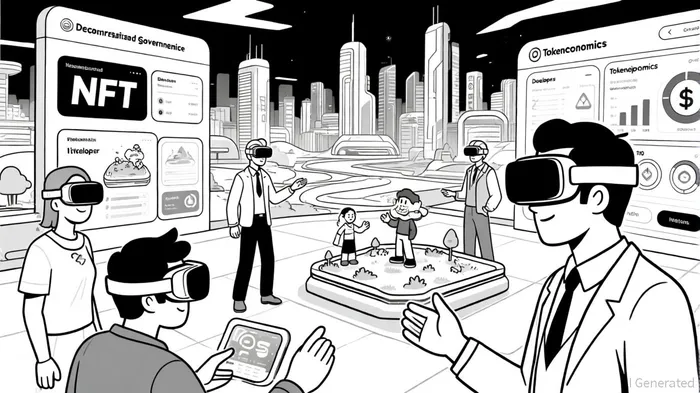






Comentarios
Aún no hay comentarios