
Platinum's Historic Rally in 2025: A Strategic Case for Precious Metals Exposure Amid Inflation and Supply Deficits
The platinum market in 2025 has witnessed a seismic shift, with prices surging over 77% year-to-date to reach $1,931.28 per ounce as of December 19, 2025. This unprecedented rally is not a fleeting anomaly but the culmination of structural supply constraints, inflationary pressures, and a reawakening of platinum's role as a strategic asset. For investors, the question is no longer if to act but how to time the bull market in a commodity that has historically underperformed gold and silver but now appears poised to outshine them.
Structural Supply Deficits: The Foundation of the Rally
The 2025 platinum bull market is anchored by a persistent global supply deficit. The World Platinum Investment Council forecasts a shortfall of approximately 850,000 troy ounces (koz) in 2025, driven by declining mine output in South Africa-responsible for over 70% of global production-and weak recycling volumes. South African mining operations, already strained by aging infrastructure and energy shortages, saw seven of twelve divisions report annual declines in April 2025, with platinum group metals (PGMs) dropping 24.1% year-on-year. This supply-side fragility has pushed above-ground stocks to a mere five months of demand cover, the lowest level in decades.
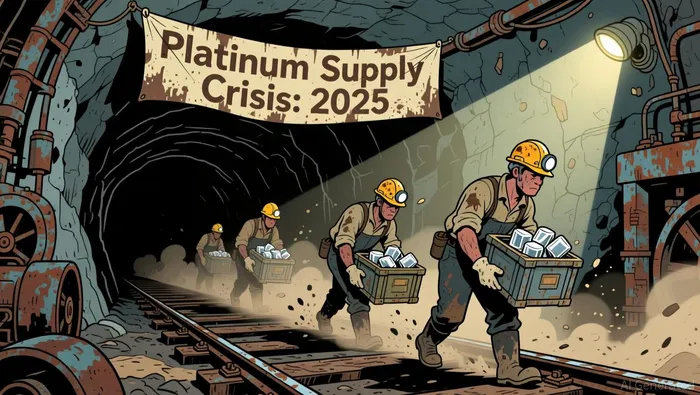 The tightening supply has also triggered a surge in platinum lease rates, which hit 15% in late 2025-a stark indicator of market scarcity. Such conditions mirror the early 2000s, when six consecutive years of consumption-led deficits (1999–2005) drove platinum prices to record highs. Today, similar dynamics are at play, with analysts projecting deficits to persist through 2027 as supply growth remains stagnant.
Inflationary Pressures and the Flight to Scarcity
Global inflationary pressures have further amplified platinum's appeal. Core inflation rates in major economies remain stubbornly above central bank targets, while interest rate cuts have failed to curb price pressures. In this environment, investors are increasingly favoring assets that cannot be "printed" by central banks. Platinum, with its dual role as an industrial and monetary metal, has emerged as a compelling hedge.
The U.S. and other large economies are grappling with ballooning budget deficits and rising public debt, exacerbating concerns about currency debasement. This has driven a surge in demand for platinum bars and coins, particularly in China, where investment demand rose 300% year-over-year in Q1 2025. Unlike gold, platinum's relative affordability (currently trading at a 1:1.5 ratio to gold) makes it accessible to a broader investor base, further fueling its adoption as a diversification tool.
Historical Parallels and Strategic Timing
The 2025 rally bears striking similarities to platinum's "super cycle" of the early 2000s. During that period, sustained supply deficits and industrial demand growth outpaced the effects of interest rate cuts, leading to a multi-year price surge. Today, the same forces are converging: structural supply deficits, resilient industrial demand (notably in hydrogen fuel cells and hybrid vehicle catalysts), and a macroeconomic backdrop favoring tangible assets. This dynamic was evident in May 2025, when platinum broke through a decade-long resistance level, surging over 50% year-to-date. Technical indicators, including backwardation in the London over-the-counter market, further reinforce the bullish case.
Strategic Investment Approaches
For those positioning for the platinum bull market, a multi-pronged strategy is advisable:
1. Physical Accumulation: Direct purchases of platinum bars and coins, particularly in jurisdictions with strong demand (e.g., China), offer exposure to both price appreciation and numismatic premiums. This approach is supported by market analysis.
2. Equity Leverage: Mining equities in South Africa and Russia, where production bottlenecks are most acute, provide amplified returns but come with operational risks. Investors should monitor these risks.
3. Derivatives and ETFs: Platinum futures and ETFs offer liquidity and leverage, though investors must monitor warehouse outflows and geopolitical risks. This remains a key consideration.
Historical case studies underscore the importance of early entry. During the 2000s, investors who accumulated platinum during the initial deficit phase reaped outsized gains as prices surged. Similarly, 2025's rally suggests that those who act now-before trade tensions ease or supply normalization occurs-stand to benefit most. This strategic timing is critical.
Conclusion: A Defiant Case for Platinum
Platinum's 2025 rally is not a speculative bubble but a response to structural forces: supply constraints, inflationary pressures, and a rekindled demand for scarcity. With deficits projected to persist through 2027 and technical indicators pointing to continued upward momentum, the metal is uniquely positioned to outperform traditional precious metals and equities. For investors, the key lies in timing-leveraging historical parallels and current fundamentals to secure exposure before the market's next phase of revaluation.







Comentarios
Aún no hay comentarios