
Platinum Analytics Cayman's Nasdaq Debut and Its Strategic Implications for Fintech Growth
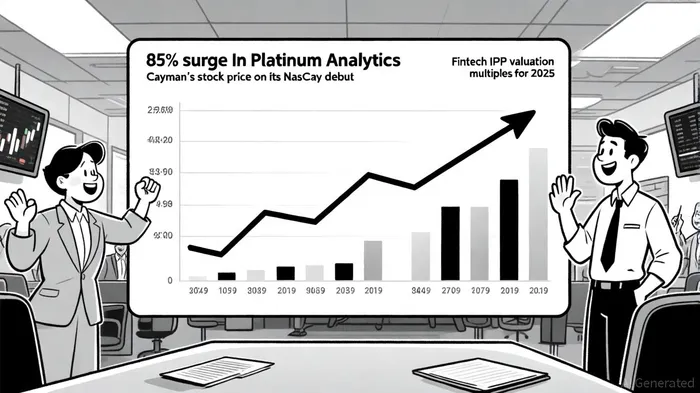
Platinum Analytics Cayman's (PLTS) Nasdaq IPO on September 19, 2025, marked a pivotal moment for the fintech sector, particularly for firms targeting emerging markets. Priced at $4 per share, the offering raised $8 million, with shares surging 85% to close at $7.40 on debut, signaling robust investor appetite for its AI-driven foreign exchange (FX) trading software[1]. This performance underscores a broader trend: fintech firms leveraging niche markets and advanced technology are attracting capital despite macroeconomic headwinds. However, the company's valuation—implied at ~57x 2024 revenue—raises questions about sustainability in a sector where payments firms trade at 5.1x revenue[2].
Market Entry Valuation: A Double-Edged Sword
PLTS's IPO valuation reflects both optimism and risk. The company's 2024 revenue of $2.21 million grew at a 280% annual rate[3], driven by demand for its AI-powered platforms like PATS ECN and sentiment analysis tools. Yet, its Q2 2025 retained earnings stood at -$8.44 million[4], highlighting operational challenges. This stark contrast between growth and profitability is common in fintech IPOs, where investors often prioritize long-term potential over short-term metrics.
By comparison, industry benchmarks suggest caution. Payments firms like Stripe and KlarnaKLAR-- trade at 5.1x–6.6x revenue[2], while PLTS's valuation implies a premium of over 10x. This disconnect may stem from its focus on emerging markets—a high-growth but volatile segment—and its proprietary AI capabilities, which differentiate it from competitors[5]. However, such a premium also exposes PLTS to scrutiny, particularly as fintech valuations have contracted since 2021, with median revenue multiples falling to 4.7x[6].
Catalyst-Driven Momentum: Strategic Allocation of Proceeds
The IPO's success hinges on how effectively PLTS deploys its $8 million in proceeds. The company plans to allocate 40% ($2.7 million) to R&D, 30% ($2.1 million) to marketing/sales expansion, and 30% ($2 million) to IT infrastructure and licenses[1]. This strategy aligns with fintech growth drivers:
1. R&D: Enhancing AI-driven analytics and expanding into new markets (e.g., Southeast Asia, Latin America).
2. Sales/Marketing: Targeting institutional clients in Asia, where FX trading volumes are projected to grow at 12% annually[7].
3. Infrastructure: Strengthening cybersecurity and regulatory compliance, critical for gaining trust in emerging markets[5].
These allocations mirror trends among successful fintech IPOs, such as Revolut's focus on global expansion and embedded finance[8]. However, PLTS's reliance on a single revenue stream (FX software) and customer concentration risks could hinder scalability[9].
Competitive Positioning: Navigating a Crowded Landscape
The global fintech market, valued at $394.88 billion in 2025[10], is dominated by giants like Stripe and PayPalPYPL--. PLTS's niche—AI-driven FX solutions for emerging markets—positions it to capitalize on underserved demand. Its tools, including real-time sentiment analysis and smart execution features, address pain points for traders in volatile regions[5]. Yet, competition is intensifying. For example, Klarna's partnership with Stripe to integrate BNPL into payments highlights the importance of ecosystem-building—a strategy PLTS has yet to fully adopt[8].
Risks and Opportunities
While PLTS's IPO demonstrates momentum, several risks loom:
- Valuation Concerns: At 57x 2024 revenue, the stock is vulnerable to earnings shortfalls or macroeconomic shifts.
- Regulatory Hurdles: Expanding into new markets requires navigating complex licensing regimes.
- Customer Concentration: Over-reliance on a few clients could destabilize revenue streams[9].
Conversely, opportunities abound. The underwriters' 45-day option to purchase an additional 300,000 shares (potentially raising $1.2 million) provides flexibility for scaling[1]. Moreover, PLTS's focus on AI aligns with a sector-wide shift toward automation and data analytics, which could drive recurring revenue models[6].
Conclusion: A High-Stakes Bet on Emerging Markets
PLTS's Nasdaq debut exemplifies the fintech sector's duality: innovation and risk. Its valuation, while lofty, reflects investor confidence in AI-driven solutions for emerging markets—a space with significant untapped potential. However, the company must balance aggressive growth with profitability to justify its premium. For investors, PLTS represents a speculative play on fintech's next frontier, but one that demands close monitoring of execution and market dynamics.







Comentarios
Aún no hay comentarios