
The Platformization Paradox in Cybersecurity: Why Tenable and Other Best-of-Breed Vendors Are Losing Ground to Ecosystem Giants
The cybersecurity sector is undergoing a seismic shift as platformization and ecosystem dominance redefine market dynamics. While best-of-breed vendors like TenableTENB-- have long dominated niche segments-such as vulnerability management-ecosystem giants like MicrosoftMSFT-- and Palo Alto NetworksPANW-- are leveraging their scale, integration capabilities, and AI-driven innovations to displace them. This "platformization paradox" reflects a broader structural transformation in the industry, where unified, modular, and cloud-native solutions are outpacing specialized tools in both market share and valuation growth.
Market Structure Shifts: The Rise of Platformization
The cybersecurity market is evolving from fragmented, point-solution architectures to integrated platforms that unify identity, endpoint, network, and cloud security. By 2025, the global cybersecurity market was valued at USD 271.88 billion, with projections of USD 663.24 billion by 2033, driven by a 11.9% CAGR. Central to this growth is the emergence of Security Data Pipeline Platforms (SDPPs), which act as preprocessing layers in Security Operations Centers (SOCs), normalizing and enriching telemetry data before it reaches downstream systems like SIEMs and XDRs. This reduces storage costs and enhances detection accuracy, making SDPPs a critical component of modern security infrastructure.
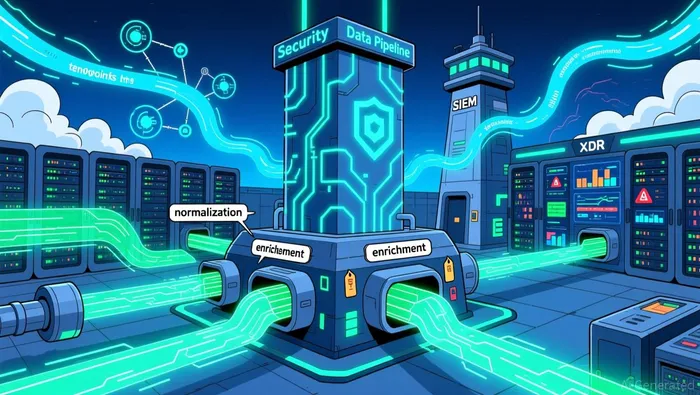 Platformization is also reshaping traditional SIEM models. Modern SIEMs are becoming modular, with storage and analytics decoupled to prioritize real-time alerting while relying on cost-effective cloud storage solutions like Snowflake or Azure Blob for long-term retention. AI further amplifies this shift, automating threat detection and enabling generative AI to create parsing rules and enrich data in real time. These trends are accelerating the adoption of zero-trust architectures and extended detection and response (XDR) solutions, which require unified platforms to manage distributed and cloud-first environments.
Ecosystem Dominance: The Platformization Playbook
Ecosystem giants are capitalizing on platformization by bundling capabilities into cohesive, cloud-native security suites. Microsoft, for instance, has expanded its Defender portfolio to include Defender for Endpoint, Defender Vulnerability Management, and AI-driven analytics, all integrated within Azure. Similarly, Palo Alto Networks has launched AI-powered platforms like Cortex Xpanse 3.0 for autonomous asset discovery and partnered with IBM to enhance multi-cloud security. These strategies allow them to offer end-to-end solutions that reduce the need for standalone tools like Tenable's vulnerability management platform.
The valuation dynamics underscore this dominance. Microsoft's market capitalization ($3.31 trillion) dwarfs Tenable's ($4.8 billion), while Palo Alto Networks reported FY 2024 revenue of $8.1 billion, with Next-Generation Security (NGS) ARR growing 43% YoY to exceed $4 billion. In contrast, Tenable's Q3 2025 revenue of $252.4 million reflects an 11% YoY increase-a stark slowdown compared to the ecosystem giants' growth trajectories.
Tenable's struggles highlight the challenges faced by best-of-breed vendors. Despite maintaining a 29% market share in device vulnerability management and leveraging AI-powered ExposureAI, its stock hit a 52-week low in January 2026, reflecting a 43% decline over the past year. Ecosystem giants, meanwhile, are acquiring niche capabilities to fill gaps in their platforms. For example, Microsoft's cloud-native solutions and Palo Alto's AI-driven innovations are eroding Tenable's competitive edge by offering bundled, cost-effective alternatives .
Financial and Valuation Implications
The financial performance of Tenable versus ecosystem giants reveals a stark divergence. While Tenable's valuation remains modest, its ecosystem competitors benefit from higher valuation multiples due to their scale and recurring revenue models. Palo Alto Networks, for instance, has a market capitalization of $107 billion, with NGS ARR growth outpacing Tenable's. Microsoft's dominance in cloud security and identity management further cements its position as a platform leader, with its security portfolio aligned to global compliance standards like NIST and GDPR.
The services segment of the cybersecurity market is also shifting in favor of ecosystem players. Managed security services are projected to grow at a 13.1% CAGR through 2030. Ecosystem giants, with their extensive resources and AI-driven automation, are better positioned to capitalize on this trend than best-of-breed vendors, which often lack the infrastructure for scalable service delivery.
Conclusion: Navigating the Platformization Paradox
The platformization paradox underscores a fundamental truth: in an era of AI-driven threats and cloud-first strategies, unified ecosystems are outpacing specialized tools. While Tenable and other best-of-breed vendors have excelled in niche markets, their inability to compete with the scale, integration, and cost efficiency of ecosystem giants is eroding their market share and valuation. For investors, this signals a shift toward platform-centric cybersecurity stocks-those with robust AI capabilities, cloud-native architectures, and bundled solutions. However, best-of-breed vendors that can pivot to platformization or form strategic partnerships with ecosystem leaders may still find opportunities in a fragmented but rapidly evolving market.







Comentarios
Aún no hay comentarios