
Plasma One: Redefining DeFi Infrastructure and Financial Inclusion Through Stablecoin-Native Banking
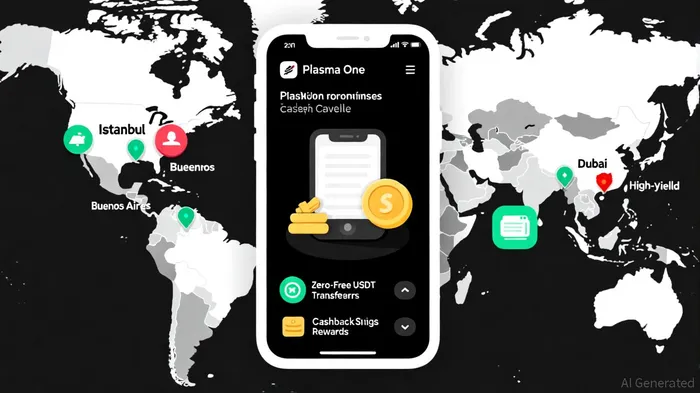
The stablecoin revolution is no longer confined to speculative trading or cross-border remittances. With the launch of Plasma One, the first stablecoin-native neobank, the financial infrastructure of the future is being reimagined—particularly for emerging markets where access to digital dollars is a lifeline. By consolidating savings, spending, and yield generation into a single app, Plasma One is not just a product but a paradigm shift in how DeFi interacts with real-world economies.
A Technological Leap for Stablecoin Usability
Plasma One addresses a critical pain point in the DeFi ecosystem: the fragmentation of tools. Users no longer need to juggle wallets, exchanges, and third-party apps to manage stablecoins. The platform offers zero-fee USDT transfers, 10%+ annual yields on eligible balances, and 4% cashback on card transactions, all within a single interface[2]. This is made possible by Plasma's purpose-built blockchain infrastructure, which enables near-instant transactions and eliminates the friction of traditional stablecoin usage[5].
For instance, a user in Dubai can now earn passive income on their USDTUSDT-- holdings while spending the same stablecoins at 150 million global merchants without conversion fees[4]. Such seamless integration is a game-changer for markets where dollar-denominated transactions are essential for preserving value against volatile local currencies.
Building the Foundation for a Global Financial Layer
Plasma One's impact extends beyond consumer convenience. It is designed as a production-ready infrastructure layer for institutions and fintechs to build upon[2]. By offering APIs and developer tools, Plasma is positioning itself as the backbone of a new financial ecosystem where stablecoins are not just a medium of exchange but a programmable asset.
This aligns with broader trends in DeFi infrastructure. According to a report by Delphi Digital, stablecoins are poised to become the "digital dollars" of the global economy, with a $1 trillion opportunity in infrastructure that bridges traditional finance and blockchain[3]. Plasma One's partnerships with entities like Rain and Binance further solidify its role in expanding liquidity and card deployment, ensuring that stablecoin adoption is not limited to tech-savvy users[6].
Financial Inclusion in Emerging Markets: A Data-Driven Case
Emerging markets are where Plasma One's vision shines brightest. Over 1.4 billion adults remain unbanked globally, and many more rely on underdeveloped financial systems[1]. Plasma One tackles this by deploying localized teams and peer-to-peer cash networks in cities like Istanbul and Buenos Aires, where demand for dollar-backed assets is acute[2].
Consider the case of a small business owner in Istanbul. Previously, converting local currency to stablecoins required navigating clunky interfaces and high fees. Now, Plasma One's app allows them to deposit cash via local partners, earn yields on USDT, and spend directly without intermediaries[4]. This democratization of financial tools is not just theoretical—it's a scalable solution for regions where traditional banking infrastructure is either absent or prohibitively expensive.
Challenges and the Road Ahead
While Plasma One's potential is immense, challenges remain. Regulatory scrutiny of stablecoins and neobanks could slow adoption, particularly in jurisdictions with strict capital controls. Additionally, competition from established players like Circle and Ripple may test Plasma's ability to differentiate itself.
However, the platform's first-mover advantage and $423 million in funding[2] position it to navigate these hurdles. The upcoming mainnet beta launch on September 25, 2025, and a public token sale will be critical milestones to watch[3]. Early depositors are already incentivized with high yields, signaling strong demand for this new financial model.
Conclusion: A High-Leverage Bet on the Future of Finance
Plasma One is more than a neobank—it's a catalyst for redefining DeFi infrastructure and financial inclusion. By solving the usability gap in stablecoin adoption and targeting underserved markets, it taps into a structural shift in global finance. For investors, this represents a high-leverage exposure to a sector that could outperform traditional fintech and DeFi models combined.
As the world moves toward a digital financial layer, Plasma One is not just participating in the future—it's building it.







Comentarios
Aún no hay comentarios