
Plasma's Mainnet Beta and the Future of Stablecoin Liquidity
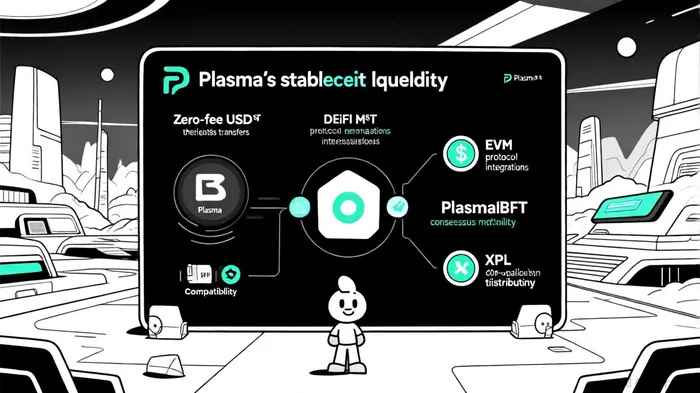
The launch of Plasma's Mainnet Beta on September 25, 2025, marks a pivotal moment in the evolution of stablecoin-driven DeFi infrastructure. By anchoring $2 billion in stablecoin liquidity and integrating over 100 DeFi partners—including AaveAAVE--, EthenaENA--, and Euler—Plasma has positioned itself as the eighth-largest blockchain by stablecoin liquidity[1]. This strategic move not only underscores the growing demand for scalable, low-cost stablecoin solutions but also challenges traditional LayerLAYER-- 1 blockchains to rethink their value propositions in an era where digital dollars dominate global transactions[2].
Plasma's Technological Edge: PlasmaBFT and EVM Compatibility
At the core of Plasma's innovation lies its PlasmaBFT consensus mechanism, a leader-based Byzantine Fault Tolerance (BFT) protocol inspired by Fast HotStuff. This architecture enables sub-1-second finality and supports thousands of transactions per second (TPS) in a single-chain environment[3]. Unlike energy-intensive proof-of-work models, PlasmaBFT prioritizes throughput and composability, making it ideal for stablecoin networks that require instant, zero-fee transfers[4]. For instance, Plasma's authorization-based routing allows USD₮ transfers to bypass gas fees entirely, a feature initially limited to its native products but slated for third-party expansion[5].
EVM compatibility further amplifies Plasma's appeal. By leveraging the Reth client, the platform ensures seamless deployment of Ethereum-based smart contracts without code modifications[6]. This modular execution environment accelerates the migration of DeFi protocols, with partnerships already secured with Curve, Aave, and Morpho[7]. Such interoperability reduces friction for developers and liquidity providers, creating a flywheel effect that could attract billions in additional TVL.
Tokenomics and Market Dynamics: XPL's Role in Network Security
The XPL token is central to Plasma's ecosystem, serving dual purposes in governance and validator incentives. At launch, 25 million XPL tokens were distributed to verified depositors and early contributors, while 2.5 million were allocated to the Stablecoin Collective—a community initiative focused on education and adoption[8]. Notably, U.S. participants received a 12-month delay in token distribution (scheduled for July 28, 2026), a regulatory safeguard that mitigates compliance risks[9]. This structured approach to token allocation ensures broad ownership while aligning long-term incentives with network security.
Market reactions to XPL's launch were robust. According to a report by MEXC, the token's trading volume surged 214% in the days following the mainnet beta, driven by speculative fervor and institutional interest in its stablecoin infrastructure[10]. Analysts at Gate.io highlight that XPL's utility in staking and governance could further drive demand, particularly as Plasma expands its integration with physical cash networks for remittances and merchant payments[11].
Strategic Investment Potential: Reshaping DeFi Infrastructure
Plasma's strategic positioning as a stablecoin-centric Layer 1 blockchain offers compelling investment potential. By addressing the scalability and cost inefficiencies of existing DeFi platforms, Plasma is well-positioned to capture a significant share of the $150 billion stablecoin market[12]. Its focus on real-world adoption—such as bridging digital and physical cash networks—aligns with macroeconomic trends toward decentralized financial systems[13].
Moreover, the platform's $1 billion stablecoin deposit campaign and $373 million public sale demonstrate strong institutional backing[14]. These funds will likely accelerate the development of USD₮ markets, deepening liquidity pools and reducing slippage for traders. For investors, this translates to a network effect where increased usage of Plasma's infrastructure directly correlates with XPL's utility and value.
Risks and Regulatory Considerations
While Plasma's prospects are promising, risks remain. The U.S. token distribution delay highlights the regulatory complexities of stablecoin projects, particularly under the SEC's evolving framework[15]. Additionally, competition from established Layer 1s like EthereumETH-- and SolanaSOL-- could pressure Plasma to innovate rapidly. However, its niche focus on stablecoin infrastructure—coupled with zero-fee transfers and EVM compatibility—provides a defensible moat.
Conclusion: A Catalyst for the Next DeFi Cycle
Plasma's Mainnet Beta represents more than a technical milestone—it is a catalyst for redefining how stablecoins power global finance. By combining high-performance consensus, EVM compatibility, and a community-driven token model, Plasma addresses critical pain points in DeFi infrastructure. For investors, the platform's strategic alignment with macro trends—scalability, low-cost transactions, and real-world adoption—positions XPL as a key asset in the next phase of decentralized finance.
As the stablecoin ecosystem matures, Plasma's ability to execute on its vision will determine its long-term success. But with $2 billion in liquidity already deployed and a roadmap emphasizing interoperability and accessibility, the stage is set for a transformative impact.






Comentarios
Aún no hay comentarios