
Plasma's Disruptive Potential in On-Chain Payments: Scalability and User Adoption as the Next Growth Catalyst for Crypto Infrastructure
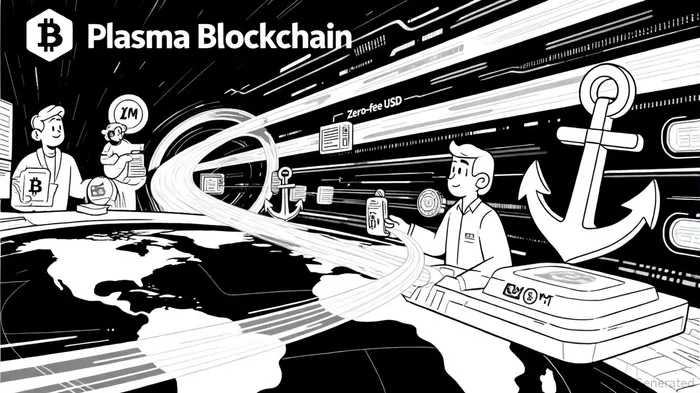
The crypto landscape is at a pivotal inflection point. Stablecoins, now the dominant asset class in digital finance, have outpaced traditional payment networks in transaction volume[3]. Yet, legacy blockchains like EthereumETH-- and Tron—despite their early success—struggle with scalability, high fees, and centralization risks. Enter Plasma, a purpose-built blockchain for stablecoins, which is redefining the infrastructure layer for on-chain payments. With a $24 million funding round led by Framework Ventures and Bitfinex[1], Plasma is not just solving technical bottlenecks but also unlocking a trillion-dollar market for feeless, high-speed stablecoin transactions.
Scalability: The Technical Breakthrough
Plasma's architecture is engineered for one primary use case: stablecoin transfers. Unlike generalized blockchains, it leverages a PlasmaBFT consensus mechanism—a leader-based Byzantine Fault Tolerance protocol inspired by Fast HotStuff—to achieve thousands of transactions per second (TPS) with sub-second finality[4]. This is critical for stablecoins, which require low latency and zero fees to compete with traditional payment systems.
Data from eco.com reveals that Plasma's execution layer, built on a modular Reth engine, optimizes throughput without requiring smart contract rewrites[1]. By pipelining transactions and using quorum certificates, Plasma reduces latency to near real-time. Additionally, its hybrid model anchors state roots to BitcoinBTC--, ensuring censorship resistance while leveraging Bitcoin's security properties[4]. This dual-layer approach—high-performance execution + Bitcoin-anchored settlement—positions Plasma as a neutral, globally accessible infrastructure for stablecoins.
User Adoption: From Neobanks to Global Remittances
Scalability alone isn't enough; user adoption is the ultimate growth catalyst. Plasma has strategically targeted pain points in existing stablecoin ecosystems. For instance, Tron, which dominates USD₮ flows, faces rising fees and centralization concerns[3]. Ethereum, while innovative, is plagued by congestion. Plasma's zero-fee USD₮ transfers, enabled by a custom gasGAS-- token system, directly address these issues[4].
A key case study is Plasma One, the platform's first stablecoin-native neobank. Launched in September 2025, Plasma One simplifies saving, spending, and earning in digital dollars, particularly in emerging markets where access to dollar-pegged assets is critical[2]. By deploying localized teams and peer-to-peer cash networks, Plasma One has already demonstrated rapid adoption in regions like Southeast Asia and Latin America.
Moreover, Plasma's partnership with USD₮0 has streamlined cross-chain deployments, enabling secure, feeless USD₮ transfers across Ethereum, TronTRX--, and TON[3]. This interoperability is a game-changer for cross-border remittances, where stablecoins could replace traditional SWIFT transfers. In June 2025, Plasma raised $1 billion in deposits within 30 minutes—a testament to the demand for its infrastructure[5]. These deposits, which served as a liquidity mechanism for the upcoming XPL token sale, highlight the platform's ability to attract both retail and institutional users.
Market Opportunity: A Trillion-Dollar Inflection Point
Stablecoins processed over $32.8 trillion in transactions in 2024, surpassing Visa's annual volume[3]. Plasma is uniquely positioned to capture a significant share of this market. Its EVM compatibility ensures seamless integration with DeFi protocols, while its Bitcoin-anchored security model appeals to institutional players seeking robust settlement layers[4].
The platform's partnerships with liquidity providers and DeFi protocols further solidify its ecosystem. For example, the collaboration with Arkham adds transparency to stablecoin activity, a critical factor for regulatory compliance and user trust[4]. As stablecoins expand beyond crypto-native use cases into mainstream finance—such as tokenized cash and international trade—Plasma's feeless, high-performance model becomes indispensable[3].
Investment Thesis: Why Plasma Matters
Plasma's disruptive potential lies in its ability to solve two critical challenges: technical scalability and user adoption. By optimizing for stablecoin infrastructure, it avoids the inefficiencies of generalized blockchains. Its $24 million funding round[1], $1 billion deposit event[5], and strategic partnerships underscore its credibility and execution power.
For investors, Plasma represents a rare convergence of innovation and market readiness. As stablecoins become the backbone of global payments, Plasma's infrastructure is poised to become the default layer for digital dollars. With Bitcoin anchoring its security and EVM compatibility enabling DeFi integration, Plasma isn't just a blockchain—it's a bridge to the future of finance.






Comentarios
Aún no hay comentarios