
Pippin Price Prediction: AI Agent PIPPIN's 80% Surge – Is This a Meme-Driven Frenzy or a Legitimate AI Investment Opportunity?
The PIPPIN Surge: A Product of AI Hype or Substance?
PIPPIN's rapid ascent mirrors the broader AI craze gripping both traditional markets and crypto. For instance, C.H. Robinson's AI strategy delivered a 12.6% reduction in operating expenses and a 10.8% cut in headcount while boosting margins. Conversely, C3.ai-a company synonymous with enterprise AI-faced a 25.58% single-day stock plunge after CEO health issues and poor financial guidance exposed vulnerabilities in its execution, according to a Morningstar report. These contrasting outcomes highlight the dual-edged nature of AI adoption: when executed well, it drives value; when mismanaged, it amplifies risk.
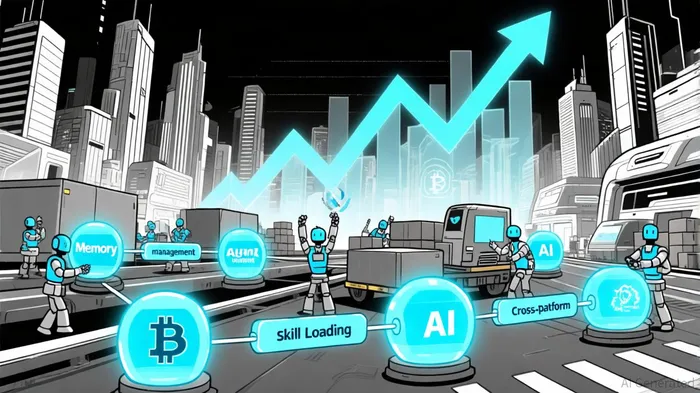
PIPPIN's whitepaper suggests a more structured approach. The project evolved from BabyAGI into the Pippin Framework, introducing features like memory management, dynamic skill loading, and cross-platform tool integration. These capabilities enable AI agents to self-reflect and generate tasks autonomously, creating a flexible ecosystem for developers. Unlike speculative tokens like PING-which surged 802% in 24 hours but lacks clear utility, as noted in a Fool article-PIPPIN's framework is tied to a token ($PIPPIN) that facilitates governance and tool development. Yet, its value remains heavily dependent on community consensus, a trait common to meme-driven assets.
PIPPIN vs. PING: A Tale of Two Tokens
The PING token, associated with Coinbase's x402 protocol, offers a cautionary parallel. While its 970% price surge in October 2025 reflects retail investor enthusiasm, according to a Lookonchain feed, it also underscores the risks of speculative assets. PING's utility-enabling autonomous AI agent transactions-is still unproven, and its volatility mirrors that of runewords, a prior memeMEME-- coin phenomenon.
PIPPIN, by contrast, claims deeper integration with AI infrastructure. Its partnerships with energy giants like Shell-detailed in Shell's AI case study-suggest real-world relevance. For example, Shell's collaboration with SparkCognition reduced deep-sea oil exploration times from nine months to nine days using generative AI. While PIPPIN is not explicitly tied to these partnerships, its focus on cross-platform AI tooling aligns with the growing demand for industrial AI solutions.
Global AI Adoption: A Tailwind or a Mirage?
The logistics and transportation sectors are leading AI adoption, with 96% of North American and European companies using generative AI for tasks like route optimization and freight forecasting, according to an annual survey. The AI in Transportation Market is projected to grow at a 10.54% CAGR through 2035, per an AI in Transportation Market report, driven by autonomous vehicles and smart infrastructure. This trend validates the long-term potential of AI-driven efficiency gains.
However, PIPPIN's legitimacy hinges on its ability to contribute meaningfully to this ecosystem. The Pippin Framework's emphasis on agentic AI-systems capable of self-directed task generation-could position it as a developer tool for enterprises. Yet, the absence of concrete use cases or partnerships in the provided sources raises questions about its practicality. For now, PIPPIN appears to occupy a gray area between speculative hype and foundational AI infrastructure.
The Risks of AI Hype: Lessons from C3.ai and BigBear.ai
The collapse of C3.ai's stock price after leadership turmoil and poor financial results serves as a stark reminder of the risks in AI ventures. Similarly, BigBear.ai-a defense-focused AI company-saw its stock surge 300% in 2025 due to partnerships with U.S. tactical forces and airport security systems, according to TS2.Tech coverage. However, its Q2 2025 revenue fell 18% year-over-year, and a one-time accounting hit led to a $228.6 million net loss. These examples underscore the volatility of AI-driven investments, where short-term hype often outpaces long-term fundamentals.
PIPPIN's token economics further complicate its valuation. While its whitepaper outlines a governance model and developer incentives, the token's price is largely driven by community participation-a factor more akin to meme coins than enterprise software. This dynamic is reminiscent of PING, whose value spiked without clear utility.
Conclusion: A Calculated Bet or a Passing Frenzy?
PIPPIN's 80% surge is emblematic of the 2025 crypto market's AI obsession. While its technical framework and alignment with industrial AI trends suggest potential, its reliance on community-driven value creation and lack of concrete partnerships leave it vulnerable to the same speculative forces that propelled PING and BigBear.ai.
For investors, the key question is whether PIPPIN can transition from a hype-driven token to a foundational AI infrastructure player. If it succeeds in delivering tools that enhance enterprise AI workflows-akin to C.H. Robinson's logistics automation-it could justify its valuation. However, if it follows the trajectory of C3.ai or PING, the current rally may prove unsustainable.
In a market where AI promises are as abundant as they are unproven, due diligence remains paramount. PIPPIN's future will depend not on its price chart, but on its ability to build a legitimate ecosystem of developers and enterprises.





Comentarios
Aún no hay comentarios