
Pioneer Lithium's Strategic Claims in Idaho and Wyoming: A Catalyst for U.S. Supply Chain Resilience and Shareholder Value
In an era where mineral security is inextricably linked to national and economic resilience, Pioneer Lithium's recent acquisition of 111 critical mineral claims in Idaho and Wyoming positions the company as a pivotal player in the U.S. critical minerals sector, according to a Discovery Alert report. These claims, spanning the North Pine Project in Idaho and the Central Buttes Uranium Project in Wyoming, target antimony, tungsten, and uranium-commodities designated as critical by the U.S. Department of the Interior for their roles in defense, clean energy, and advanced manufacturing. While lithium is not explicitly mentioned in Pioneer's current portfolio, the company's strategic alignment with U.S. supply chain goals and its proximity to emerging lithium projects underscore its potential to contribute to a diversified and resilient mineral ecosystem.
Strategic Minerals and Geopolitical Imperatives
The North Pine Project in Idaho, centered on the Springfield Prospect, includes a historical tungsten and antimony site with polymetallic potential, including gold. Tungsten, a key component in high-strength alloys and military applications, and antimony, essential for flame retardants and batteries, are both critical to U.S. industrial security, as noted in a U.S. Geological Survey report. Meanwhile, the Central Buttes Uranium Project in Wyoming targets sandstone-hosted uranium deposits amenable to In-Situ Recovery (ISR) methods, a low-impact technique that aligns with environmental regulations while addressing the nation's energy needs.
These projects are not isolated ventures. They are part of a broader U.S. strategy to reduce reliance on foreign imports for critical minerals. For instance, the U.S. imports over 98% of its antimony and 95% of its tungsten, according to the U.S. Geological Survey. Pioneer's claims, located near established mining districts and infrastructure, offer a tangible pathway to localize supply chains. CEO Michael Beven has emphasized that these acquisitions align with the Biden-Harris Administration's push for domestic production, particularly through initiatives like the Inflation Reduction Act and the Department of Energy's loan programs, the Discovery Alert report observed.
The Lithium Connection: Indirect Synergies and Broader Context
While Pioneer's current focus does not include lithium, its operations intersect with the U.S. lithium landscape in two key ways. First, the company's Wyoming claims are in close proximity to hard rock lithium projects being explored by firms like Chariot Corporation. Chariot's Black Mountain Project, for example, has reported lithium grades up to 3.79% Li₂O, highlighting the state's untapped potential. Second, the U.S. government's emphasis on securing critical minerals extends beyond lithium to the entire suite of materials required for clean energy transitions. By strengthening supply chains for antimony, tungsten, and uranium, Pioneer indirectly supports the infrastructure needed for electric vehicles (EVs) and renewable energy systems, which also depend on lithium.
The U.S. is already witnessing a surge in sedimentary lithium projects, such as Ioneer's Rhyolite Ridge and Lithium Americas' Thacker Pass, both of which are projected to begin production by 2026–2028, supported in part by a DOE loan guarantee to IoneerIONR--. These projects, coupled with Pioneer's efforts, illustrate a coordinated push to diversify mineral sources. As noted by the Department of Energy, such initiatives are critical to achieving the administration's goal of producing enough lithium to support 370,000 EVs annually.
Financial and Operational Catalysts for Shareholder Value
Pioneer's strategic positioning offers multiple catalysts for long-term shareholder value. The company's claims in Idaho and Wyoming are in regions with established mining infrastructure, reducing capital expenditures and accelerating exploration timelines. For example, the Springfield Prospect remains largely unexplored, with historical data suggesting 178,000 tons of tungsten oxide grading 0.27% WO₃. A technical review and field reconnaissance program, announced by the company, could unlock significant resource potential.
Moreover, the geopolitical tailwinds are robust. The U.S. government's $996 million loan guarantee to Ioneer for its Rhyolite Ridge project underscores the scale of public-private partnerships in the critical minerals sector. Pioneer's alignment with similar priorities-such as its uranium project's compatibility with ISR methods-positions it to benefit from future subsidies or regulatory support.
Risks and Considerations
Investors must remain cognizant of challenges, including exploration risks and regulatory scrutiny. Uranium projects, in particular, face environmental and political headwinds, though ISR methods mitigate some of these concerns. Additionally, the current low lithium price environment may delay junior projects, including those adjacent to Pioneer's claims, according to a carboncredits analysis. However, the company's focus on high-demand, geopolitically sensitive minerals like antimony and tungsten provides a buffer against commodity volatility.
Conclusion: A Cornerstone of U.S. Mineral Security
Pioneer Lithium's 111 claims in Idaho and Wyoming are more than a corporate expansion-they represent a strategic investment in U.S. supply chain resilience. By targeting minerals critical to national defense and clean energy, the company is addressing a gap that has long been exploited by foreign competitors. While lithium exploration remains the domain of other players, Pioneer's role in securing complementary materials ensures its relevance in the broader transition to a low-carbon economy. For investors, the combination of geopolitical tailwinds, operational proximity to lithium projects, and a clear path to resource delineation makes Pioneer a compelling long-term play in the critical minerals space. 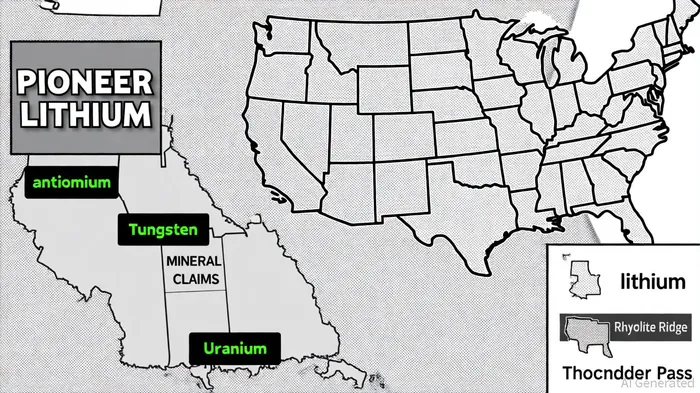





Comentarios
Aún no hay comentarios