
Pico Prism's 99.6% ETH Block Proving and the Implications for Ethereum Scalability
Ethereum's journey toward scalable, secure, and cost-effective blockchain infrastructure has reached a pivotal milestone with the advent of Pico Prism, a zero-knowledge virtual machine (zkVM) developed by Brevis. By achieving 99.6% real-time proving coverage for Ethereum blocks in under 12 seconds and 96.8% coverage in under 10 seconds, Pico Prism has redefined the technical and economic feasibility of zero-knowledge (ZK) proof generation for Ethereum's base layer, according to Brevis's blog. This breakthrough not only accelerates Ethereum's roadmap to 10,000 transactions per second (TPS) by 2029 but also addresses critical institutional barriers-security, cost, and scalability-that have historically hindered mass adoption of blockchain technology.
Technical Advancements: A New Benchmark for ZK-EVMs
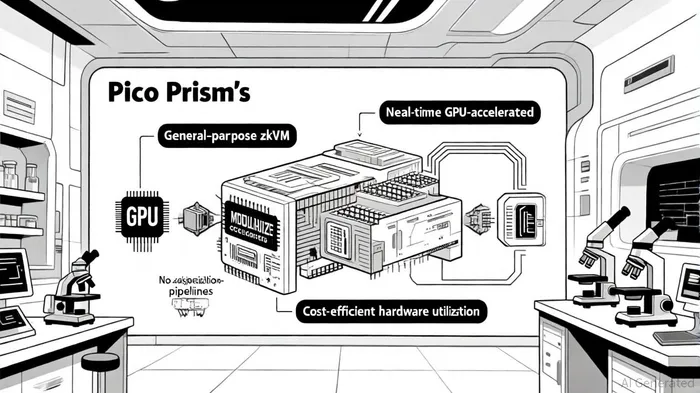
Pico Prism's performance is underpinned by a modular "glue-and-coprocessor" architecture, which combines a general-purpose zkVM with high-performance, app-specific circuits optimized for GPU acceleration, as described in the Pico docs. This design reduces hardware costs by 50% compared to prior solutions, requiring only 64 consumer-grade RTX 5090 GPUs to achieve real-time proving, versus 160 RTX 4090 GPUs in competing systems, according to Business Insider. The result is an average proving time of 6.9 seconds for 45M gas limit blocks, outperforming Succinct's SP1 Hypercube by 3.4x in speed and cost efficiency, as reported by CryptoDaily.
Vitalik Buterin has highlighted Pico Prism as a "significant step forward in ZK-EVM proving speed and diversity", emphasizing its role in enabling Ethereum's transition to a proof-verification-based consensus model, as noted on CoinPedia. This shift reduces computational overhead for validators, who no longer need to re-execute transactions, and aligns with Ethereum's 2025 roadmap goals of 99% coverage, sub-10-second proving, and hardware costs under $100K, as outlined by Cointelegraph.
Ethereum's Scalability Vision: From 1.65M TPS to 10,000 TPS
The implications of Pico Prism extend beyond Ethereum's base layer. By enabling real-time validation, the technology paves the way for native rollups-Layer 2 solutions that synchronize directly with Ethereum's Layer 1-eliminating trust assumptions and enabling atomic interactions like flash loans and arbitrage, as Panewslab explains. This innovation is critical for Ethereum's ambition to scale to 10,000 TPS by 2029, a target that would make the network viable for high-frequency applications such as institutional-grade DeFi protocols and tokenized real-world assets (RWAs), according to an arXiv paper.
Moreover, Pico Prism's GPU acceleration and modular design allow for seamless integration with existing infrastructure, reducing barriers for institutions to adopt Ethereum-based solutions. For example, platforms like Starknet and zkSync are already leveraging ZKZK-- rollups to tokenize real estate, carbon credits, and private equity shares, processing up to 71 swaps per second-a 6x improvement over Ethereum's mainnet, according to the Layer 2 benchmarks.
Institutional Adoption: Security, Compliance, and Economic Viability
Institutional investors have long been cautious about EthereumETH-- due to concerns over security, regulatory compliance, and economic feasibility. Pico Prism addresses these pain points by:
1. Enhancing Security: ZK proofs enable trustless verification, eliminating the need for re-executing transactions and reducing attack surfaces, as reported by Cryptonomist.
2. Meeting Compliance Needs: Ethereum's integration of ERC-3643 permissioned tokens and programmable token behaviors allows institutions to tokenize assets while maintaining privacy and regulatory compliance, as BMREducation explains.
3. Lowering Costs: Pico Prism's 50% reduction in hardware costs and energy consumption (under 10 kW) makes real-time proving economically viable for large-scale deployment, according to CryptoDaily.
Institutional partnerships are already materializing. For instance, BlackRock's BUIDL tokenized fund and the EURCV euro stablecoin leverage Ethereum's ZK infrastructure to tokenize real-world assets, with over $8.3 billion in RWAs now hosted on the network, per Crypto.com research. These developments align with Ethereum's broader ecosystem growth, including 1.65 million daily transactions, $45 billion in DeFi TVL, and 1 million validators staking 30 million ETH, as reported by Axon.
The Road Ahead: From Real-Time Proving to a ZK-Friendly Ecosystem
Ethereum's 2025-2026 roadmap includes critical upgrades like the Fusaka update, which introduces PeerDAS and increased gas limits to further enhance scalability, according to Gate. These upgrades, combined with Pico Prism's real-time validation capabilities, position Ethereum as a proof-verification layer where ZK proofs replace traditional re-execution methods. This transition not only improves performance but also reinforces Ethereum's role as a foundational infrastructure for blockchain innovation.
For investors, the convergence of technical advancements, institutional adoption, and regulatory clarity presents a compelling case. Ethereum's ability to scale to 10,000 TPS while maintaining security and compliance makes it an attractive asset for portfolios seeking exposure to the next phase of blockchain adoption.
Conclusion
Pico Prism's 99.6% real-time proving coverage is more than a technical achievement-it is a catalyst for institutional Ethereum adoption. By addressing scalability, security, and cost barriers, the technology accelerates Ethereum's transition to a ZK-friendly ecosystem, enabling institutions to tokenize assets, execute high-frequency transactions, and participate in decentralized finance with confidence. As Ethereum inches closer to its 2029 scalability goals, the integration of ZK solutions like Pico Prism will likely redefine the boundaries of blockchain's utility in traditional finance.






Comentarios
Aún no hay comentarios