
Pi Network: A Resilient Underdog in Crypto's Mainstream Push
The Unique Mining Model: A Community-Driven Foundation
Pi Network's mining model diverges sharply from traditional proof-of-work (PoW) systems. Instead of requiring energy-intensive hardware, it allows users to mine Pi coins via a mobile app, fostering broad participation from non-technical users. This approach has cultivated a global community of node operators-now exceeding 350,000-who validate transactions and maintain network security, as noted in a Cryptopolitan update. The model's accessibility has been both a strength and a point of skepticism, but recent upgrades to the Pi Desktop app and node infrastructure are addressing concerns about scalability and reward distribution.
The release of node version 0.5.4 in 2025 marked a pivotal step forward. This update refined mining reward calculations, resolved issues with automatic updates, and introduced open port verification to enhance security, according to the Cryptopolitan update. By improving the user experience for node operators, Pi Network is reinforcing its core thesis: that decentralized networks can thrive through community engagement rather than institutional capital.
AI Integration: Decentralizing Computational Power
One of Pi Network's most compelling developments in 2025 is its foray into AI integration. A Proof-of-Concept collaboration with OpenMind, an AI company developing an open-source operating system for robotics, demonstrated that Pi Nodes could perform AI processing tasks with stable performance and minimal errors, according to a Coinfomania case study. This initiative aligns with Pi's broader vision of creating a decentralized computational layer, where node operators contribute processing power to AI workloads instead of relying on centralized cloud providers.
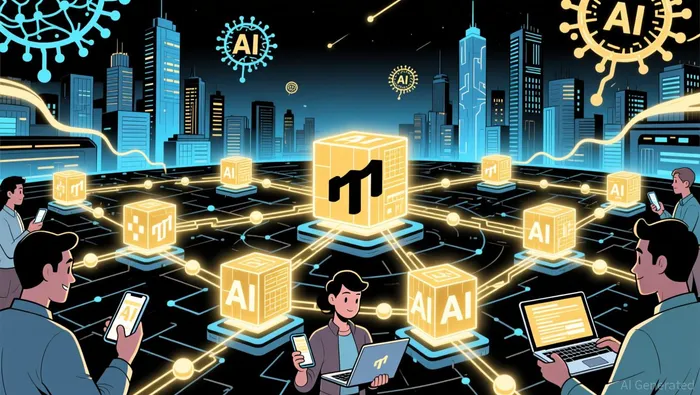
The implications are profound. By leveraging its distributed node infrastructure, Pi Network could reduce the environmental and financial costs of AI training while distributing rewards to individual contributors. This model challenges the status quo of centralized AI development and positions Pi as a potential enabler of ethical, community-driven AI innovation.
Regulatory Compliance: Bridging Blockchain and Traditional Finance
Regulatory scrutiny remains a critical hurdle for blockchain projects, but Pi Network is taking proactive steps to align with global standards. In 2025, the project joined the ISO 20022 standard group, a global financial messaging protocol used by institutions like StellarXLM-- and Ripple, according to a Coinpedia article. This move, with a target compliance date of November 22, 2025, signals Pi's intent to integrate seamlessly with traditional banking systems and facilitate cross-border transactions, as noted in the Coinfomania article.
The alignment with ISO 20022 is more than a technical upgrade-it's a strategic pivot toward institutional credibility. By positioning itself as a regulated payment network, Pi Network is addressing concerns about volatility and utility, two factors that have historically limited blockchain adoption. With 25 million KYC-verified users, the project is also demonstrating its capacity for real-world compliance and scalability, according to the Coinfomania article.
Ecosystem Growth and Governance: Preparing for Mainnet
Pi Network's ecosystem is maturing rapidly. Testnet 1 has achieved a near-zero transaction failure rate, a critical milestone for the Open Mainnet launch, according to a Coinfomania milestone report. The upcoming Mainnet version v23 will support financial transactions and AI-based computations, expanding Pi's utility beyond a store of value.
Community governance remains central to Pi's development. The Pi App Studio, a platform for decentralized application (dApp) development, has been upgraded to accelerate innovation within the ecosystem, as noted in the Coinfomania case study. These efforts underscore Pi's commitment to fostering a self-sustaining network where users can participate in governance, development, and economic activity.
Addressing Skepticism: A Long-Term Investment Case
Critics argue that Pi Network's mobile mining model lacks the security guarantees of traditional blockchains. However, the project's focus on community engagement, AI integration, and regulatory alignment suggests a long-term strategy that prioritizes adoption over short-term speculation. The steady increase in the base mining rate to 0.0027551 π/hour also indicates sustained user engagement, according to the Coinfomania article.
For investors, Pi Network represents a unique opportunity: a blockchain project that is simultaneously addressing technical, regulatory, and social challenges. While the path to Open Mainnet remains uncertain, the ecosystem's progress in 2025-spanning node upgrades, AI partnerships, and compliance efforts-demonstrates resilience in a competitive landscape.
Conclusion
Pi Network's journey from a mobile mining experiment to a blockchain ecosystem with AI and regulatory ambitions is a testament to the power of community-driven innovation. By combining accessibility with technical rigor, Pi is challenging the notion that decentralized networks must choose between scalability and inclusivity. For investors willing to bet on the long-term potential of blockchain and AI convergence, Pi Network offers a compelling case-one where the underdog's resilience could redefine the future of digital finance.






Comentarios
Aún no hay comentarios