
Pi Network: Regulatory Clarity and Adoption Momentum Position for Near-Term Value Re-Rating
Regulatory Clarity and Institutional Access
Pi Network's regulatory progress in Q3 2025 has been a cornerstone of its credibility-building efforts. By registering PIBIT LTD under the EU's MiCA regime, the project has signaled its commitment to transparency and legal oversight, a stark departure from its earlier community-driven model. This alignment with ESMA and Malta's MFSA systems not only legitimizes Pi's operations but also opens the door to institutional participation. The Valour Pi ETP, listed on Sweden's Spotlight Stock Market in August 2025, has already provided European investors with regulated exposure to Pi, with public trading set to expand on November 28, 2025.
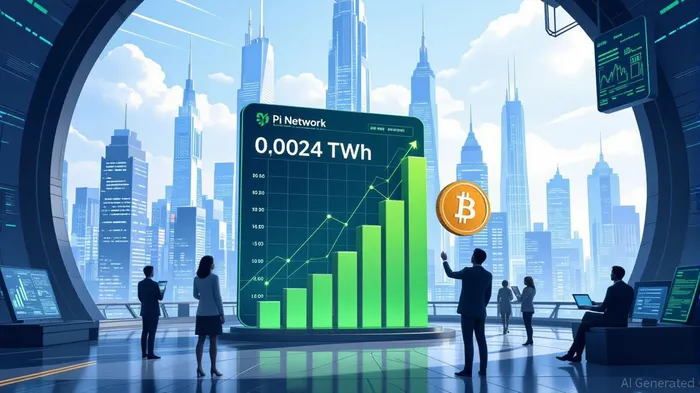
Financial analysts have highlighted the significance of these moves. notes that Pi's MiCA whitepaper-detailing its non-ICO launch, auditable token supply, and energy-efficient consensus mechanism-has bolstered institutional confidence. Furthermore, Pi's annual energy consumption of 0.0024 TWh, over 99.9% lower than Bitcoin's, aligns with Europe's green-finance goals, making it an attractive asset for ESG-focused investors.
Network Adoption and Utility Expansion
While regulatory compliance has been a key focus, Pi Network has also prioritized real-world utility to drive adoption. The launch of the BNPi app in Q3 2025, which allows users to book and pay for hotel stays using Pi tokens, marks a tangible step toward mainstream acceptance. This initiative, part of a broader "holiday commerce" strategy, aims to transition Pi from a speculative asset to a functional medium of exchange.
However, adoption metrics remain mixed. Despite the open mainnet launch in 2025 and local merchant integrations, on-chain activity in Q3 2025 showed limited institutional interest, with analysts citing tokenomics imbalances-such as the free mobile mining model-as a barrier to demand. That said, Q4 2025 brought optimismOP-- with the V23 Mainnet Protocol upgrade, which introduced smart contracts, enhanced scalability, and a decentralized exchange (DEX). These upgrades, expected to be finalized by late 2025 or early 2026, could catalyze broader ecosystem participation.
On-Chain Activity and Market Sentiment
On-chain data reveals a volatile but resilient trajectory for Pi. By late November 2025, the token had dropped 5.6% to $0.2283, driven by exchange supply surges and selling pressure. Yet, this dip occurred against a backdrop of broader crypto market corrections, with Pi maintaining a price floor above $0.20-a sign of relative stability. Analysts attribute this resilience to Pi's focus on utility over speculation, as well as its growing merchant network.
Institutional sentiment, however, remains cautious. While the project has attracted tens of millions of identity-verified users, token unlocks-such as the 105 million PI tokens scheduled for December 2025-pose short-term risks of increased supply and downward price pressure. The anticipated launch of the Pi DEX in 2026 could mitigate these challenges by enhancing liquidity and reducing reliance on centralized exchanges.
Future Outlook and Expert Insights
The coming quarters will be pivotal for Pi Network. analysis suggests that successful execution of the V23 upgrades and Open Mainnet transition could push Pi toward its $3 all-time high by 2026. Meanwhile, price predictions vary widely, with some experts forecasting a 170% rise to $0.39 and others cautioning a potential drop to $0.0395. These divergent views underscore the project's high-risk, high-reward profile.
Regulatory hurdles persist, particularly in the U.S. and China, where the SEC and Chinese authorities have raised concerns over KYC compliance and unregistered fundraising. Yet, Pi's alignment with MiCA and its emphasis on decentralized governance may insulate it from some of these pressures, especially as global crypto frameworks mature.
Conclusion
Pi Network's journey in 2025 reflects a strategic pivot from speculative hype to structured compliance and utility-driven growth. While challenges-such as token supply dynamics and regulatory scrutiny-remain, the project's regulatory milestones, real-world integrations, and upcoming technical upgrades position it for a potential re-rating. Investors who can navigate the short-term volatility may find Pi's long-term vision of a decentralized, user-centric ecosystem increasingly compelling.






Comentarios
Aún no hay comentarios