
Pi Network (PI): Can Fundamental and Market Catalysts Justify a $1 Price Target by Year-End 2025?
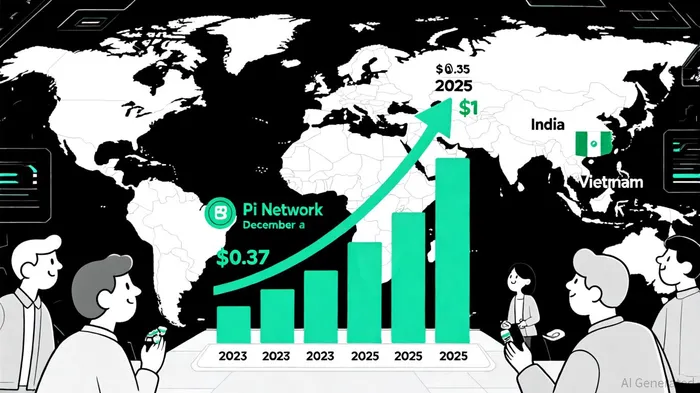
The Case for Pi Network: A $1 Price Target in 2025
Pi Network (PI) has emerged as one of the most polarizing yet ambitious projects in the blockchain space. With over 110 million app downloads and 60 million engaged users as of May 2025[1], the platform's mobile-first mining model and community-driven ethos have fueled rapid adoption. But can these fundamentals, combined with recent technological and institutional progress, justify a $1 price target by year-end 2025?
User Adoption and Geographic Reach: A Foundation for Growth
Pi Network's user base has grown exponentially, driven by its accessibility in emerging markets. Nigeria leads with 10% of users, followed by India (9%) and Vietnam (7%), reflecting strong adoption in regions with limited traditional banking infrastructure[3]. By September 2025, over 13 million users had migrated to the mainnet, with 19 million completing KYC verification[4]. This migration is critical, as it transitions Pi from a community-driven experiment to a decentralized, publicly tradable asset.
The geographic distribution underscores Pi's potential to disrupt financial inclusion. In markets like Nigeria and India, where smartphone penetration outpaces traditional banking access, Pi's utility as a digital currency for local commerce could drive demand[3]. For instance, the platform's integration with merchant ecosystems and low-fee transactions positions it as a viable alternative to cash in underbanked regions[5].
Technological Progress: Open Mainnet and Ecosystem Expansion
The February 2025 launch of the Open Mainnet marked a pivotal shift. By enabling public nodes, external wallet integrations, and exchange listings (e.g., BANXA), Pi Network has taken steps toward institutional credibility[2]. The Open Mainnet also allows users to transfer Pi tokens to external wallets, a critical step for liquidity and broader adoption[4].
Ecosystem development further strengthens the case. Over 100 decentralized applications (dApps) now operate on Pi's platform, ranging from local commerce tools to AI-powered platforms like Pi2Day[5]. The introduction of .pi domains and AI-driven dApp development tools signals a focus on real-world utility, which is essential for long-term value retention[5].
Tokenomics and Market Dynamics: Balancing Supply and Demand
Pi's tokenomics are designed to balance scarcity and utility. With a max supply of 100 billion tokens, the network employs an exponential decay model to reduce mining rewards over time[6]. As of 2025, the circulating supply stands at 7.26 billion tokens, with a market cap of $2.92 billion[1]. However, the recent 149.5 million token unlock in September 2025 added 5% to the circulating supply, introducing bearish pressure if demand does not keep pace[5].
The challenge lies in aligning supply growth with utility-driven demand. While Pi's ecosystem is expanding, the sheer size of its token supply—coupled with low liquidity—poses risks. For example, a 2025 price drop from $2.98 to $0.40 followed a large token unlock, highlighting volatility[6]. Yet, controlled supply growth, combined with merchant adoption and exchange listings, could mitigate these risks[1].
AI Sentiment and Market Predictions: A Mixed Outlook
AI-driven sentiment analysis reveals a nuanced picture. While some models predict a 40% chance of Pi reaching $1 by year-end 2025, others project a 15% probability due to market volatility[7]. The bullish case hinges on DeFi adoption, strategic partnerships, and the Binance listing rumor[7]. Conversely, bearish models cite regulatory risks, liquidity constraints, and oversupply concerns[5].
Community-driven optimism is also evident. The Pi Network community prioritizes a $5 price target, emphasizing ecosystem growth over speculative hype[4]. This focus on utility—such as the Fruity Pi gaming platform and merchant integrations—could attract long-term users and developers[5].
Institutional Partnerships and Strategic Positioning
Pi Network's participation in high-profile events like Consensus 2025 and the World Tech Summit has bolstered its institutional profile[5]. Strategic partnerships with fiat on-ramp providers and potential listings on major exchanges (e.g., Binance) could enhance liquidity and visibility[5]. Additionally, the network's compliance-ready infrastructure and verified user base make it an attractive candidate for enterprise integration in financial services and supply chain finance[5].
The $1 Price Target: Feasible or Fantasy?
Achieving a $1 price by December 2025 would require Pi's market cap to reach $100 billion—a 33x increase from its current valuation. While ambitious, this is not impossible. Historical precedents show that user growth and real-world utility can drive valuations. For example, Trust Your Supplier reduced supplier onboarding time by 70% using blockchain, demonstrating the technology's tangible value[8]. Similarly, Pi's 60 million users and expanding ecosystem could justify a premium if adoption accelerates.
However, several hurdles remain. Regulatory scrutiny, particularly in the U.S. and EU, could delay exchange listings. Additionally, the September 2025 token unlock may test market confidence. For Pi to reach $1, it must:
1. Accelerate Mainnet migration to 100 million users.
2. Secure major exchange listings to improve liquidity.
3. Expand merchant adoption to drive transaction volume.
4. Navigate regulatory challenges without compromising decentralization.
Conclusion: A High-Risk, High-Reward Bet
Pi Network's $1 price target is a bold but not implausible goal. The project's massive user base, strategic partnerships, and ecosystem development provide a strong foundation. However, the token's large supply, regulatory uncertainties, and liquidity constraints pose significant risks. For investors, the key is to balance optimism with caution. If Pi can execute its roadmap—particularly in expanding utility and securing institutional partnerships—the $1 threshold may be within reach. But until then, it remains a speculative bet with both extraordinary upside and considerable volatility.







Comentarios
Aún no hay comentarios