
Pi Network's Long-Term Viability: Navigating Regulatory Shifts and User Adoption Challenges in 2025
The cryptocurrency market in 2025 is defined by a tectonic shift in regulatory frameworks, technological innovation, and institutional adoption. Against this backdrop, Pi Network (PI) emerges as a project with both promise and peril. While its grassroots user base and real-world utility initiatives signal potential, structural challenges—ranging from liquidity constraints to regulatory scrutiny—pose significant hurdles. This analysis evaluates Pi's long-term viability through the lens of market dynamics, user adoption, and technological adaptability, drawing on recent developments to assess its price potential.
Regulatory Clarity: A Double-Edged Sword
The U.S. SEC and CFTC's September 2025 joint statement, which clarified that regulated exchanges can list spot crypto assets, has injected institutional capital into the market[1]. Similarly, the EU's MiCA regulation has standardized compliance requirements, pushing projects to align with stringent licensing and transparency norms[1]. For Pi Network, these developments present a paradox: while regulatory clarity could legitimize its open network, the same frameworks may amplify compliance costs. Pi's reliance on KYC-verified users (14+ million as of 2025) contrasts with the pseudonymous nature of many competitors, potentially deterring users in regions with privacy-centric preferences[2].
User Adoption: Volume vs. Velocity
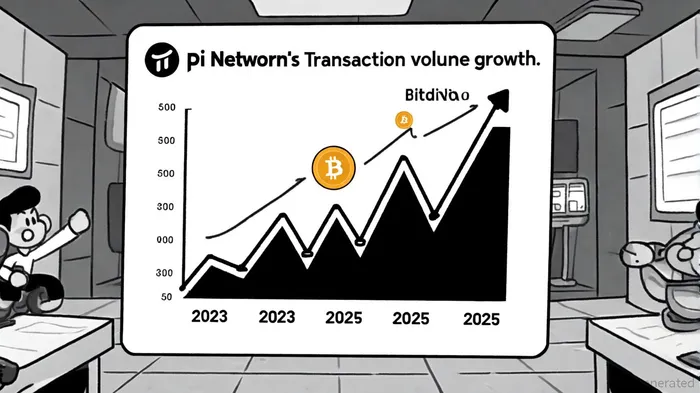
Pi Network's 60 million registered users represent a formidable user base, but transaction volume remains a critical bottleneck. Data from Disruption Banking reveals that Pi's daily transactions lag far behind BitcoinBTC-- and SolanaSOL--, with skeptics attributing this to its KYC process, which requires users to submit biometric data[2]. While the Open Network's February 2025 launch enabled external transactions and dApps like Pi Exchange, the transition has been met with mixed market reactions. Initial price surges were followed by corrections, partly due to high sell pressures from early adopters[2]. This volatility underscores a broader challenge: Pi must balance user growth with liquidity depth to avoid becoming a speculative asset rather than a functional currency.
Technological Integration and Market Positioning
Pi's integration with blockchain-based domains and decentralized applications (dApps) aligns with broader trends in DeFi and AI-driven crypto tools[2]. However, the project faces stiff competition from established players. Bitcoin's projected price surge to $150,000 by year-end—driven by ETF approvals and institutional adoption—highlights the dominance of legacy assets[1]. Meanwhile, tokenization of traditional assets by firms like BlackRock and Fidelity is reshaping investor preferences, leaving Pi to carve a niche in underserved markets. Its focus on small businesses in developing regions, where Pi is accepted as a payment method, could serve as a differentiator—if infrastructure challenges are addressed[2].
Price Potential: Realism Over Hype
Experts estimate a 60% likelihood that Pi could establish a niche in the regulated digital economy, provided it streamlines KYC processes and enhances real-world utility[2]. However, price projections remain speculative. Unlike Bitcoin, which benefits from ETF-driven liquidity, Pi's market cap remains fragmented, with limited institutional interest. A CoinBuzzNow analysis notes that Pi's price corrections post-Open Network launch reflect broader market skepticism about its scalability[1]. For Pi to achieve meaningful price appreciation, it must demonstrate sustained transaction velocity and attract partnerships with traditional financial institutions—a feat complicated by its current liquidity constraints.
Conclusion: A Project in Transition
Pi Network's long-term viability hinges on its ability to adapt to a rapidly evolving regulatory landscape while addressing user adoption bottlenecks. While its open network and dApp ecosystem signal progress, the project must overcome liquidity challenges and differentiate itself in a market increasingly dominated by institutional-grade assets. For investors, Pi represents a high-risk, high-reward proposition—its success will depend not on speculative fervor but on its capacity to integrate with traditional finance and deliver tangible utility.







Comentarios
Aún no hay comentarios