
Pi Network's Emerging Institutional Credibility and Scalability Potential: A Transition to Investment-Grade Infrastructure
Pi Network, once a grassroots mobile-mining experiment, is rapidly evolving into a Web3 infrastructure platform with institutional-grade capabilities. By 2025, the project has demonstrated a clear trajectory toward scalability, compliance, and enterprise adoption, positioning itself as a contender in the race for blockchain-driven financial and technological ecosystems. This analysis evaluates Pi's transition from speculative hype to a robust, investment-grade infrastructure, supported by recent technological upgrades, strategic partnerships, and tokenomic adjustments.
Technological Foundations: Scalability and Enterprise Readiness
Pi Network's 2025 infrastructure upgrades have been pivotal in addressing scalability concerns that previously hindered institutional adoption. The integration of Stellar Core v23.0.1 has elevated the network's transaction throughput to over 1,000 transactions per block, enabling high-volume operations in sectors like finance and logistics, according to a Hokanews report. This leap in performance aligns Pi with enterprise-grade standards, as highlighted by the Hokanews report, which notes that the upgrade "positions Pi as a viable backbone for decentralized applications and payment systems."
Further, the release of Pi Node Linux in August 2025 has streamlined infrastructure deployment for partners and service providers. By offering standardized node software compatible with Linux environments, Pi eliminates the need for custom builds, enhancing network stability and reducing operational friction, as the Hokanews report also notes. These advancements are complemented by Protocol 23, which introduces secure smart contract execution and decentralized KYC enforcement, directly addressing institutional concerns around compliance and reliability, according to Hokanews.
Strategic Partnerships: Bridging the Gap to Institutional Adoption
Pi's institutional credibility has been bolstered by high-profile collaborations. In September 2025, the network partnered with Sign Protocol, an Ethereum-based digital verification platform, signaling potential pathways for listings on major exchanges, according to a PiBazar article. Additionally, Pi became the first token listed on Payochain, a mobile blockchain platform, marking a milestone for accessibility in emerging markets.
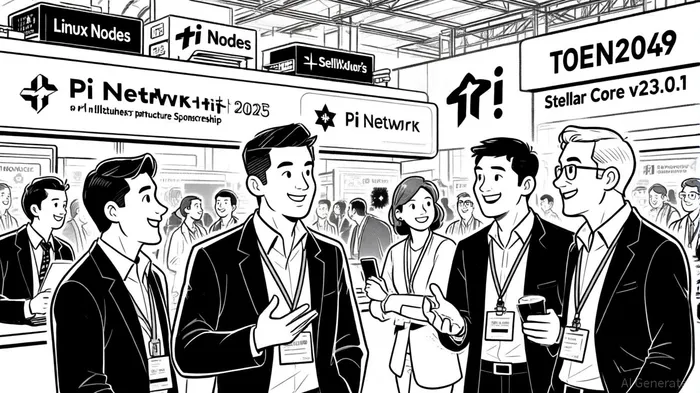
The project's visibility has also surged through events like its Gold Sponsorship at TOKEN2049 Singapore, one of the most influential Web3 conferences. This move underscores Pi's transition from a community-driven project to a globally recognized platform. Meanwhile, the Fast Track KYC feature, which allows users to bypass the previous 30-mining-session requirement for identity verification, has further streamlined onboarding for institutional clients.
Tokenomics and Market Positioning
Pi Network's tokenomics have evolved to prioritize scarcity and long-term value creation. A reduction in the base mining rate has been implemented to curb oversupply, a strategy analyzed by The Coin Republic as a "critical step toward establishing deflationary pressure and investor confidence." This adjustment aligns with broader trends in institutional-grade assets, where controlled supply dynamics are essential for price stability.
The launch of the .pi Domains Auction in 2025 has added a platform-level utility, leveraging Pi as the exclusive currency for blockchain-based domain purchases. The initiative was introduced on Pi Day 2025, and it notNOT-- only diversifies the token's use cases but also attracts enterprises seeking decentralized identity solutions.
Future Outlook: Consensus 2025 and Beyond
Pi Network's upcoming participation in Consensus 2025 is poised to be a watershed moment. As reported by a Beincrypto report, the project aims to secure strategic partnerships and showcase its decentralized economy, including Pi-powered marketplaces and identity services. These developments, coupled with ongoing protocol upgrades (Testnet1, Testnet2, and Mainnet), suggest a roadmap toward real-world asset integration and AI-driven applications, as Hokanews observed.
Despite internal community tensions and price volatility, Pi's focus on infrastructure and compliance has attracted institutional interest. A report by Yahoo Finance highlights that entities are increasingly viewing Pi not as a speculative asset but as a "transparent and scalable model suitable for financial services."
Conclusion
Pi Network's 2025 advancements demonstrate a clear shift from grassroots adoption to investment-grade infrastructure. By addressing scalability, compliance, and enterprise integration, the project has laid the groundwork for institutional collaboration. While challenges remain-such as regulatory scrutiny and market competition-Pi's strategic partnerships, technological upgrades, and tokenomic adjustments position it as a compelling case study in the evolution of Web3 infrastructure. Investors and institutions alike should monitor its progress at Consensus 2025 and beyond, as the network's ability to deliver on its vision will determine its long-term viability in the competitive blockchain landscape.






Comentarios
Aún no hay comentarios