
Pi Network's DEX and AMM: A New Frontier for DeFi or a Hype-Driven Mirage?
The Rise of Pi Network's DeFi Ecosystem
Pi Network's recent launch of a decentralized exchange (DEX) and automated market makerMKR-- (AMM) on its Testnet marks a pivotal shift in its evolution from a mobile mining experiment to a functional Web3 ecosystem. These tools, now live on the Pi Testnet, allow developers and community members to experiment with token swaps, liquidity pools, and token creation using Test-Pi tokens, as described in the Pi Testnet announcement. By providing a risk-free environment for innovation, Pi Network aims to bridge the gap between retail users and DeFi, fostering financial literacy while testing governance, security, and utility before Mainnet deployment, according to a JituMaster analysis.
The DEX and AMM are protocol-level features integrated into the Pi blockchain, enabling trustless transactions and dynamic pricing mechanisms through liquidity pools. Unlike traditional order-book exchanges, Pi's AMM model relies on algorithmic pricing, incentivizing liquidity providers with fee shares and governance tokens. This approach mirrors established DeFi platforms like UniswapUNI-- but introduces a unique emphasis on community-driven development and educational experimentation, as reported by HokaNews.
Technical Advantages and Disruption Potential
PiDaoSwap, the first DEX on Pi's Open Mainnet, leverages an improved Directed Acyclic Graph (DAG) protocol to achieve 500 TPS on Testnet-far surpassing the throughput of traditional blockchain-based DEXs, according to a PiDaoSwap analysis. This technical innovation, combined with cross-chain bridging via LayerZeroZRO--, positions Pi Network to compete with interoperable platforms like BNBBNB-- Chain and EthereumETH--. The DAG architecture also reduces latency, making high-frequency trading and real-time liquidity provision feasible in a decentralized framework.
Moreover, Pi's focus on DAO governance and fee-sharing models could attract retail investors seeking passive income. For instance, liquidity providers on PiDaoSwap earn 0.3% of transaction fees and PDO token rewards, while a deflationary mechanism burns 0.5% of fees to counter inflation, the same analysis notes. These incentives align with the principles of community ownership, a stark contrast to the speculative dynamics of memecoinMEME-- ecosystems.
Retail Investor Appeal and Challenges
Pi Network's massive user base-over 60 million registered users and 13 million KYC-verified Pioneers-provides a unique advantage in driving organic adoption. Unlike traditional DeFi platforms that rely on external marketing, Pi's ecosystem is built on a pre-existing community familiar with its value proposition. The testnet environment further lowers barriers to entry, allowing users to experiment with DeFi mechanics without financial risk, as outlined in an OKX guide.
However, skepticism persists. Critics highlight Pi's closed Mainnet status, regulatory uncertainties, and the lack of real-world utility for Pi Coin. While the Open Mainnet launched in February 2025, enabling external connectivity and exchange listings, the token's price volatility and token concentration among a small number of wallets remain unresolved issues, according to a Picoins report. Additionally, the absence of specific adoption metrics for the DEX/AMM-such as transaction volumes or active users-makes it difficult to quantify retail engagement, notes a BitJournal piece.
Comparative Analysis: Pi vs. Traditional DeFi
Traditional DeFi platforms like Uniswap and PancakeSwapCAKE-- prioritize open access and rapid innovation but often lack the educational focus and risk mitigation strategies embedded in Pi's approach. Pi's testnet-first model mirrors traditional finance's emphasis on safety and gradual adoption, potentially attracting risk-averse retail investors. Furthermore, Pi's integration of .pi domains and the Pi Ad Network into its financial infrastructure underscores its ambition to create a self-sustaining ecosystem, as discussed in a DailyCoin article.
Yet, Pi faces stiff competition. Projects like MAGAX have demonstrated that immediate utility and presale incentives can capture retail attention more effectively than prolonged testnet phases. For Pi to succeed, it must demonstrate that its cautious, community-driven strategy can scale into a robust Mainnet ecosystem without succumbing to speculative hype, as argued in an Analytics Insight article.
Conclusion: A Calculated Bet on the Future
Pi Network's DEX and AMM represent a bold step toward redefining DeFi accessibility. By combining technical innovation with a massive, engaged user base, Pi has the potential to disrupt traditional models by democratizing financial tools for retail investors. However, the project's long-term success hinges on addressing liquidity challenges, regulatory scrutiny, and the need for tangible Mainnet utility.
For investors, Pi's journey offers both opportunity and risk. The testnet phase has laid a solid foundation, but the true testTST-- lies in Mainnet deployment and real-world adoption. As the DeFi landscape evolves, Pi's ability to balance innovation with stability will determine whether it becomes a transformative force or a cautionary tale.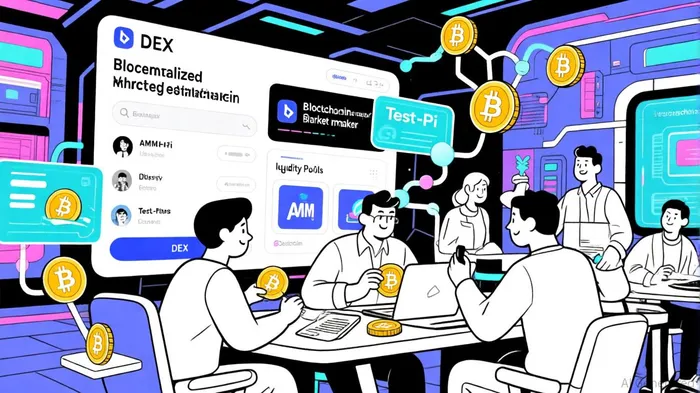






Comentarios
Aún no hay comentarios