
Pi Coin's Valuation Risks Amid Weak Community-to-Usage Transition
The transition of Pi Coin (PI) from a community-driven mobile mining project to a functional cryptocurrency has been a tale of ambition and uncertainty. Launched in 2019 with a vision to democratize access to blockchain, Pi Network's 2025 mainnet launch marked a pivotal shift, enabling token transfers and ecosystem participation. Yet, despite over 70 apps and merchant adoption in 155 countries, the token's utility remains underdeveloped, and its liquidity constraints persist as a critical risk. This analysis unpacks the structural challenges Pi faces in bridging the gap between speculative hype and real-world adoption.
Token Utility Gaps: Beyond the Hype
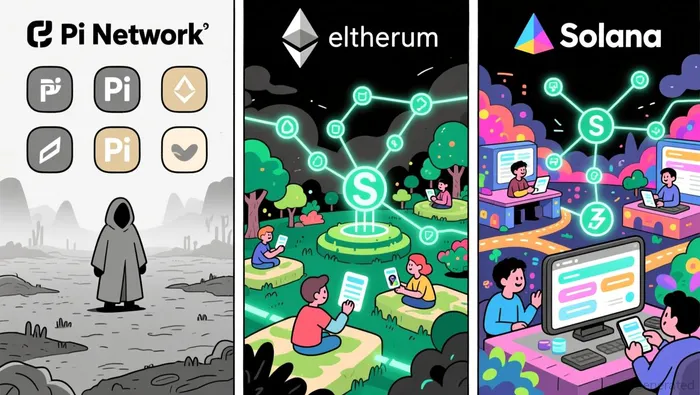
Pi Network's roadmap emphasizes building a decentralized ecosystem with smart contracts and dApps. By Q4 2025, 47 dApps were in development, including privacy-focused platforms like Blind_Lounge and loyalty programs like Starmax according to CoinMarketCap. However, these projects lack the scale or innovation to rival established platforms on EthereumETH-- or SolanaSOL--. The PiFest 2025 event, which saw 1.8 million users engage in local commerce transactions, highlighted incremental progress but failed to address the core issue: Pi's token utility remains abstract.
Experts argue that Pi's utility is constrained by its reliance on speculative demand rather than functional use cases. For instance, while the network claims 60 million users, blockchain explorers only record 9.11 million active wallets according to CCN analysis. This discrepancy raises questions about the authenticity of its user base and the token's ability to drive meaningful economic activity. Unlike Bitcoin's scarcity-driven model or Ethereum's DeFi infrastructure, Pi's value proposition hinges on unproven assumptions about merchant adoption and dApp scalability as discussed in Gate's comparison.
Liquidity Constraints: A Volatility Time Bomb
Pi's liquidity struggles are exacerbated by its tokenomics. By January 2025, the total supply migrated to the mainnet had surged to 5.56 billion, with only 659.88 million remaining locked-a 36.61% increase in three months according to CCN analysis. This rapid inflationary pressure, combined with daily token unlocks, has created a bearish technical environment. The price peaked at $3 in March 2025 but plummeted to $0.4430 by July 2025, reflecting weak demand and liquidity.
Exchange listings on platforms like OKX and Bitget have provided some visibility, but Pi remains a niche asset. Unlike Bitcoin's $1 trillion market cap or Ethereum's institutional adoption, Pi's liquidity is fragmented and speculative. A recent transfer of 2 million PI tokens from the core team's liquidity reserve further intensified bearish sentiment, with technical indicators like RSI and MACD showing growing downward momentum according to FXStreet. Analysts warn that without major exchange listings (e.g., Binance or Coinbase), Pi's liquidity will remain a bottleneck, limiting its ability to attract institutional capital according to Pintu's analysis.
Comparative Valuation: Pi vs. Bitcoin/Ethereum
Pi's valuation challenges become stark when compared to BitcoinBTC-- and Ethereum. Bitcoin's fixed 21 million supply underpins its scarcity narrative, while Ethereum's institutional adoption-bolstered by spot ETFs and growing staking yields-has driven its fair value to $3,496.5–$9,500, according to 2025 models according to MEXC analysis. In contrast, Pi's undefined total supply and lack of regulatory clarity make it a high-risk asset.
Ethereum's Metcalfe's Law valuation model suggests it is undervalued by over 213%, reflecting its robust dApp ecosystem and on-chain activity according to MEXC analysis. Pi, meanwhile, lacks comparable metrics. Its price is driven by community sentiment and speculative trading, with no clear link to on-chain utility or revenue generation according to CoinFomania comparison. This divergence underscores Pi's fundamental weakness: it operates in a vacuum where token value is decoupled from economic fundamentals.
Regulatory and Structural Risks
Regulatory uncertainty further compounds Pi's challenges. While the network has introduced AI-enhanced KYC processes and ISO 20022 compliance goals, its partially open-sourced codebase and centralized node control raise red flags according to Coinpedia. In a market where transparency is paramount, Pi's opacity could deter institutional adoption. Additionally, the U.S. GENIUS Act and EU's MiCA framework have raised the bar for compliance, making it harder for projects like Pi to gain legitimacy .
Conclusion: A High-Risk Bet
Pi Coin's 2025 journey illustrates the perils of prioritizing community growth over utility. While events like PiFest and dApp development signal incremental progress, the token's valuation remains precarious. Liquidity constraints, inflationary pressures, and regulatory uncertainties create a perfect storm for volatility. For investors, Pi represents a high-risk, high-reward proposition-dependent on catalysts like major exchange listings or breakthrough dApps. Until then, it remains a speculative asset with limited real-world utility.





Comentarios
Aún no hay comentarios