
Pi Coin's Stagnation vs. Bitcoin and Ethereum's Growth: A 2025 Investment Analysis
In 2025, the cryptocurrency market remains a theater of divergent narratives. BitcoinBTC-- (BTC) and EthereumETH-- (ETH) continue to cement their dominance as pillars of institutional adoption and technological innovation, while Pi Coin (PI) lingers in the shadows, a project caught between aspirational vision and structural limitations. This analysis dissects the market dynamics and project fundamentals underpinning Pi Coin's stagnation versus the growth trajectories of Bitcoin and Ethereum, offering insights for investors navigating the evolving digital asset landscape.
Market Performance and Investor Sentiment: A Tale of Two Paradigms
Bitcoin and Ethereum have stabilized post-2021 booms, with BTCBTC-- trading at $117,554 and ETHETH-- at $4,604.79 in 2025, their market caps reaching $2.34 trillion and $555.19 billion, respectively, according to a PiCoins analysis. Institutional adoption has been a key driver, with CoinBird data projecting Bitcoin ETFs to accumulate $48 billion in net inflows and Ethereum ETFs $28.5 billion. Retail investors, meanwhile, view Bitcoin as a "digital gold" store of value and Ethereum as the backbone of Web3 innovation, per a Currency Analytics report.
Pi Coin, by contrast, trades between $0.26 and $0.62, with a market cap of $2.2–4.35 billion, per a Gate price analysis. Its 24-hour trading volume ($51.58 million) pales against Bitcoin's $58 billion and Ethereum's $43.73 billion, as noted in the PiCoins analysis. Investor sentiment is split: while Pi's mobile-first mining and StellarXLM-- Consensus Protocol (SCP) attract grassroots adoption, its lack of liquidity, delayed mainnet launch, and unresolved KYC issues have bred skepticism, according to OKX coverage. A recent survey noted that 98% of UAE investors plan to increase crypto holdings in 2025, but their allocations skew heavily toward Bitcoin and Ethereum, as the Currency Analytics report found.
Technical and Structural Limitations: Why Pi Struggles to Scale
Pi Coin's SCP aims to balance energy efficiency with accessibility, enabling smartphone mining without specialized hardware, the PiCoins analysis notes. However, this model relies on a federated trust system, where nodes must agree on a common set of trusted validators-a departure from Bitcoin's decentralized PoW and Ethereum's PoS, as highlighted in a Medium analysis. While SCP reduces energy consumption by 99.7% compared to Bitcoin, per a CoinPedia report, it introduces centralization risks, as the Pi Core Team reportedly controls a majority of the token supply, according to CoinEdition coverage.
Bitcoin's PoW, despite its energy inefficiency, remains a proven security model with a 59.9% market dominance, as CoinBird data shows. Ethereum's post-Merge PoS transition has enhanced scalability, processing 12-second block times and reducing energy use by 99%, based on CoinLaw statistics. Pi, however, operates on an enclosed mainnet where tokens are non-transferable and restricted to internal apps, stifling real-world utility, according to a CoinPedia analysis. This structural rigidity contrasts with Ethereum's DeFi and NFT ecosystems, which drive transactional demand and staking yields, as the PiCoins analysis observes.
Project Fundamentals: Roadmap Delays and Regulatory Hurdles
Pi Network's roadmap has been marred by delays. The project, which launched in 2019, transitioned to an "Open Network" in 2025, allowing listings on exchanges like Bitget and OKX, as detailed in Coindoo coverage. Yet, its Open Mainnet-promised to enable full decentralization and token transfers-remains unlaunched, with October 2025 touted as a potential turning point in a HokaNews report. Meanwhile, KYC bottlenecks have left users unable to migrate tokens, with some losing holdings due to hard deadlines, a situation CoinEdition reported.
Bitcoin and Ethereum, by contrast, have matured through iterative upgrades. Bitcoin's halving events and Ethereum's layer-2 solutions (e.g., ArbitrumARB--, Optimism) have reinforced their roles as foundational assets, as CoinBird notes. Institutional confidence is further bolstered by regulatory clarity in the U.S. and EU, with CoinDesk analysis citing JPMorgan that 25% of Bitcoin ETPs are now held by institutions.
Long-Term Implications for Digital Asset Strategy
For investors, the contrast between Pi Coin and its peers underscores the importance of liquidity, utility, and governance. Bitcoin's role as a store of value and Ethereum's smart contract dominance position them as low-risk, high-conviction assets. Pi Coin, while appealing to accessibility-focused retail users, remains speculative, with its success hinging on resolving decentralization, liquidity, and regulatory challenges, per a Gate comparison.
Institutional capital is flowing toward projects with clear tokenomics and proven ecosystems. Bitcoin's capped supply and Ethereum's dynamic staking yields offer predictable value accrual, whereas Pi's undefined tokenomics and reliance on community trust introduce volatility, as Coindoo coverage observed. For long-term strategies, this suggests allocating to Bitcoin and Ethereum as core holdings while treating Pi as a high-risk, high-reward satellite asset-provided it delivers on its 2025 roadmap.
Conclusion
The 2025 crypto landscape is defined by two realities: established leaders like Bitcoin and Ethereum, and aspirants like Pi Coin. While Pi's mobile-first approach democratizes access, its structural limitations-enclosed mainnet, unresolved KYC, and centralization risks-hinder scalability. Investors must weigh Pi's potential for mass adoption against the proven resilience of Bitcoin and Ethereum. As the market matures, fundamentals will increasingly dictate outcomes, favoring projects that balance innovation with institutional-grade security and utility.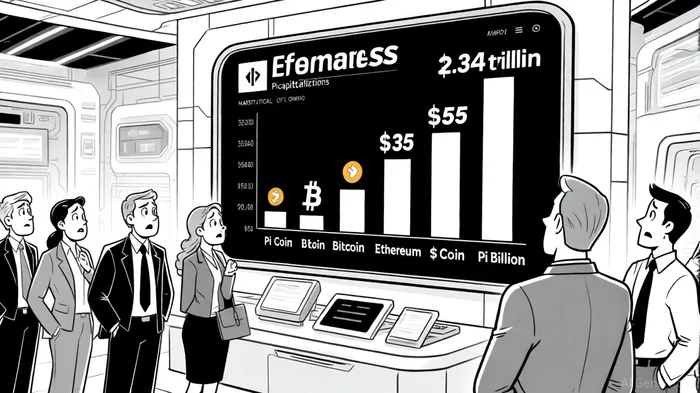






Comentarios
Aún no hay comentarios