
Is Pi Coin Poised for a Major Breakout Amid Strengthening Fundamentals?
Technical Catalysts: From Mobile Mining to Mainnet Maturity
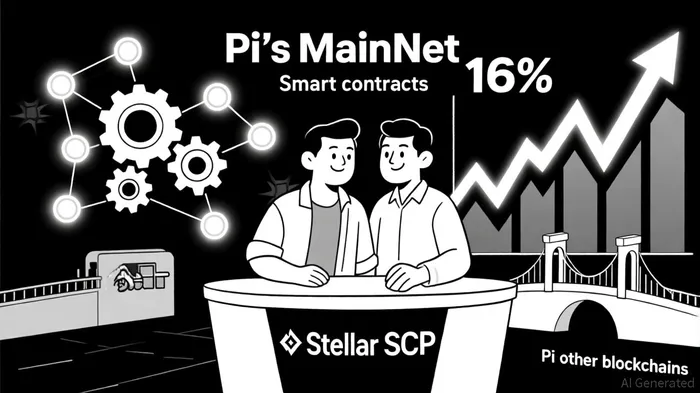
Pi Network's journey from a mobile-mining experiment to a blockchain with smart contract capabilities has been anything but linear. The Testnet2 v23 upgrade, activated in Q3 2025, marks a pivotal inflection point. This update introduced Stellar SCP compatibility, enabling cross-chain interoperability and laying the groundwork for decentralized finance (DeFi) tools, as noted by CoinEdition. For context, Stellar's consensus protocol is already used by major financial institutions for cross-border payments, suggesting Pi is borrowing battle-tested infrastructure to avoid reinventing the wheel.
The upgrade also unlocked smart contract functionality, a critical step for Pi to transition from a speculative asset to a utility token. Developers can now deploy decentralized applications (dApps) on Pi's network, opening the door to lending protocols, NFT marketplaces, and more. This mirrors Ethereum's early days but with a key difference: Pi's user base is already massive. Over 3.36 million Pioneers have completed KYC verification, and 2.69 million have migrated to the Pi Mainnet, according to the CoinEdition report. That's not just a community-it's a ready-made audience for dApps.
Strategic Partnerships: Building a Real-World Ecosystem
Technical upgrades alone aren't enough to drive mass adoption. Pi Network has been methodically building partnerships to turn PI into a usable currency. According to a Bitget report, Pi has integrated with wallet providers like Bitget Wallet, enabling users to store and transact with PI securely. This is critical for liquidity-without a reliable wallet, even the most innovative blockchain is just a toy.
The network has also partnered with e-commerce platforms and crypto payment gateways, allowing users to spend PI on goods and services. For example, collaborations with DeFi projects are enabling yield-generating opportunities, while educational platforms are onboarding new users through tutorials and certifications, the Bitget report explains. These partnerships aren't just checkmarks; they're designed to create a flywheel effect. The more use cases for PI, the more value it accrues, which in turn attracts more partners and developers.
What's particularly compelling is Pi's partner selection criteria: reputation, regulatory compliance, and technical compatibility, as highlighted by Bitget. This isn't a wild west experiment-it's a calculated effort to build trust with institutions and users alike.
Fundamental Risks and the Road Ahead
Despite the progress, Pi still faces headwinds. Regulatory scrutiny remains a wildcard, especially as it moves toward global mainnet launch. Additionally, competition from established blockchains like SolanaSOL-- and CardanoADA-- is fierce. However, Pi's unique value proposition-a user-first approach with a pre-built community-gives it an edge.
For investors, the key question is whether Pi can maintain its momentum. The Testnet2 v23 upgrade and partnerships have created a foundation, but execution will determine long-term success. If the network can onboard even a fraction of its 3.36 million verified users into DeFi or e-commerce ecosystems, PI's price could see exponential growth.
Conclusion: A Breakout Candidate or a Hyped Hare?
Pi Coin's Q3 2025 surge isn't a fluke-it's the result of strategic technical upgrades and partnerships that address real-world use cases. While risks remain, the alignment of fundamentals and user adoption suggests Pi is no longer just a moonshot. For investors willing to bet on a project that's building from the ground up, Pi could be the next big breakout.
As always, due diligence is key. But in a crypto landscape dominated by speculative tokens, Pi's focus on utility and community might just be its secret weapon.






Comentarios
Aún no hay comentarios