
Phreesia, Inc. (PHR): Strategic Positioning in the Evolving Healthcare Data and Patient Engagement Market
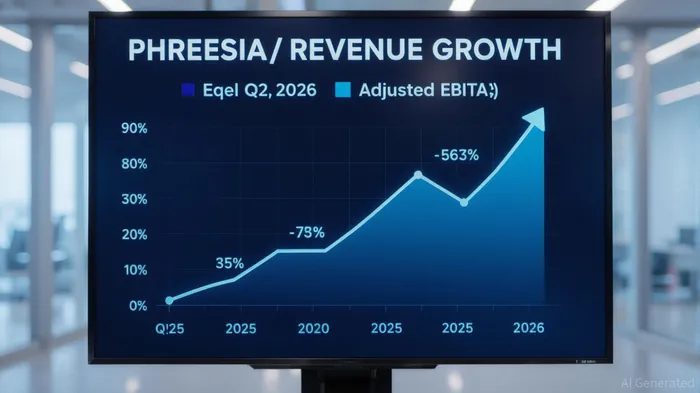
Phreesia, Inc. (NYSE: PHR) has emerged as a compelling case study in the healthcare data and patient engagement sector, with its Q2 2026 earnings call underscoring both operational progress and strategic ambition. The company reported $117.3 million in revenue for the quarter, a 15% year-over-year increase, alongside its first-ever GAAP net income of $700,000 and adjusted EBITDA of $22 million (19% margin) [1]. These metrics signal a pivotal shift from historical net losses to profitability, a transformation driven by disciplined cost management and a growing contribution from high-margin segments like network solutions, which saw 25% year-over-year growth [1].
Strategic Expansion: The AccessOne Acquisition and TAM Expansion
Phreesia’s $160 million acquisition of AccessOne, expected to close in Q3 or Q4 2026, represents a calculated move to expand its total addressable market (TAM) by $6 billion, bringing the total to $24 billion [1]. AccessOne’s $35 million in annualized revenue and $11 million in adjusted EBITDA are not just incremental—they reflect Phreesia’s ability to integrate complementary assets without assuming financial risk, as CEO Chaim Indig emphasized that PNC Bank and healthcare providers bear payment plan risks [1]. This risk mitigation is critical in a sector where patient financing models are increasingly scrutinized for compliance and liquidity.
The acquisition aligns with broader industry trends. The global patient engagement technology market is projected to reach $49.6 billion by 2026, driven by demand for tools that streamline revenue cycles and improve patient adherence [2]. Phreesia’s expansion into healthcare financing via AccessOne positions it to capture a larger share of this growth, particularly as providers seek integrated solutions to reduce bad debt and administrative burdens.
Financial Health and Market Positioning
Phreesia’s financials reveal a company in transition. While it maintained a strong cash balance of $98.3 million as of Q2 2026 [1], its R&D expenses remain elevated at 27% of revenue, reflecting ongoing investments in AI-driven products like Voice AI [1]. This innovation pipeline is a double-edged sword: it strengthens Phreesia’s differentiation in a competitive landscape dominated by larger players like Epic Systems and Cerner but also raises questions about near-term profitability.
The company’s adjusted EBITDA outlook for 2026, raised to $87–92 million, suggests confidence in sustaining its momentum [1]. However, the 2% decline in healthcare services861198-- revenue per average client (to $17,481) in Q3 2025 highlights the challenge of scaling while maintaining pricing power [3]. This metric will be critical to monitor as PhreesiaPHR-- integrates AccessOne and expands its client base.
Industry Tailwinds and Risks
The healthcare data market is poised for robust growth, with the digital health sector projected to expand at a 22% CAGR through 2030 [4]. Phreesia’s focus on AI and telehealth aligns with these trends, particularly as generative AI in healthcare is expected to grow from $1.59 billion in 2023 to $23.07 billion by 2033 [3]. Yet, regulatory shifts and economic pressures—such as constrained provider budgets—pose risks. Phreesia’s reliance on healthcare systems for its SaaS platform makes it vulnerable to macroeconomic headwinds, a factor investors must weigh against its current growth trajectory.
Investment Thesis
Phreesia’s strategic positioning appears strong, but its investment viability hinges on execution. The AccessOne acquisition and AI monetization efforts demonstrate a clear path to TAM expansion and margin improvement. However, the company’s historical net losses and high R&D spend underscore the need for disciplined capital allocation. For investors, the key question is whether Phreesia can sustain its 15% revenue growth while converting operating leverage into consistent profitability.
Given the sector’s tailwinds and Phreesia’s first-mover advantage in monetizing AI tools, the stock offers a speculative but potentially rewarding opportunity. However, conservative investors may prefer to wait for clearer signs of EBITDA margin expansion and reduced R&D intensity before committing.
**Source:[1] Phreesia PHRPHR-- Q2 2026 Earnings Call Transcript [https://www.fool.com/earnings/call-transcripts/2025/09/04/phreesia-phr-q2-2026-earnings-call-transcript/][2] Phreesia Announces Second Quarter Fiscal 2026 Results [https://www.businesswire.com/news/home/20250904689827/en/Phreesia-Announces-Second-Quarter-Fiscal-2026-Results][3] Top 10 Healthcare Trends in 2025 [https://www.emergenresearch.com/blog/top-10-healthcare-trends-in-2025?srsltid=AfmBOorOk8sXALEyDNEuQrlXws4lrmwW3Xbb3qJjn7B_Y71bugR3NK64][4] Digital Health Market Size And Share | Industry Report, 2030 [https://www.grandviewresearch.com/industry-analysis/digital-health-market]





Comentarios
Aún no hay comentarios