
Phoenix Education Partners' IPO: Navigating Growth in China's Dynamic Education Sector
China's education sector is undergoing a seismic transformation, driven by government-led modernization, technological innovation, and shifting workforce demands. By 2025, the K-12 segment alone is valued at over $300 billion, while higher education and vocational training are projected to reach $120 billion and $100 billion, respectively, as detailed in China's 2025 education budget. The Ministry of Education's "Smart Education of China" initiative has accelerated digital adoption, with AI-driven platforms and STEM-focused curricula becoming central to policy priorities, according to a 2025 edtech analysis. This evolving landscape presents both opportunities and challenges for international players like PhoenixPHB-- Education Partners, which recently filed for a $100 million U.S. IPO under the ticker PXED, according to Reuters.
Phoenix's Business Model and Strategic Positioning
Phoenix Education Partners, the parent company of The University of Phoenix, operates as a mission-driven online education provider catering to working adults. Its AI-ready infrastructure and career-aligned programs have enabled it to serve 1.1 million alumni and confer 1.3 million degrees since 1976, according to a PXED stock profile. The company's recent financial performance-$750 million in revenue and $118 million in net income for the nine months ending May 2025-underscores its profitability, driven by cost-effective digital delivery models, as Reuters reported. Backed by ApolloAPO-- Global Management, Phoenix has positioned itself as a scalable player in post-secondary education, leveraging technology to bridge skill gaps in a rapidly changing labor market, as that edtech analysis noted.
However, Phoenix's U.S. operations have faced scrutiny. The University of Phoenix has settled legal disputes totaling $191 million with the FTC and $4.5 million with California's Attorney General, raising concerns about its historical practices, according to Higher Education Inquirer. These liabilities highlight the need for a cautious approach as the company explores international expansion, particularly in a highly regulated market like China.
China's Education Market: A Strategic Frontier
China's education sector is increasingly attractive to global investors, with the government approving 113 new transnational education (TNE) partnerships in 2025 alone, the British Council noted. These collaborations, concentrated in STEM disciplines and underdeveloped regions like Yunnan and Jiangxi, align with national goals to enhance technological innovation and regional economic balance, as ICEF Monitor reported. For Phoenix, this represents a potential entry point: its AI-driven platforms and vocational training programs could complement China's push for workforce upskilling.
Yet, market entry requires more than product fit. As Jun Zheng of Speexx China notes, success hinges on "meaningful partnerships" and localized strategies, as he outlines in a WorldDidac analysis. Phoenix's recent collaboration with Cengage Asia-establishing the Phoenix-NGL Selection Research Institute to train English educators-demonstrates its commitment to building trust in the Chinese market, described in a Phoenix-Cengage announcement. While this partnership is in publishing, it signals a broader willingness to engage with local stakeholders, a critical step for any international provider.
Challenges and Opportunities
Phoenix's path to growth in China is not without hurdles. The "double reduction" policy has disrupted after-school tutoring, pushing many providers underground, as that budget report noted. Meanwhile, competition from public universities, niche bootcamps, and global MOOCs like Coursera remains fierce. Regulatory scrutiny of for-profit education models further complicates expansion.
However, Phoenix's digital-first approach and Apollo's financial backing offer distinct advantages. Its AI-driven platforms could address China's growing demand for flexible, skills-based learning, particularly among working professionals. The company's IPO proceeds-targeting $100 million-could fund localized content development and strategic acquisitions in China's edutech ecosystem.
Conclusion: A Calculated Bet on Innovation
Phoenix Education Partners' IPO reflects a broader trend: the convergence of global education providers and China's digital transformation. While the company's U.S. legacy carries risks, its technological infrastructure and Apollo's resources position it to capitalize on China's $300 billion K-12 and $120 billion higher education markets. Success will depend on its ability to navigate regulatory complexities, form credible partnerships, and align its offerings with national priorities like STEM and vocational training. For investors, Phoenix's China strategy represents a high-reward, high-risk proposition-one that could redefine its role in the global education landscape.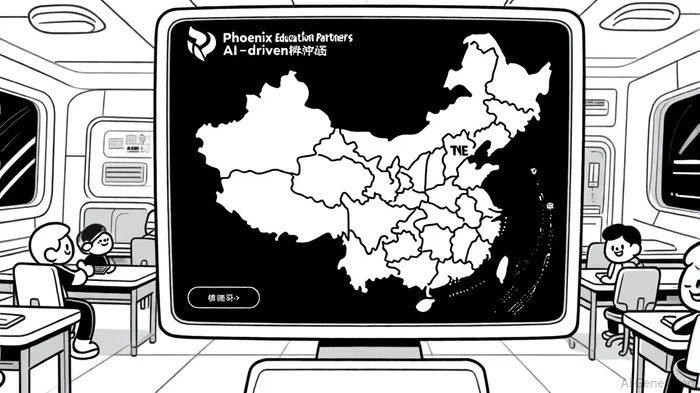







Comentarios
Aún no hay comentarios