
Phillips Edison & Company: Navigating the Post-Pandemic Real Estate Recovery with Strategic Agility
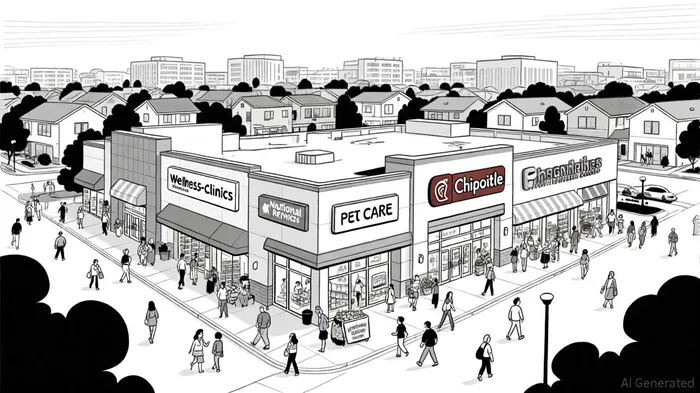
The post-pandemic commercial real estate landscape has been defined by rapid shifts in consumer behavior, supply chain adjustments, and a renewed emphasis on necessity-driven retail. Amid this evolving environment, Phillips Edison & CompanyPECO-- (PECO) has emerged as a strategic leader, leveraging its expertise in grocery-anchored shopping centers to capitalize on resilience and adaptability. By aligning with emerging trends such as the "PetTail" retail model and suburban retail migration, PECOPECO-- is positioning itself as a key player in the sector's recovery.
Strategic Adaptability in Retail Innovation
According to a report by Phillips EdisonPECO-- & Company, the firm has identified two transformative trends shaping 2025: the rise of "PetTail" services—where consumers seek integrated pet care and retail solutions—and the growing demand for wellness-focused brands in grocery-anchored centers[1]. These trends reflect a broader shift toward one-stop destinations that cater to both physical and mental health needs. For instance, national retailers like Chipotle and Chick-fil-A are expanding into suburban markets, adapting their traditional footprints to align with changing consumer preferences[1]. This strategic pivot underscores PECO's ability to anticipate and respond to market dynamics, ensuring its properties remain relevant in a post-pandemic world.
The "halo effect" of grocery anchors continues to drive consistent foot traffic, supporting ancillary tenants such as small businesses and service providers[1]. Phillips Edison's National Accounts and Emerging Trends team plays a critical role in identifying these shifts, enabling the firm to develop creative leasing strategies that enhance property value. For example, the acquisition of Clayton Station in a San Francisco suburb and Westgate Shopping Center in Cleveland—both anchored by major retailers—demonstrates PECO's focus on high-growth markets with strong tenant demand[2].
Financial Performance and Operational Resilience
PECO's Q2 2025 results highlight its operational strength, with a 4.2% year-over-year increase in same-center net operating income (NOI) to $114.5 million[1]. The company reported Nareit FFO of $86.0 million and Core FFO of $88.2 million, reflecting 9.8% and 10.3% growth, respectively, compared to Q2 2024[1]. These metrics underscore the firm's ability to maintain profitability despite macroeconomic headwinds.
Leased portfolio occupancy remains robust, with overall occupancy at 97.4% and same-center occupancy at 97.6%[1]. Phillips Edison executed new leases at a 34.6% rent spread and renewal leases at 19.1%, demonstrating pricing power in a competitive market[1]. However, the company faces challenges, including a 17.3% quarter-over-quarter increase in interest expense to $27.7 million, driven by a rise in net debt to $2.45 billion[2]. This has pushed the Net Debt to Adjusted EBITDAre ratio to 5.4x, up from 5.0x in prior periods[2].
Acquisition Pipeline and Long-Term Value Creation
PECO's aggressive acquisition strategy in 2025 further solidifies its market position. During Q2, the firm acquired six shopping centers for $133.3 million, including properties like Westgate Shopping Center and Clayton Station[2]. Additionally, a joint venture with Cohen & Steers Income Opportunities REIT, Inc. led to the acquisition of Oak Grove Shoppes in Orlando, Florida, a Publix-anchored property[3]. These investments align with PECO's focus on necessity-based retail and its target of $350 million to $450 million in gross acquisitions for 2025[4].
The company's acquisition pipeline has seen a 50% increase in deal flow compared to the previous year, reflecting strong confidence in the grocery-anchored sector[4]. By targeting strategic locations with high occupancy rates and strong tenant demand, PECO aims to drive long-term value creation. For instance, the acquisition of Westgate Shopping Center—anchored by Target—highlights the firm's ability to secure properties with established retail gravitas[2].
Challenges and Risk Mitigation
Despite its successes, PECO must navigate risks such as rising interest rates and potential softening in rental growth. A 9.8% decline in average base rent per square foot for new leases suggests pressure on future income streams[2]. However, the company's emphasis on necessity-driven retail and its robust tenant base provide a buffer against economic volatility. Management has also increased full-year 2025 earnings guidance, projecting 6.3% growth in Nareit FFO and 6.0% in Core FFO[1], signaling confidence in its ability to mitigate these risks.
Conclusion
Phillips Edison & Company's strategic positioning in the post-pandemic commercial real estate recovery is a testament to its agility and foresight. By capitalizing on trends like the "PetTail" model and suburban retail migration, while maintaining strong financial discipline, PECO is well-positioned to navigate macroeconomic uncertainties. Its focus on grocery-anchored properties, coupled with a robust acquisition pipeline, ensures continued relevance in a sector defined by adaptability. For investors, PECO represents a compelling opportunity to participate in the long-term resilience of necessity-driven retail.





Comentarios
Aún no hay comentarios