
Phillips 66's Strategic Acquisition of WRB Refining: A Catalyst for Enhanced Margins and Shareholder Value
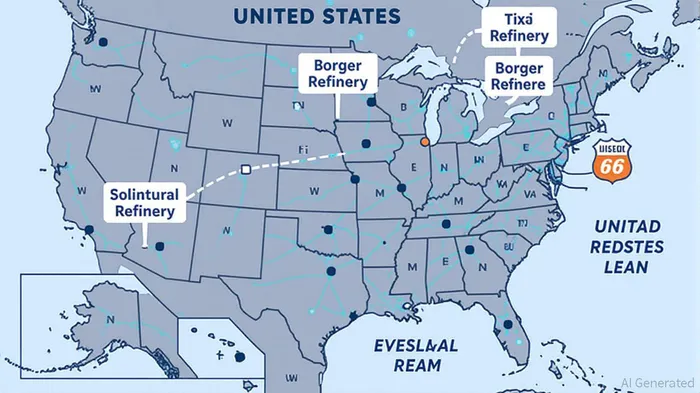
In September 2025, Phillips 66PSX-- announced a transformative move in its refining strategy: the $1.4 billion acquisition of the remaining 50% stake in WRBWRB-- Refining LP from Cenovus Energy Inc.CVE-- . This transaction grants the company full ownership of the Wood River refinery in Illinois and the Borger refinery in Texas, two assets with combined crude throughput capacity of 495,000 barrels per day . The deal, expected to close by year-end, underscores Phillips 66's commitment to leveraging operational and financial synergies to bolster margins and unlock shareholder value.
Operational Synergies: Integration and Efficiency Gains
The acquisition eliminates the complexities of joint-venture governance, enabling full integration of WRB's assets into Phillips 66's value chain. According to the company, this integration is projected to generate $50 million in annual operational and commercial synergies by optimizing logistics, refining processes, and product distribution . The Wood River and Borger refineries, which have processed heavy and medium sour crudes alongside light sweet crudes since 2007, are uniquely positioned to capitalize on Phillips 66's downstream infrastructure, including its extensive pipeline network and marketing channels .
Moreover, the transaction unlocks opportunities for low-capital, high-return projects. For instance, Phillips 66 has historically reduced refining costs by $1 per barrel through business transformation initiatives . With full ownership, the company can accelerate such efforts, including advanced analytics for predictive maintenance and energy efficiency upgrades. These measures align with Phillips 66's broader strategy to achieve a 98% crude utilization rate, as demonstrated in Q2 2024 .
Financial Synergies: EBITDA Growth and Debt Management
Financially, the acquisition is a calculated bet on refining sector resilience. Phillips 66's 2025 capital budget allocates $822 million for refining operations, with $408 million earmarked for growth projects at WRB and other assets . These investments are expected to drive EBITDA expansion, building on prior successes such as the $1.5 billion in run-rate savings from the DCP Midstream integration . While specific EBITDA contributions from WRB are not disclosed, the company's 2025 guidance targets $14 billion in EBITDA, reflecting confidence in its integrated model .
The $1.4 billion cash consideration is also fiscally prudent. As of June 30, 2025, Phillips 66 held $1.1 billion in cash and $3.7 billion in committed credit facilities, providing ample flexibility to fund the deal without overleveraging . This aligns with the company's disciplined approach to debt reduction, exemplified by its $5.3 billion in shareholder returns in 2024 . By prioritizing debt reduction and cost efficiency, Phillips 66 aims to maintain a robust balance sheet while returning over 50% of operating cash flow to shareholders .
Strategic Alignment and Market Implications
The WRB acquisition reinforces Phillips 66's focus on downstream dominance in key U.S. markets. The Wood River refinery, located near the Illinois River, benefits from low-cost crude access via the Cushing hub, while the Borger refinery in Texas serves the Permian Basin's growing production. Full ownership allows Phillips 66 to optimize feedstock procurement and refine crude slates dynamically, enhancing margins in volatile markets.
Market reactions have been largely positive. The deal's announcement coincided with a 3% rise in Phillips 66's stock price, reflecting investor confidence in the company's ability to execute synergies. Analysts at Bloomberg note that the acquisition positions Phillips 66 to outperform peers in refining margins, particularly as U.S. transportation fuel demand remains resilient .
Conclusion
Phillips 66's acquisition of WRB Refining is a masterclass in strategic asset consolidation. By securing full ownership of two high-capacity refineries, the company is poised to amplify operational efficiencies, drive EBITDA growth, and maintain its leadership in the downstream sector. As the energy transition reshapes the industry, Phillips 66's focus on refining optimization and disciplined capital allocation offers a blueprint for sustainable shareholder value creation.





Comentarios
Aún no hay comentarios