
The Philippines' Regulatory Crackdown on Unlicensed Crypto Platforms: Implications for Global Market Access and Investor Behavior
The Philippines' 2025 regulatory crackdown on unlicensed crypto platforms has reshaped the regional digital asset landscape, triggering a recalibration of global investor strategies and accelerating the migration of capital toward compliant markets like Singapore and Vietnam. This shift underscores the growing importance of regulatory clarity in Southeast Asia's crypto ecosystem, where fragmented frameworks and evolving policies are redefining risk profiles and investment opportunities.
Regulatory Risk Assessment: The Philippine Crackdown
The Bangko Sentral ng Pilipinas (BSP) and the National Telecommunications Commission (NTC) have taken decisive action to block access to 50 unregistered online trading platforms, citing risks to financial stability and consumer protection. This move, underpinned by amendments to the Manual of Regulations for Non-bank Financial Institutions (BSP Circular No. 1206, 2024), reflects a broader effort to centralize oversight of virtual asset service providers (VASPs) and eliminate unregulated intermediaries. The NTC emphasized that the crackdown was coordinated with enforcement agencies to mitigate fraud and scams, which had proliferated in the absence of a unified regulatory framework.
For global investors, the Philippine experience highlights the volatility of operating in jurisdictions with inconsistent enforcement. While the crackdown aims to protect retail investors, it has also created uncertainty for market participants accustomed to a more permissive environment. The sudden closure of unregistered platforms has disrupted liquidity and forced users to seek alternatives, often in neighboring markets with clearer regulatory pathways.
Investor Behavior Shifts: From Ambiguity to Compliance
The regulatory vacuum in the Philippines has prompted a strategic reallocation of capital toward Southeast Asia's more structured crypto markets. Vietnam and Singapore, in particular, have emerged as destinations for investors seeking stability and innovation. Vietnam's 21% crypto adoption rate-the highest in the region-is driven by a youthful, tech-savvy population and a government-led pilot program for licensed exchanges under Resolution No. 05/2025/NQ-CP. This initiative, which mandates strict capital requirements ($381 million minimum) and cybersecurity protocols, signals a commitment to balancing growth with risk mitigation.
Singapore, meanwhile, has solidified its position as a global crypto hub by expanding its licensing regime under the Financial Services and Markets Act (FSMA). The Monetary Authority of Singapore (MAS) granted 13 crypto licenses in 2024 and introduced Digital Token Service Provider (DTSP) rules to close loopholes for unregulated activity. These measures, coupled with Singapore's sandbox framework for stablecoin issuers, have attracted institutional investors, who now account for 68.8% of regional crypto transactions.
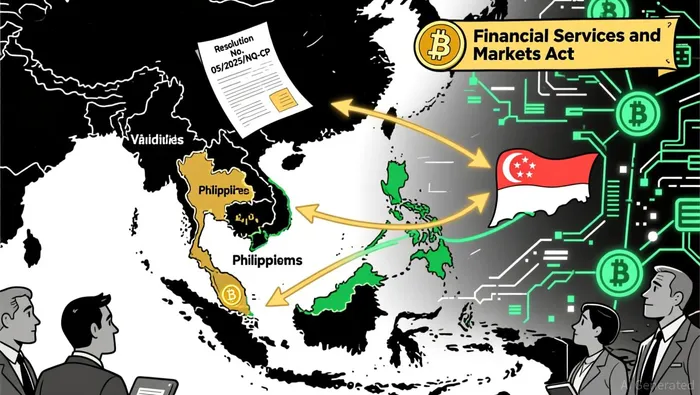
The migration of capital is further amplified by cross-border regulatory collaboration. The MAS and Vietnam's State Securities Commission (SSC) have launched joint initiatives to harmonize digital asset frameworks, sharing expertise on anti-money laundering and operational resilience. This alignment reduces friction for investors navigating multiple jurisdictions and enhances Singapore and Vietnam's appeal as gateways to Southeast Asia's $2.3 billion projected crypto market by 2027.
Opportunities in Compliant Markets: Innovation Within Structure
Vietnam's pilot program for digital asset exchanges represents a unique opportunity for investors. By requiring platforms to operate in Vietnamese đồng and integrate global liquidity pools, the government aims to align domestic pricing with international benchmarks while maintaining control over capital flows. The pilot's emphasis on real-asset-backed tokens and strict AML compliance also positions Vietnam as a testbed for sustainable crypto innovation.
Singapore's regulatory rigor, meanwhile, has fostered a thriving ecosystem for tokenized assets and stablecoins. The city-state's Project Guardian, which explores operational frameworks for tokenized securities and central bank bill trials, exemplifies its forward-looking approach. Additionally, Singapore's XSGD stablecoin, used in cross-border payments and government programs, underscores the role of regulated stablecoins in financial infrastructure.
For global investors, these markets offer a dual advantage: the potential for high-growth crypto adoption and the safeguards of structured regulation. Vietnam's $100 billion digital asset market and Singapore's institutional-grade infrastructure provide fertile ground for diversified portfolios, particularly as ASEAN nations continue to harmonize regulatory standards.
Conclusion: Navigating the New Normal
The Philippines' regulatory crackdown serves as a cautionary tale for investors operating in jurisdictions with fragmented oversight. While the move has curtailed illicit activity, it has also accelerated the shift toward compliant markets where innovation and regulation coexist. Vietnam and Singapore's strategic frameworks-combining investor protection with technological experimentation-position them as linchpins in Southeast Asia's crypto evolution.
For investors, the lesson is clear: regulatory clarity is no longer a peripheral concern but a core determinant of market access and risk-adjusted returns. As the region's crypto markets mature, those who align with compliant ecosystems will be best positioned to capitalize on Southeast Asia's digital asset boom.







Comentarios
Aún no hay comentarios