
The Philippines' Crypto Regulatory Crackdown and Its Implications for Global and Local Market Participants
The Philippines has emerged as a pivotal player in the global cryptocurrency landscape, implementing a sweeping regulatory framework in 2025 to address risks associated with digital assets while fostering innovation. These measures, spearheaded by the Securities and Exchange Commission (SEC) and the Bangko Sentral ng Pilipinas (BSP), have significant implications for investment risk migration and regulatory arbitrage opportunities. This analysis explores how these regulatory shifts are reshaping capital flows and market dynamics, both within the Philippines and globally.
A New Regulatory Framework for Crypto Assets
In May 2025, the SEC issued two landmark Memorandum Circulars-SEC MC No. 4-2025 and SEC MC No. 5-2025-to govern Crypto-Asset Service Providers (CASPs). These rules mandate that all CASPs register with the SEC, maintain a minimum paid-up capital of PHP 100 million, and operate a physical office in the Philippines. The regulations emphasize investor protection, market integrity, and compliance with anti-money laundering (AML) protocols, effectively raising the bar for entry into the Philippine crypto market according to the SEC.
Simultaneously, the BSP extended a moratorium on new Virtual Asset Service Provider (VASP) licenses until September 2025, signaling a cautious approach to balancing innovation with systemic risk management according to BSP. These dual-agency efforts reflect a broader global trend toward structured crypto regulation, with stablecoins and institutional adoption emerging as key policy focuses according to TRM Labs.
Investment Risk Migration: Where Is Capital Flowing?
The Philippines' stringent regulatory environment has prompted investment risk migration to jurisdictions with more favorable or less restrictive frameworks. According to a 2025 report by TRM Labs, jurisdictions like Singapore, the UAE, and parts of the Caribbean are attracting capital and businesses previously operating in the Philippines according to TRM Labs. These regions offer mature regulatory ecosystems, innovation-friendly policies, and lower operational costs, making them attractive alternatives for crypto firms.
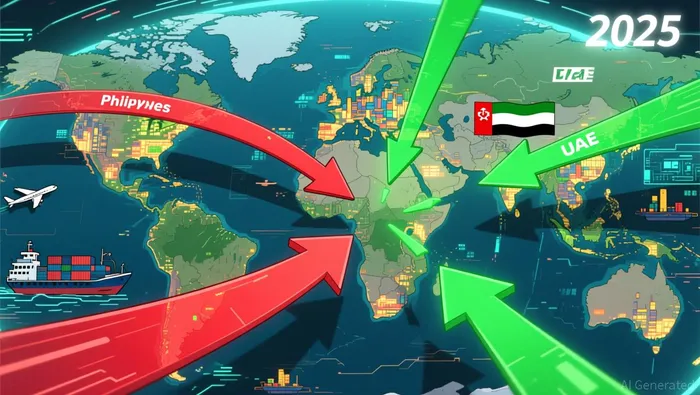
For example, global exchanges such as Bybit and Bitget were banned in the Philippines for operating without local licenses under the CASP framework according to IDN Financials. These platforms may now pivot to jurisdictions with clearer compliance pathways, such as Mexico and Brazil, which maintain relatively flexible regulatory environments according to insights4vc. Additionally, the Philippines' Capital Markets Efficiency Promotion Act (CMEPA), which reduced the stock transaction tax to 0.1%, has enhanced its competitiveness in Southeast Asia, but stricter crypto rules may still drive some investors to greener pastures according to Legal Business Online.
Regulatory Arbitrage Opportunities: A Diminishing Window?
While the Philippines' regulatory crackdown reduces arbitrage opportunities within the country, global trends suggest that arbitrage remains a feature of the crypto landscape. The EU's MiCA Regulation and the US's GENIUS Act, both implemented in 2025, have created structured frameworks that attract institutional investors while mitigating cross-border risks according to TRM Labs. However, jurisdictions with less mature regulations, such as Hong Kong and Malta, continue to offer competitive advantages for firms seeking to minimize compliance costs according to insights4vc.
Notably, the Philippines' dual-agency oversight model (SEC and BSP) has created a structured but complex environment for crypto operations. This complexity may incentivize firms to seek jurisdictions with simpler regulatory architectures, even as global harmonization efforts reduce arbitrage opportunities according to TRM Labs.







Comentarios
Aún no hay comentarios