
Philippine Peso Stabilization and the Central Bank's Balancing Act: A Path to Resilience
Philippine Peso Stabilization and the Central Bank's Balancing Act: A Path to Resilience
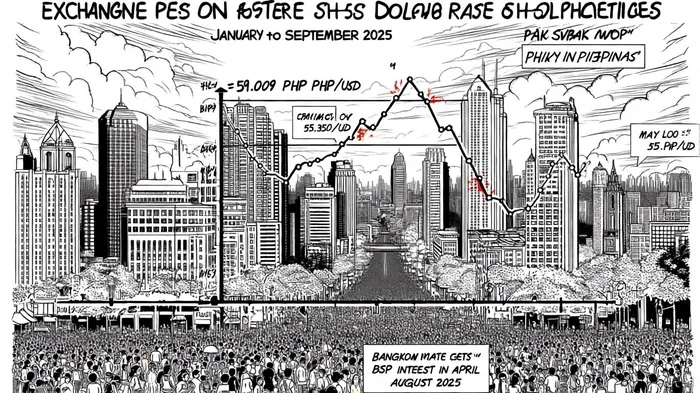
The Philippine Peso has faced a turbulent year, depreciating by 4.3% against the US Dollar by December 2024 and continuing to fluctuate in early 2025. Yet, amid these headwinds, the Bangko Sentral ng Pilipinas (BSP) has demonstrated a nuanced approach to stabilization, balancing inflationary pressures with the need to support economic growth. For investors, the question remains: Can the peso stabilize, and is a rebound on the horizon?
Central Bank Interventions: A "Goldilocks Rate" Strategy
The BSP's monetary policy in 2025 has been defined by aggressive rate cuts. In August, the central bank reduced the benchmark interest rate by 25 basis points to 5%, marking the third consecutive cut since April. Governor Eli Remolona Jr. described this rate as a "Goldilocks rate"-a level that supports growth without fueling inflation, according to a Rappler report. This easing reflects a broader global trend of accommodative policies, but it also underscores the BSP's confidence in the Philippines' macroeconomic resilience.
Annual inflation, which had been a concern in 2023, has plummeted to 0.9% in July 2025-the lowest since October 2019, as noted in the same Rappler report. The BSP forecasts an average of 1.7% for 2025, well below its 2–3% target range. This has given the central bank room to prioritize growth, particularly as external demand for Philippine exports remains robust. However, risks linger. A potential adjustment in electricity rates and higher rice tariffs could push inflation higher in 2026 and 2027, according to Trading Economics. For now, the BSP's strategy appears to be working, but vigilance is required.
Macroeconomic Resilience: A Fragile Foundation?
The peso's depreciation is not solely a function of monetary policy. Weaker external balances, including a widening current account deficit and subdued foreign direct investment (FDI), have contributed to downward pressure on the currency, according to a Philstar report. Meanwhile, the US Federal Reserve's slower pace of rate cuts and the uncertain economic policies of President-elect Donald Trump have created a volatile global backdrop, as noted in that Philstar coverage.
Yet, the Philippines' macroeconomic fundamentals remain relatively strong. Domestic supply chains, particularly in agriculture, have proven resilient. For example, government interventions to stabilize rice prices have curbed inflationary spikes, even as transport costs and weather-related disruptions have pushed September 2025 inflation to 1.7%, a development also discussed in the Philstar piece. This suggests that while external shocks are a concern, the domestic economy has tools to mitigate their impact.
Political Dynamics: A Double-Edged Sword
The mid-term elections and the impeachment trial of Vice President Sara Duterte add another layer of complexity. Political uncertainty can deter investment and amplify currency volatility, as seen in the peso's sharp swings in early 2025-an observation highlighted in an ING analysis. However, these dynamics also highlight the importance of institutional credibility. The BSP's consistent communication and data-driven approach have helped anchor market expectations, even as political noise rises.
The Road Ahead: Stabilization or Rebound?
For the peso to stabilize, the BSP must navigate a delicate balancing act. Further rate cuts-projected to total 75 basis points by 2025-could stimulate growth but may exacerbate depreciation if external conditions worsen, as some analysts have warned. Conversely, tightening policy prematurely could stifle recovery. The key lies in the central bank's ability to manage expectations while addressing structural weaknesses, such as boosting FDI and narrowing the current account deficit.
Investors should also consider the broader geopolitical context. A potential shift in US monetary policy or a resolution to the Trump-era trade uncertainties could provide a tailwind for the peso. In the short term, however, the BSP's "Goldilocks rate" strategy and the Philippines' inflationary moderation offer a degree of optimism.
Conclusion: A Calculated Bet
The Philippine Peso's path to stabilization hinges on the BSP's ability to maintain its accommodative stance without triggering inflationary surges. While external vulnerabilities persist, the central bank's proactive interventions and the economy's inherent resilience suggest that a rebound-though not guaranteed-is within reach. For investors, the Philippines presents a calculated opportunity: a market where policy agility and macroeconomic fundamentals may yet outpace the headwinds.







Comentarios
Aún no hay comentarios