
The Philippine Peso's Divergence: Currency Weakness, Political Risk, and Emerging Opportunities
The Philippine peso (PHP) has entered a period of divergence, marked by a weakening currency, political instability, and a services-led economy grappling with both headwinds and opportunities. As the peso depreciates against the U.S. dollar-reaching 59.355 per dollar in late December 2025-investors must navigate a complex interplay of domestic governance failures, external trade pressures, and structural shifts in key sectors. This analysis examines the long-term implications of these dynamics for the Philippines' economy and identifies where resilience and potential lie.
Currency Weakness: A Confluence of Domestic and External Pressures
The PHP's decline is not merely a function of monetary policy but a symptom of deeper structural vulnerabilities. A deteriorating current-account balance, declining foreign direct investment (FDI), and a corruption scandal involving ghost flood control projects have eroded investor confidence. The Bangko Sentral ng Pilipinas (BSP) has responded with a potential rate-cutting cycle in 2025, with Governor Eli Remolona signaling openness to easing monetary policy to cushion economic fallout. However, these measures risk exacerbating capital outflows, as a weaker peso makes Philippine exports cheaper but imports-and debt servicing-more expensive.
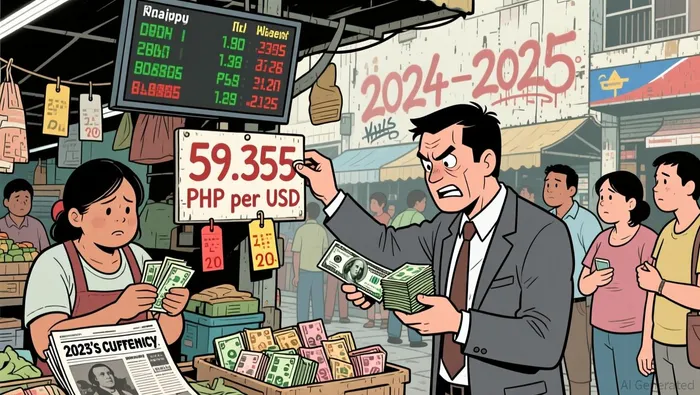 External pressures compound the challenge. The U.S. government's imposition of a 19% tariff on Philippine exports, higher than initially anticipated, threatens key industries such as semiconductors. Meanwhile, global currency fluctuations, including a weaker Indian rupee, have created a mixed environment for the Philippines' services sector. While a weaker peso could make outsourcing services more competitive, it also raises operational costs for businesses reliant on imported goods.
Political Risks: Governance Failures and Economic Uncertainty
The political landscape in late 2025 has been defined by a crisis of governance. A corruption scandal involving collusion between lawmakers, public officials, and contractors-revealed during President Ferdinand Marcos Jr.'s State of the Nation Address-has triggered public outrage and political fragmentation. The government's anti-corruption campaign has been criticized as inconsistent, further undermining trust in institutions. These developments have contributed to a sharp decline in FDI and a downward revision of economic growth forecasts from 6%-7% to 5%-6% for 2026.
Structural governance issues, including delayed public investments and regulatory burdens, have also weakened business confidence. The World Bank's Philippines Economic Update highlights how these challenges have spilled over into the services sector, slowing growth in business process outsourcing (BPO) and tourism. Without meaningful reforms, the Philippines risks losing its competitive edge in global services markets.
Emerging Opportunities in a Services-Led Economy
Despite these challenges, the Philippines' services sector remains a cornerstone of economic resilience. The BPO industry, a critical driver of employment and foreign exchange, could benefit from a weaker peso by enhancing its cost competitiveness against rivals like India. However, this advantage is tempered by global trends such as U.S. reshoring and local talent shortages.
Tourism, meanwhile, is projected to contribute PHP 5.9 trillion to the economy in 2025, accounting for 21% of GDP and supporting 11.7 million jobs. This growth is underpinned by strong global demand for travel and the sector's ability to adapt to post-pandemic norms. Remittances from overseas Filipinos also remain a stable source of foreign exchange, bolstered by robust global labor markets and formal transfer channels.
Long-term investment opportunities lie in sectors poised for structural upgrades. The World Bank emphasizes the need for reforms in telecoms, transport, logistics, and renewable energy to enhance competitiveness. These areas offer attractive prospects for investors willing to navigate short-term volatility.
Conclusion: Balancing Risk and Reward
The Philippine peso's divergence reflects a broader tension between political fragility and economic potential. While currency weakness and governance risks pose significant challenges, the services sector's resilience and untapped opportunities in infrastructure and technology suggest a path forward. Investors must weigh the immediate uncertainties against the long-term gains of a reformed, services-driven economy. For those with a strategic horizon, the Philippines remains a paradox: a market of contradictions, but one where patience and precision could yield substantial rewards.







Comentarios
Aún no hay comentarios