
Pharma Pricing Dynamics and Market Response to Regulatory Pressure: Assessing Bristol-Myers Squibb's Strategic and Financial Implications Following Trump's Demand for Price Cuts on Sotyktu
The pharmaceutical industry has long grappled with the tension between innovation and affordability, but recent regulatory interventions have intensified this struggle. At the center of this storm is Bristol-Myers SquibbBMY-- (BMY), whose strategic and financial resilience is being tested by President Donald Trump's aggressive demands for price cuts on its psoriasis drug, Sotyktu. This analysis examines how pricing pressures—driven by Trump's “most-favored-nation” (MFN) policy and the Inflation Reduction Act (IRA)—are reshaping BMY's R&D priorities, profit margins, and stock performance, while offering insights into broader sector-wide implications.
Regulatory Context: Trump's Pricing Demands and the MFN Policy
In July 2025, Trump escalated his campaign to lower drug costs by sending letters to 17 major pharmaceutical companies, including BMYBMY--, demanding immediate price reductions and compliance with the MFN policy, which ties U.S. drug prices to those in other developed countries[2]. BMY responded by slashing the price of Sotyktu—a first-in-class TYK2 inhibitor for plaque psoriasis—by over 80% for cash-paying patients[1]. This move aligns with Trump's broader strategy to curb U.S. drug costs, which includes leveraging trade tools to enforce compliance[4].
The MFN policy, revived via an executive order in May 2025, has already triggered international pricing pressures. For instance, Japan's health ministry approved an 8.6% price cut for Sotyktu under its cost-effectiveness assessment (CEA) scheme in April 2024[4]. These developments signal a global shift toward value-based pricing, which could erode profit margins for innovative therapies.
Financial Implications: R&D Investment and Profit Margins
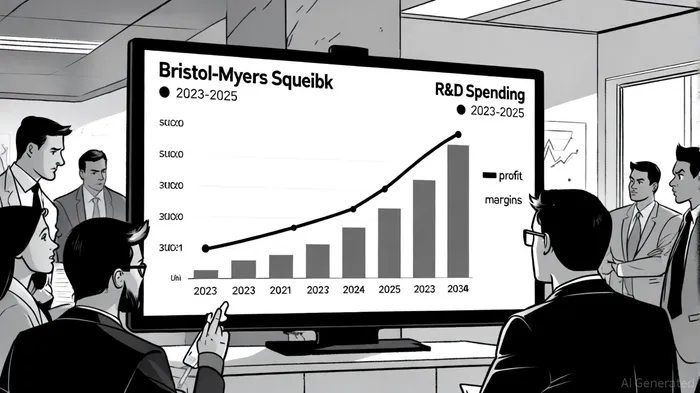
BMY's R&D spending has shown mixed trends amid these pressures. Annual R&D expenses reached $11.159 billion in 2024, a 20% increase from 2023, but the second quarter of 2025 saw a 11% year-over-year decline in quarterly R&D costs[1]. This volatility reflects strategic recalibration: while BMY continues to invest in innovation, it is also prioritizing cost efficiency to offset revenue declines from price cuts.
Profit margins, however, tell a starker story. Despite a net income of $5,049 million in fiscal year 2025, BMY reported a 10.58% profit margin, a sharp contrast to its $8.948 billion net loss in 2024[4]. The Sotyktu price cut, coupled with IRA-mandated reductions for Eliquis and other high-cost drugs, has compressed margins. Analysts at Leerink Partners now project only 10% sequential revenue growth for Sotyktu in Q2 2025, far below expectations for a newly launched product[1].
The IRA, which allows Medicare to negotiate drug prices, has further complicated BMY's financial outlook. As one of the first 10 companies to negotiate under the law, BMY faces potential revenue declines for Eliquis and other key products. Legal challenges to the IRA have so far failed, with courts upholding the government's authority to set price caps[2].
Stock Performance: A Mixed Bag Amid Uncertainty
BMY's stock has mirrored the turbulence of its financial landscape. As of September 2025, the stock traded at $44.16, reflecting a 13.31% decline over the past year and a 56.50% drop since 2020[4]. Pricing pressures on Sotyktu, competition from JAK inhibitors, and IRA-related uncertainties have weighed on investor sentiment. However, recent developments—including positive phase 3 trial results for Sotyktu in psoriatic arthritis and a $2 billion cost-cutting plan by 2027—have spurred a 2.12% quarterly stock rally[5].
The biopharma sector as a whole has struggled, with healthcare stocks trading near historic lows in terms of market capitalization and P/E ratios[3]. Tariffs on imported medicines, delayed FDA approvals, and constrained capital access have compounded challenges. Yet, potential catalysts for recovery include clarity on drug pricing policies, Fed interest rate cuts, and AI-driven R&D advancements[3].
Strategic Adjustments: Navigating a High-Stakes Landscape
BMY's response to pricing pressures underscores a broader industry trend: the need to balance innovation with affordability. The company's direct-to-patient discount model for Sotyktu—offered via the BMS Patient Connect platform—aims to preserve market share while complying with regulatory demands[1]. Additionally, BMY has announced a $2 billion cost-cutting initiative by 2027 to offset revenue declines from patent expirations for Opdivo and Eliquis[5].
Legally, BMY has joined peers like AstraZeneca and Johnson & Johnson in challenging the IRA, arguing that the law violates constitutional rights under the First and Fifth Amendments[3]. While these lawsuits remain unresolved, they highlight the existential risks posed by pricing regulations to pharmaceutical innovation.
Conclusion: A Tenuous Path Forward
BMY's experience illustrates the profound impact of regulatory pricing pressures on biopharma firms. While the company has demonstrated agility in adjusting its pricing strategies and cost structure, its long-term success will depend on its ability to innovate in a low-margin environment. For investors, the key risks include further margin compression, legal uncertainties, and competitive threats. However, catalysts such as AI-driven R&D, strategic acquisitions (e.g., Karuna Pharmaceuticals), and potential IRA reforms could reinvigorate growth.
In a sector where profitability and public health intersect, BMY's journey offers a cautionary tale and a blueprint for navigating an increasingly regulated future.





Comentarios
Aún no hay comentarios