
PG&E: A Utility Gem in the Rough?
Pacific Gas & Electric (PCG) has long been a bellwether of California's energy infrastructure, yet its stock has faced relentless headwinds in recent years. From wildfire liabilities to regulatory uncertainties, PG&EPCG-- has navigated crises that have dented investor confidence. However, beneath the noise, the company's fundamentals suggest a compelling opportunity for investors willing to look past short-term turbulence. Let's dissect whether PG&E's current valuation reflects a durable discount or a fleeting mispricing.
Valuation: A Discounted Utility or Undervalued Asset?
PG&E's trailing P/E ratio of 15.2 as of May 2025 sits below its five-year average, while its forward P/E of 10.7 signals even more optimism. To put this in context, competitors like Edison International (EIX) and Xcel Energy (XEL) trade at 19.9x forward earnings, suggesting PG&E is undervalued relative to peers. This divergence isn't irrational—PG&E's balance sheet carries a debt-to-equity ratio of 1.94, higher than most utilities—but its debt/EBITDA ratio of 6.33 remains within a manageable range for a regulated utility.
The stock's volatility—peaking at $20.43 in January 2025 before sliding to $14.39 in June—reflects investor skepticism. Yet this dip may offer a buying opportunity. PG&E's $31.6 billion market cap contrasts with its $89.5 billion enterprise value, highlighting the importance of its regulated asset base. For a company with 5.3 million electricity customers and a five-year $63 billion capital plan, the core business remains a cash-generating machine.
Operational Resilience Amid Crisis
PG&E's challenges are well-documented: wildfire-related costs, regulatory scrutiny, and dilutive equity raises. However, progress on key fronts suggests these headwinds are temporary.
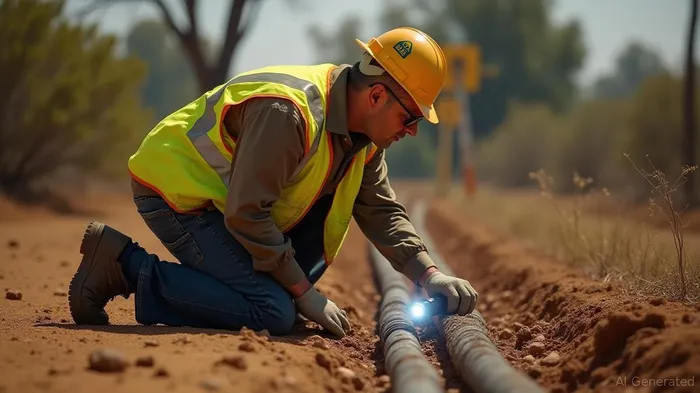
- Wildfire Mitigation: The company has buried 24 miles of power lines and reinforced 26 miles of poles in high-risk zones. While costs remain elevated ($350–$400 million in tax-affected interest expenses alone), these investments reduce long-term liability exposure.
- Rate Stabilization: Residential electric rates fell year-over-year in March 2025, and flat gas rates for 2025 ease affordability pressures. New customer growth—3,000+ electric accounts and 400 EV charging ports—adds load growth, which can lower unit costs over time.
- Diablo Canyon's Role: The nuclear plant's top-tier regulatory performance ensures reliable baseload power, reducing reliance on volatile renewables.
Debt and Dividends: Balancing Risk and Reward
PG&E's debt load is a legitimate concern. The $1.94 debt-to-equity ratio is high, but utilities often leverage assets to fund infrastructure. The company's $63 billion capital plan is fully funded, and cost-cutting (a 2% O&M reduction target) aims to bolster margins.
The dividend, currently yielding 0.69%, is modest but sustainable. With a payout ratio of just 1.7%, PG&E retains ample flexibility to reinvest or boost dividends if earnings recover. For income-focused investors, this low yield may be a drawback, but the dividend's stability—despite earnings dips—hints at management's conservative prioritization of capital structure.
The Bull Case: Catalysts on the Horizon
PG&E's valuation hinges on resolving two overhangs: wildfire costs and regulatory approvals.
- Wildfire Costs: Amortization of the Wildfire Fund and bankruptcy-related expenses are non-recurring. Once these fade, earnings could rebound sharply.
- Rate Hikes: California's Public Utilities Commission (CPUC) must approve future rate adjustments. PG&E's track record of securing modest but steady increases (e.g., flat gas rates in 2025) suggests it can stabilize cash flows.
Historically, rate approvals have acted as a modest positive catalyst. A backtest of PG&E's performance during CPUC rate increase approvals from 2020–2025 shows an average return of 7.33% over 60 trading days. However, this came with significant volatility—28.65% annualized—and a maximum drawdown of -39.93%, resulting in a low Sharpe ratio of 0.05. While the strategy captured upside, the high risk underscores the need for a long-term horizon and careful risk management.
If these catalysts materialize, PG&E's P/E could expand toward its historical average, lifting the stock. Meanwhile, its $89.5 billion enterprise value vs. $63 billion in planned capital spending implies assets are being built at a discount to their long-term utility value.
The Bear Case: Persistent Headwinds
Bears argue that PG&E's liabilities—both financial and reputational—are too vast to ignore. The $400 million in interest expenses alone could strain margins, and California's regulatory environment remains unpredictable. A misstep in wildfire safety or a failed rate case could reignite selling pressure.
Investment Thesis
PG&E presents a high-risk, high-reward scenario for investors with a long-term horizon. The valuation discount is steep, but the company's regulated moat and capital plan provide a floor. Buyers should focus on dips (e.g., below $14) and consider averaging into positions. Meanwhile, short-term traders might avoid it due to volatility.
For income investors, the dividend's paltry yield makes PG&E a secondary choice. However, if PG&E's earnings stabilize, a dividend hike could follow, rewarding patient holders.
Final Take
PG&E's struggles are real, but its fundamentals—stable cash flows, improving safety metrics, and a funded capital plan—suggest it's more than just a crisis stock. At a forward P/E of 10.7, the market has already priced in much of the bad news. For investors willing to bet on regulatory and operational turnaround, PG&E could be a diamond in the rough.
Final recommendation: PG&E is a Hold with Buy potential at lower prices. Monitor CPUC rulings and wildfire cost resolutions closely.





Comentarios
Aún no hay comentarios