
PFAS Remediation: A Lucrative Frontier in Environmental Investment with Strategic Risk Mitigation
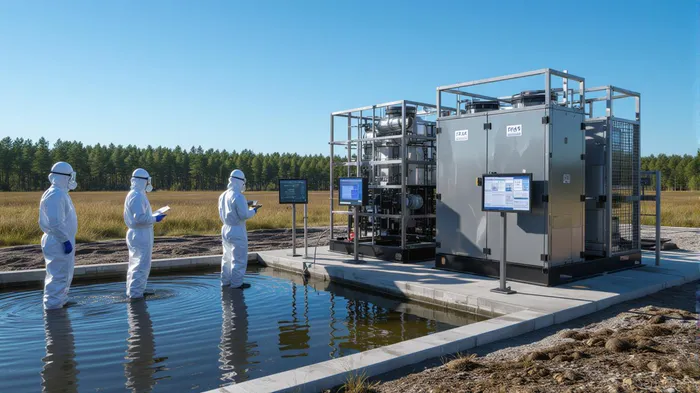
The PFAS remediation market is emerging as a cornerstone of environmental investment, driven by regulatory urgency, technological innovation, and growing public awareness of "forever chemical" risks. By 2025, the market size is estimated at USD 3.5 billion, with projections to surge to USD 8.2 billion by 2033 at a compound annual growth rate (CAGR) of 10.2% [1]. This trajectory is fueled by stringent regulations, such as the U.S. EPA’s enforceable PFAS limits and the EU’s REACH framework, which mandate advanced remediation solutions for water, soil, and industrial waste [2].
Market Dynamics and Value Creation
The PFAS remediation ecosystem spans filtration, water treatment, and in-situ/ex-situ technologies. For instance, the PFAS filtration market alone is projected to grow from USD 2.28 billion in 2025 to USD 3.22 billion by 2030 at a CAGR of 7.18% [3]. Key innovations include granular activated carbon (GAC), reverse osmosis (RO), and emerging methods like electrochemical oxidation and bioremediation, which offer cost-effective and sustainable solutions [4]. North America dominates the market, but Asia-Pacific is poised for rapid growth due to industrialization and regulatory tightening [5].
Value creation is evident in companies leveraging cutting-edge technologies. For example, Puraffinity’s recent USD 13.9 million Series A funding enables scalable PFAS removal solutions, while Xylem’s acquisition of Evoqua Water Technologies created a USD 7.5 billion platform for integrated water treatment [6]. These examples highlight how strategic M&A and R&D investments are reshaping the sector.
Risk Mitigation and Regulatory Resilience
Investors must navigate a fragmented regulatory landscape. Over 75 U.S. state-level PFAS regulations and the EU’s near-total PFAS ban under REACH create compliance challenges [7]. To mitigate risks, companies like Battelle have developed lifecycle frameworks:
1. Desktop Review: Identify PFAS in raw materials and supply chains.
2. Analytical Testing: Quantify PFAS levels in water, soil, and air.
3. Risk Assessment: Prioritize mitigation actions based on impact and likelihood.
4. Material Alternatives: Transition to safer substitutes while maintaining product performance.
5. Environmental Remediation: Deploy technologies like Battelle’s PFAS Annihilator® for complete chemical breakdown [8].
Regulatory resilience also requires proactive compliance. The EPA’s “polluter pays” framework and CERCLA designations increase liability for contamination, pushing companies to adopt transparent supply chain practices and invest in post-market surveillance [9]. For example, WalmartWMT-- and Target are phasing out PFAS-containing products, while water utilities are adopting advanced filtration systems to meet compliance [10].
Case Studies and Investment Opportunities
Recent M&A and funding activities underscore the sector’s potential. Clean HarborsCLH-- reported 15%-20% quarterly growth in PFAS-related work, supported by USD 50–70 million in contracts [11]. Similarly, AECOM’s partnership with Aquatech to deploy the DE-FLUORO™ system exemplifies how collaboration accelerates technology adoption [12]. Veolia’s success in treating 30+ facilities with undetectable PFAS levels further validates the scalability of these solutions [13].
Conclusion
PFAS remediation represents a high-growth, high-impact investment opportunity, but success hinges on balancing innovation with regulatory agility. By adopting structured risk mitigation frameworks, leveraging advanced technologies, and aligning with global regulatory trends, investors can unlock long-term value while addressing critical environmental and public health challenges.
Source:
[1] PFAS Remediation Market Investment Scope & Industry [https://www.linkedin.com/pulse/pfas-remediation-market-investment-scope-industry-bulne]
[2] PFAS Regulations in 2025: What EHS Professionals Need [https://www.cc-global.com/blog/2024/pfas-regulations-in-2025-what-ehs-professionals-need-to-know]
[3] PFAS Filtration Market Size, Share & 2030 Growth Trends [https://www.mordorintelligence.com/industry-reports/pfas-filtration-market]
[4] PFAS Remediation Services Market Track 2025 [https://www.linkedin.com/pulse/pfas-remediation-services-market-track-2025-v6fdf/]
[5] PFAS Remediation Market | Size, Share, Growth | 2024 [https://virtuemarketresearch.com/report/pfas-remediation-market]
[6] PFAS Filtration Company Evaluation Report 2025 [https://finance.yahoo.com/news/pfas-filtration-company-evaluation-report-145000041.html]
[7] Strategies for Navigating Changing PFAS Regulations [https://www.exponentEXPO--.com/article/strategies-navigating-changing-pfas-regulations]
[8] Our PFAS Risk Mitigation Framework - Inside Battelle Blog [https://inside.battelle.org/blog-details/our-pfas-risk-mitigation-framework]
[9] Key EPA Actions to Address PFAS | US EPA [https://www.epa.gov/pfas/key-epa-actions-address-pfas]
[10] The PFAS Crackdown: How 2025 Regulations Are Reshaping Industries [https://www.deloachindustries.com/blog/the-pfas-crackdown-how-2025-regulations-are-reshaping-industries]
[11] Strategic Capital Allocation in Environmental Remediation [https://www.ainvest.com/news/strategic-capital-allocation-environmental-remediation-rise-private-equity-green-services-sector-2507]
[12] PFAS Remediation Services Market Analysis, Dynamics [https://www.intelmarketresearch.com/pfas-remediation-services-867]
[13] PFAS Filtration Market Size to Surpass USD 4.05 Billion by [https://www.precedenceresearch.com/pfas-filtration-market]





Comentarios
Aún no hay comentarios