
Petrobras' Dividend Sustainability Amid Volatile State-Run Dynamics
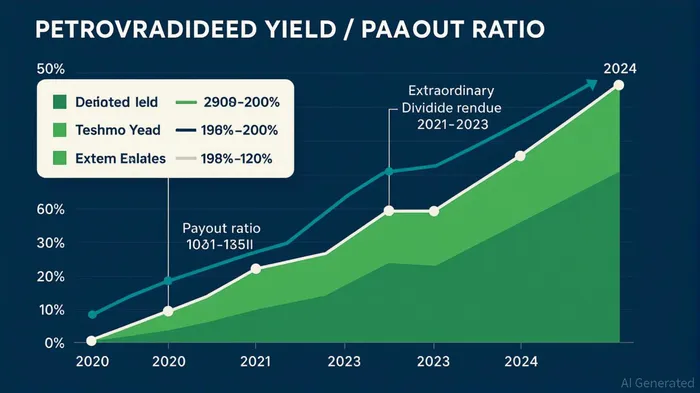
In the volatile world of state-owned energy equities, PetrobrasPBR.A-- (PBR) stands as both a beacon of shareholder returns and a cautionary tale of fiscal fragility. The Brazilian oil giant has long captivated investors with its stratospheric dividend yield—currently 17.38%—but the sustainability of these payouts amid geopolitical turbulence and oil price cycles remains a critical question.
The Dividend Allure and Its Shadows
Petrobras has demonstrated a relentless commitment to returning cash to shareholders, distributing 66% of its cash generation through dividends, government participations, and taxes in Q1 2024 alone [1]. This has translated into a dividend yield that dwarfs most global peers, peaking at 43.2% in 2022 [3]. However, the company’s payout ratio—now exceeding 198%—raises red flags. As noted by Monexa.ai, this implies dividends are being paid out at a rate surpassing net income, a precarious position in an industry prone to cyclical shocks [1].
The recent Q2 2025 results underscore this tension. Despite a record net profit of R$26.7 billion (~$4.7 billion), driven by pre-salt production hitting 2.91 million barrels of oil equivalent per day [3], Petrobras has signaled no plans to adjust its dividend policy. This decision, attributed to lower oil prices and capital expenditure (capex) of $18.5 billion for 2025 [4], highlights the delicate balancing act between rewarding shareholders and preserving financial flexibility.
Geopolitical and Pricing Cycles: The Double-Edged Sword
The sustainability of Petrobras’ dividend strategy is inextricably tied to the volatility of oil prices and Brazil’s regulatory landscape. The average Brent crude price of $67.82 in Q2 2025 [3]—far below the $80+ levels seen in 2022—has forced the company to adopt cost-cutting measures and prioritize short-term cash flow projects. CEO Bernard Looney has explicitly stated that a Brent price of $65 would necessitate a “restrained approach” to capital spending [2], a stark contrast to the aggressive pre-salt development plans of recent years.
Meanwhile, Brazil’s political and regulatory environment adds another layer of uncertainty. The Lula administration’s 2023 fiscal framework, weakened by structural spending issues and a credibility crisis [1], has left corporations and state-owned enterprises like Petrobras navigating a shifting tax landscape. While Petrobras is legally required to distribute at least 25% of its net income as dividends [5], the potential for tax reforms or local content policy adjustments could further strain its financial discipline.
Strategic Value in a State-Run Model
Despite these risks, Petrobras retains strategic appeal for investors seeking exposure to state-owned energy equities. Its operational efficiency—evidenced by a 92% refinery utilization rate in Q1 2024 [1]—and its role in Brazil’s energy transition (a 55% reduction in emissions since 2015 [1]) position it as a hybrid player in a decarbonizing world. Strategic partnerships, such as its collaboration with BPBP-- in the Bumerangue block [3], also hint at a willingness to leverage private capital for growth.
However, the high-yield allure must be tempered with caution. The 25% drop in free cash flow in 2024 [1] and the company’s refusal to increase dividends in 2025, even amid a $4.7 billion profit, suggest a recalibration of priorities. For now, Petrobras appears to be prioritizing debt reduction (now at $27.7 billion, the lowest since 2010 [1]) and capex over aggressive shareholder returns.
Conclusion: A High-Yield Gamble
Petrobras’ dividend sustainability hinges on its ability to navigate a perfect storm of falling oil prices, regulatory unpredictability, and its own aggressive payout ratios. While the company’s historical resilience—marked by a seven-year streak of consistent dividends [1]—is impressive, the current trajectory suggests a pivot toward fiscal conservatism. For investors, the key will be monitoring Brent prices, Brazil’s fiscal reforms, and Petrobras’ capex execution. In a world where energy equities are increasingly scrutinized for both returns and resilience, Petrobras remains a high-yield gamble with a clear line of sight to volatility.
**Source:[1] Earnings call: Petrobras posts strong Q1 2024 results [https://www.investing.com/news/stock-market-news/earnings-call-petrobras-posts-strong-q1-2024-results-plans-for-future-growth-93CH-3440919][2] Petrobras revises strategic plan in response to falling oil prices [https://energynews.oedigital.com/oil-gas/2025/05/13/petrobras-revises-strategic-plan-in-response-to-falling-oil-prices][3] Petrobras Q2 2025 Dividend Yield and Pre-Salt Production [https://monexa.ai/blog/petrobras-q2-2025-analysis-dividend-yield-pre-salt-PBR-2025-08-08][4] Petrobras Brazil sees little chance of additional dividends in this year [https://energynews.oedigital.com/fossil-fuels/2025/08/08/petrobras-brazil-sees-little-chance-of-additional-dividends-in-this-year][5] Document 1 - file: ebr20250327_6k1.htm [https://www.sec.gov/Archives/edgar/data/1439124/000129281425001296/ebr20250327_6k1.htm]





Comentarios
Aún no hay comentarios