
Peter Thiel's Strategic Exit from Bitmine and Implications for Crypto-Infrastructure Investing
The Rationale Behind Thiel's Exit
Founders Fund's reduction of its Bitmine holdings-from over 5 million shares to 2.5 million-shifted the firm from an active to a passive investor, reducing regulatory reporting obligations. Analysts attribute this to standard portfolio rebalancing, a common practice as VC firms adjust to market conditions and strategic milestones. Bitmine itself has evolved from a BitcoinBTC-- mining play to a corporate EthereumETH-- treasury builder, now holding over 3.39 million ETH ($13.2 billion) and positioning itself as the second-largest crypto treasury globally. Thiel's exit, therefore, may signal a recognition of Bitmine's transition from speculative growth to institutional-grade infrastructure, where Founders Fund's role as a passive investor aligns with its broader strategy.
Broader Trends in VC Portfolio Rebalancing
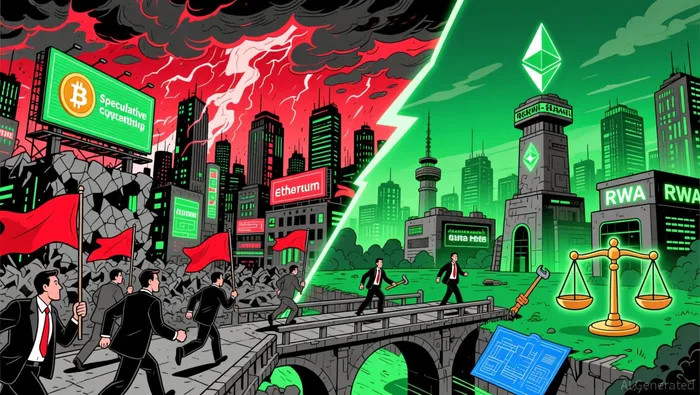
Thiel's move is emblematic of a larger industry shift. From 2023 to 2025, top-tier VCs have redirected capital toward infrastructure-focused crypto projects, favoring regulatory-compliant models and scalable technologies. For instance, Andreessen Horowitz (a16z) and Sequoia Capital have heavily invested in prediction markets like Kalshi and Polymarket, which raised $300 million and $2 billion respectively in 2025. These platforms, secured with CFTC licenses and partnerships with SolanaSOL-- and Base, exemplify the sector's pivot toward regulated, institutional-grade infrastructure.
Meanwhile, firms like Pantera Capital and Paradigm have doubled down on foundational blockchain projects, including Ethereum staking protocols and tokenized real-world assets (RWAs). This trend is driven by macroeconomic factors, such as the U.S. Federal Reserve's anticipated rate cuts and crypto-friendly legislation like The Genius Act, which have reduced regulatory uncertainty and attracted traditional investors.
Risk Appetite and Strategic Consolidation
The maturation of the crypto market has also led to a concentration of capital among fewer, larger deals. In 2025, over $16 billion was raised in the sector, with two-thirds flowing into "top-down" plays such as digital asset trading systems (DATS) and stablecoin-driven infrastructure. This contrasts with earlier cycles, where speculative projects dominated. For example, Bitmine's aggressive Ethereum accumulation-reaching 2.8% of total supply-demonstrates a focus on yield generation and governance influence, akin to MicroStrategy's Bitcoin strategy.
High-profile M&A activity further underscores this trend. Robinhood's acquisition of Bitstamp and Securitize's $400 million raise for RWA tokenization highlight a sector prioritizing consolidation and real-world utility over volatility which aligns with VCs' evolving risk profiles. These moves align with VCs' evolving risk profiles, as institutional investors demand stable, revenue-driven models.
Implications for Crypto-Infrastructure Investing
Thiel's exit and the broader VC reallocation signal three key implications for investors:
1. Infrastructure as the New Frontier: VCs are betting on foundational layers-blockchain protocols, staking infrastructure, and RWA platforms-rather than application-layer projects. Bitmine's Ethereum treasury and Kalshi's regulated prediction markets are prime examples.
2. Regulatory Compliance as a Competitive Advantage: Firms securing CFTC licenses or partnering with traditional financial incumbents (e.g., XYRA Corp. and Bitcoin Bancorp's crypto ATMATM-- collaboration) are better positioned to attract institutional capital.
3. Portfolio Diversification and Liquidity Management: As seen with Bitmine's 623 million cash reserves and active buyback program, liquidity and risk mitigation are now central to crypto infrastructure strategies.
Conclusion
Peter Thiel's exit from Bitmine is not an isolated event but a symptom of a maturing crypto market. As top-tier VCs like a16z, Sequoia, and Pantera pivot toward infrastructure and regulatory compliance, the sector is witnessing a shift from speculative hype to sustainable, institutional-grade value creation. For investors, this underscores the importance of aligning with projects that prioritize real-world utility, yield generation, and regulatory clarity-factors that will define the next phase of crypto's evolution.





Comentarios
Aún no hay comentarios