
Peter Thiel's NVIDIA Exit: A Cautionary Signal Amid the AI Bubble?
NVIDIA's Valuation: A House Built on AI Momentum
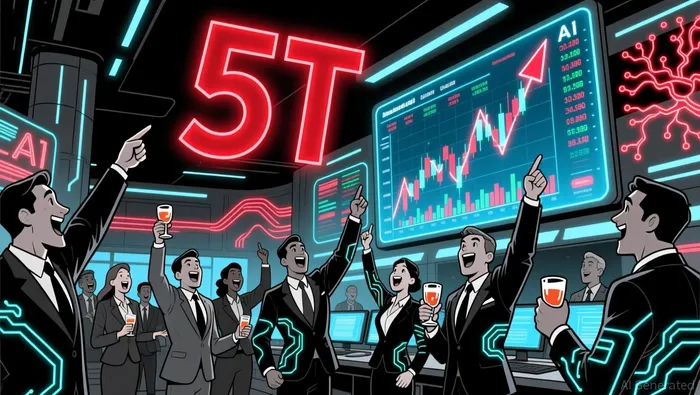
NVIDIA's meteoric rise in 2025 has been nothing short of extraordinary. As of November 2, 2025, the stock traded at approximately $202 per share, with a market capitalization briefly surpassing $5 trillion-a historic milestone that outpaced even Apple and Microsoft according to analysis. This valuation is underpinned by NVIDIA's dominance in the AI chip market, where it commands an estimated 70–90% share of high-end processors according to market data. The company's data-center AI chips alone drove a 56% year-over-year revenue surge to $46.7 billion in the last quarter, with net profit margins nearing 50% .
Strategic partnerships and acquisitions have further fueled growth. A $100 billion GPU supply deal with OpenAI, a $5 billion joint chip development agreement with Intel, and a $40 billion data-center acquisition expanded NVIDIA's footprint into cloud infrastructure, autonomous vehicles, and healthcare . These moves added $400 billion to its market cap within days, cementing its status as the "backbone of the global AI industry" . Wall Street analysts remain overwhelmingly bullish, with 80–90% recommending a "Buy" for NVDANVDA-- and a median 12-month price target of $215 . Some have even raised targets to $275–$320, citing NVIDIA's leadership in AI .
The Risks of a $5 Trillion Valuation
Despite the optimism, NVIDIA's valuation carries significant risks. Its forward price-to-earnings (P/E) ratio of 50x leaves little room for error, particularly as U.S.-China tech tensions threaten 10–15% of its sales through export curbs . Rival chipmaker AMD is also closing the performance gap, and NVIDIA insiders have sold over $1 billion in stock recently . These factors, combined with Thiel's exit and insider selling, suggest growing caution among high-profile investors.
The broader AI sector has also drawn comparisons to past tech manias. Critics warn of a "bubble" fueled by speculative hype, echoing the dot-com crash and cryptocurrency's volatile rise . While proponents argue NVIDIA's strong fundamentals justify its valuation-unlike the speculative nature of earlier booms-the company's rapid growth has created a fragile ecosystem. A single misstep, such as a slowdown in AI adoption or regulatory crackdowns, could trigger a sharp correction.
Thiel's Exit: A Signal or a Fluke?
Thiel's decision to divest NVIDIA, alongside trimming Tesla holdings and acquiring Apple and Microsoft shares, reflects a strategic rebalancing rather than a blanket rejection of tech stocks according to reports. However, the timing of his exit-amid a broader trend of institutional investors scaling back exposure-cannot be ignored. Bridgewater Associates and SoftBank's similar moves underscore a growing wariness of overvalued AI stocks according to market analysis.
This caution is not unfounded. NVIDIA's valuation now implies that AI adoption will continue to accelerate at an unsustainable pace, with data-center demand growing exponentially. Yet, as one strategist noted, "All this AI capex is coming through," and NVIDIA is the prime beneficiary . The upcoming Q3 earnings report on November 19, 2025, will be a critical test. The company has guided for 54% year-over-year revenue growth, but missing these expectations could trigger a sell-off .
Conclusion: Balancing Optimism and Caution
NVIDIA's dominance in AI is undeniable, and its strategic bets position it to capitalize on the sector's long-term potential. However, the company's valuation now hinges on the assumption that AI growth will remain unimpeded by geopolitical risks, technological competition, or market saturation. Peter Thiel's exit, while not a definitive signal of a bubble, serves as a reminder that even the most bullish investors are not immune to the risks of overvaluation.
As the AI sector continues to evolve, investors must weigh the promise of innovation against the realities of market dynamics. For NVIDIA, the path forward will depend not only on its ability to maintain its technological edge but also on its capacity to navigate the growing scrutiny of its valuation. In a market where hype often outpaces fundamentals, Thiel's move may prove to be a prescient warning-or a fleeting blip in the broader AI revolution.





Comentarios
Aún no hay comentarios