
Peru's Emerging Mining and Energy Alliances: Strategic Partnerships as Catalysts for Resource Sector Growth
Peru's Emerging Mining and Energy Alliances: Strategic Partnerships as Catalysts for Resource Sector Growth
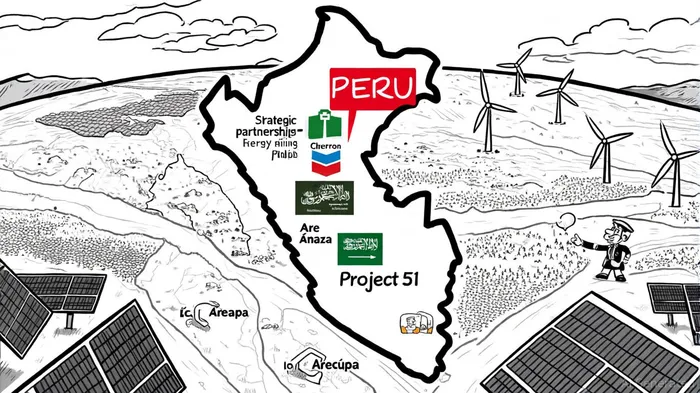
Peru is rapidly transforming its mining and energy sectors through a series of high-stakes strategic partnerships, positioning itself as a linchpin in the global energy transition. By leveraging its vast reserves of critical minerals and untapped hydrocarbon potential, the country is forging alliances with international giants and regional neighbors to unlock economic growth while navigating sustainability challenges. These partnerships, spanning from Saudi Arabia to ChevronCVX-- and Chile, are not merely transactions-they are catalysts for reshaping Peru's resource sector.
International Alliances: Diversifying Partnerships for Global Demand
Peru's recent collaboration with Saudi Arabia underscores its ambition to diversify its mining partnerships beyond traditional markets. According to Global Mining Review, the Peruvian government has engaged in preliminary discussions with Saudi investors to develop lithium and other strategic minerals, with potential extensions into seawater desalination for mining operations. This partnership aligns with Saudi Arabia's Vision 2030 goals to diversify its economy and secure supply chains for clean energy technologies.
Simultaneously, Peru is deepening its energy ties with U.S. oil giant Chevron. The company is advancing offshore oil blocks in the Pacific, with projections of reaching 250,000–300,000 barrels per day of production within three years. If realized, this could transform Peru into a net oil exporter, bolstering energy security and export revenues, per Global Mining Review.
Regionally, Peru and Chile have launched Project 51, a bold initiative to collectively supply 51% of the world's copper within 15 years. As stated by Chile's Mining Minister Aurora Williams in a UPI report, the alliance aims to industrialize copper production and build a value chain for high-tech industries, including aerospace. This partnership not only strengthens regional economic integration but also addresses global supply chain vulnerabilities in critical minerals.
Domestic Initiatives: Scaling Up with Sustainability
Peru's $8 billion mining initiative, announced in 2025, represents a cornerstone of its domestic strategy, according to GBej. This program includes 11 projects across key regions, such as the Antamina Replacement, Corani, and Tía María projects, with a dual focus on economic growth and environmental sustainability, as reported by Peru Explorer.
Renewable energy is also gaining momentum. The Ministry of Energy and Mines (MINEM) has launched four renewable projects in Ica, Arequipa, and Moquegua, adding 507 megawatts to the national grid through solar and wind power. A $2.5 billion green hydrogen facility in Arequipa, developed with Phelan Green Energy, further underscores Peru's commitment to decarbonization, with 2,600 jobs projected during its construction phase.
Economic and Environmental Impact: Jobs, Revenue, and Risks
The economic implications of these partnerships are profound. The Zafranal, Pampa del Pongo, and Trapiche projects alone are expected to create over 2,200 direct jobs during construction and thousands more in ancillary industries. Analysts estimate that each $1 billion in mining investment generates 5,000–7,000 direct and indirect jobs, with permanent positions emerging during operational phases, per Global Mining Review.
Tax revenue is also set to rise. Mining already contributes 10% of Peru's GDP and 60% of its exports. The $8.5 billion in mining investments secured by MINEM could further amplify this, with royalties and taxes bolstering public coffers. However, the IMF has cautioned that Peru must revamp its fiscal decentralization framework to ensure equitable distribution of resource revenues and mitigate social conflicts.
Environmental sustainability remains a critical focus. MINEM's emphasis on cleaner technologies and community engagement reflects a shift toward responsible mining. As Veronica Morelli, a social and environmental law expert, notes, the sector must adopt cleaner energy sources and reduce water consumption to meet decarbonization goals by 2050.
Challenges and the Path Forward
Despite these strides, challenges persist. Social conflicts, such as those surrounding the Tía María and Conga projects, highlight the need for improved community relations and transparency. To address this, Peru plans to introduce a deregulation package by March 2025 to streamline permitting and reduce delays, as noted by the IMF.
The U.S.-Peru MOU on sustainable mining, signed in August 2024, offers a model for balancing growth with environmental stewardship. By promoting technological innovation and shared best practices, the partnership aims to ensure that Peru's mineral extraction supports global climate goals, according to Global Mining Review.
Conclusion
Peru's strategic partnerships are redefining its mining and energy landscape, blending global ambitions with local sustainability. By aligning with international players and regional allies, the country is not only securing its place in the energy transition but also addressing the economic and environmental challenges that have historically hindered progress. As these alliances mature, Peru's ability to balance growth with responsibility will determine whether it becomes a model for resource-rich nations navigating the 21st-century energy economy.





Comentarios
Aún no hay comentarios