
Perpetual Futures Trading Platform Competition: Network Effects and Capital Efficiency as Key Differentiators in a Zero-Margin Era
In 2025, the perpetual futures market has entered a "zero-margin era," where trading platforms are slashing fees to near-zero levels to attract users. This shift has intensified competition, forcing platforms to differentiate through network effects and capital efficiency-two forces that now define the landscape of crypto derivatives. As traditional cost-based advantages erode, the ability to scale user networks and optimize capital deployment has become the new battleground for dominance.
The Zero-Margin Era: A New Paradigm
The zero-margin era refers to a market condition where platforms reduce trading fees to zero or near-zero to capture market share. This strategy is particularly prevalent in decentralized exchanges (DEXs), where competition is fierce and user acquisition costs are high. For example, platforms like Hyperliquid and Raydium have eliminated maker fees and slashed taker fees to 0.0025% (2.5 bps) to attract liquidity and traders, according to Messari's State of Raydium Q1 2025 report. While this model reduces immediate revenue, it accelerates user growth and liquidity accumulation, creating a flywheel effect where increased participation drives further value.
However, the zero-margin era also amplifies risks. Traders can now access leveraged positions with minimal capital outlay-often as low as 3% margin-enabling high capital efficiency but exposing them to rapid liquidations during volatile price swings, as explained in Charles Schwab's Using Futures for Capital Efficiency guide. This duality forces platforms to balance user acquisition with risk management, a challenge that only those with robust infrastructure can navigate.
Network Effects: The Engine of Platform Growth
Network effects are the cornerstone of competitive differentiation in the zero-margin era. Platforms that attract liquidity providers and traders create a self-reinforcing cycle: more liquidity attracts more traders, and more traders incentivize liquidity providers to stay. Hyperliquid, for instance, has leveraged its proprietary HyperEVM blockchain and HyperBFT consensus mechanism to process 200,000 transactions per second, rivaling centralized exchanges (CEXs) in speed while maintaining decentralization, per Alphapoint's Perpetual Futures in 2025 analysis. This technical edge has enabled Hyperliquid to capture 70% of the decentralized perpetuals market, with daily trading volumes exceeding $30 billion, according to the Medium piece "Inside Hyperliquid." The Medium analysis provides the deeper breakdown behind those figures.
Similarly, Raydium has capitalized on Solana's high-speed infrastructure to offer gas-free trading and 125x leverage, attracting retail and institutional traders. Its collaboration with Orderly Network has further enhanced liquidity, creating a unified pool that rivals CEXs in depth (see Messari's State of RaydiumRAY-- Q1 2025). These platforms exemplify how network effects-driven by infrastructure innovation and user experience-can dominate markets even in a zero-margin environment.
Capital Efficiency: The Trader's Edge
Capital efficiency-the ability to maximize returns with minimal capital-is another critical differentiator. Perpetual futures allow traders to control large positions with small margins, often as low as 3–5% of the notional value, as explained in A Primer on Perpetual Futures. This leverage, combined with funding rate mechanisms that align perpetual prices with spot prices, enables traders to hold positions indefinitely without rollover costs, per Messari's State of Raydium Q1 2025.
Platforms like dYdX and GMX have optimized capital efficiency through cross-margining and liquid staking integrations. For example, dYdX's Layer 2 infrastructure (StarkEx) reduces transaction costs, while GMX's integration with Lido allows users to stake ETH while trading, compounding yields, as noted in Charles Schwab's guide. These innovations make perpetuals more attractive than traditional futures, where margin requirements and expiration dates limit flexibility.
Case Studies: Hyperliquid and Raydium in the Zero-Margin Era
Hyperliquid's success in the zero-margin era is a masterclass in leveraging network effects and capital efficiency. By offering institutional-grade execution and on-chain liquidity, Hyperliquid has attracted both retail and professional traders. Its HyperCore and HyperEVM ecosystem has further diversified revenue streams, with lending protocols like Felix offering APYs of 8–20%, as described in the Inside Hyperliquid analysis. Despite a JELLY token manipulation incident in 2024, Hyperliquid's monthly fee revenues now exceed $66 million, demonstrating the resilience of its model (details are covered in Inside Hyperliquid).
Raydium's collaboration with Orderly Network highlights the importance of liquidity aggregation. By pooling liquidity from multiple sources, Raydium has achieved $100–200 million in daily volume during its beta phase, with potential to scale further if 12% of its spot trading volume shifts to perpetuals (see Messari's State of Raydium Q1 2025). This strategy not only enhances capital efficiency but also strengthens network effects by creating a virtuous cycle of liquidity and user growth.
The Future: Convergence of CEX and DEX Features
As the zero-margin era progresses, the lines between centralized and decentralized exchanges are blurring. CEXs like Binance and Bybit are adopting DEX-like features such as on-chain order books and transparent custody, while DEXs are integrating CEX-like tools like deep liquidity pools and intuitive interfaces, an evolution examined in Alphapoint's Perpetual Futures in 2025 analysis. This convergence is driven by the need to balance decentralization with capital efficiency, a challenge that only platforms with strong network effects can address.
Investment Implications
For investors, the zero-margin era presents both opportunities and risks. Platforms that can scale network effects while maintaining capital efficiency-like Hyperliquid and Raydium-are well-positioned to dominate. However, the absence of fees means revenue models must rely on ecosystem growth (e.g., lending, staking) and token economics. Investors should prioritize platforms with:
1. Robust infrastructure (e.g., high-speed execution, low gas fees).
2. Strong liquidity networks (e.g., cross-chain pools, AMM integrations).
3. Sustainable tokenomics (e.g., revenue-sharing models, burn mechanisms).
Conversely, platforms that fail to innovate in these areas risk being outcompeted by more efficient rivals. The zero-margin era is not a race to the bottom but a test of who can build the most resilient and scalable financial infrastructure.
Conclusion
The zero-margin era has redefined perpetual futures trading, turning network effects and capital efficiency into the ultimate differentiators. As platforms like Hyperliquid and Raydium demonstrate, success lies in combining technical innovation with ecosystem design to create self-sustaining networks. For traders and investors, the key takeaway is clear: in a world where fees are negligible, the platforms that thrive are those that maximize value through liquidity, speed, and user experience.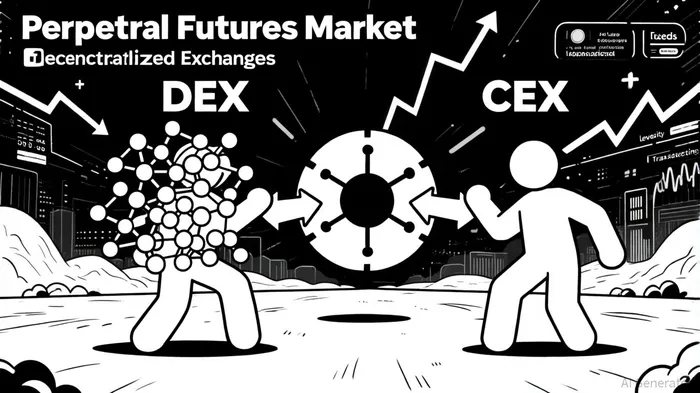







Comentarios
Aún no hay comentarios